




The KelpDAO exploit has become one of the biggest DeFi stories of April 2026 after a cross-chain failure sent fear through lending and restaking markets. Roughly 116,500 rsETH was drained from the bridge pathway, a loss valued around $292 million, and the fallout quickly turned into a broader DeFi TVL crash as users moved capital out of risk-exposed protocols.
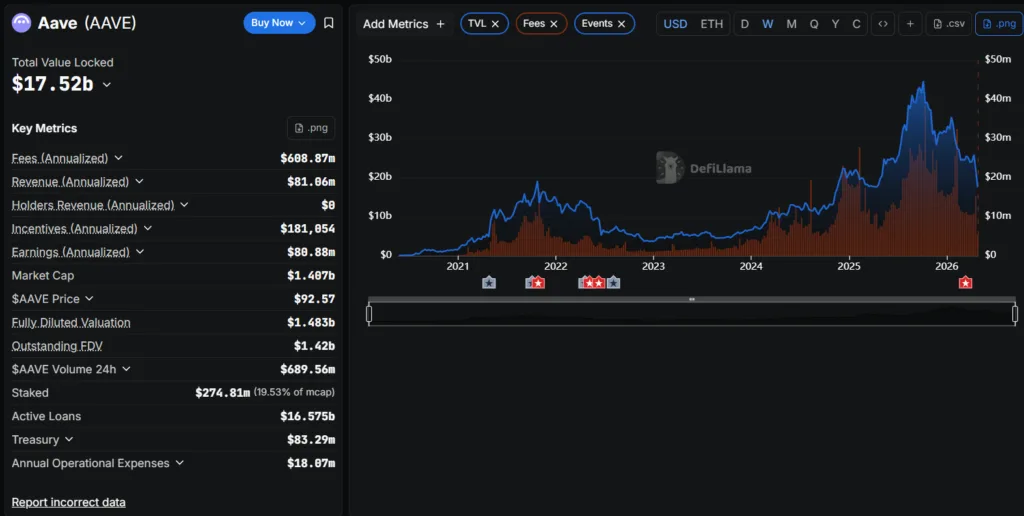
Aave took the hardest reputational hit because the attacker allegedly used the compromised rsETH in Aave markets, forcing the protocol into emergency containment. The result was a visible Aave TVL decline, market stress around frozen reserves, and a wider debate over whether DeFi has become too dependent on complex bridge design.
Aave’s own governance forum said all pools remained operational and that the exploit was scoped to rsETH rather than to an Aave smart contract flaw.

KelpDAO exploit set off the DeFi TVL crash
The KelpDAO exploit appears to have started through the rsETH bridge pathway tied to LayerZero infrastructure. Public reports and incident summaries point to unauthorized release of 116,500 rsETH, while KelpDAO-linked updates said the team paused contracts across mainnet and several Layer 2 networks after detecting suspicious cross-chain activity.
That alone would have been a major crisis. But the real damage came from how the asset moved through DeFi after the breach. Aave governance discussions say the attacker borrowed about 126,000 ETH using the compromised rsETH as collateral, creating a potential deficit that community participants estimated near $290 million at prevailing ETH prices. Those figures came from governance discussion rather than a final post-mortem, so they should still be treated as evolving.
This is why the DeFi TVL crash became far bigger than the original exploit. Once users saw the bridge issue spill into a core lending venue, they did not wait for full forensic clarity. They withdrew first. In DeFi, that reaction matters as much as the technical breach itself. Capital moves faster than governance, and TVL can disappear long before protocols publish a detailed risk memo. That is exactly what happened here.
DefiLlama now shows Aave around $17.5 billion in TVL. Community posts on Aave’s forum referenced the protocol at roughly $25 billion during the crisis.
Aave TVL decline turned a bridge failure into system risk
The Aave TVL decline mattered because Aave sits at the center of DeFi liquidity. When a smaller protocol fails, losses may stay contained. When stress reaches a top lending venue, the market starts to price in contagion. That is what made the KelpDAO exploit more than another isolated bridge hack.
Aave’s guardian froze rsETH and wrsETH markets across every deployment where the asset was listed. A follow-up governance note also said WETH was frozen on Core, Prime, Arbitrum, Base, Mantle, and Linea as a precaution. These actions were designed to stop further borrowing against exposed collateral while risk teams assessed the damage.
Even with those controls, suppliers immediately felt the strain. Governance users described ETH liquidity as effectively trapped in a pool at 100 percent utilization, with no near-term exit unless liquidity returned or loans were repaid.
That specific pool stress was described in forum posts rather than in Aave’s official summary, but it helps explain why the market reacted so aggressively. Users were not responding only to headlines. They were responding to impaired access to liquidity.
The incident also arrived at a sensitive moment for Aave governance. Forum participants tied the event to the protocol’s newer “Umbrella” protection design and argued over who should absorb any residual damage if KelpDAO does not fully backstop losses.
Some estimates in the forum suggested Aave might only face a smaller portion of the total deficit if KelpDAO socializes losses across holders. Others argued the hole could remain much larger. That debate is still unresolved.
Why the KelpDAO exploit exposed a deeper bridge problem
The KelpDAO exploit did not just damage one token. It revived a familiar DeFi concern: protocols often advertise strong security options, then operate with simpler configurations because convenience wins over resilience.
That criticism came into sharper focus after Ripple CTO David Schwartz said his RLUSD evaluations found many bridge systems had robust protections available but treated them as optional due to operational complexity.
Schwartz said he had “a funny feeling” the KelpDAO case may involve a choice not to use stronger LayerZero security features. That remains a hypothesis, not a confirmed forensic conclusion. Still, it fits the broader industry pattern in which bridge designs promise decentralization and scale, yet retain narrow trust assumptions at key verification points.
Aave forum discussion moved in the same direction. One participant argued that omnichain assets should face stricter listing standards unless they use at least two decentralized verification networks.
Another said Aave should even consider operating one of those networks if it is going to onboard this type of collateral. Those comments are governance opinions, but they show where the market may head next: fewer assumptions, tighter onboarding, and more skepticism toward bridge-dependent assets.
That is the larger meaning of the DeFi TVL crash. It was not only about money leaving. It was about capital repricing bridge risk in real time. The market treated the exploit as proof that cross-chain design choices can move from abstract architecture decisions to protocol-level solvency questions in a single weekend.
DeFi TVL crash may reshape listing standards and risk models
The next phase will depend on recovery, not on the initial exploit headline. If KelpDAO can make affected positions whole, Aave may avoid the worst-case scenario that some forum users feared. If recovery drags, governance pressure will intensify and the Aave TVL decline may become a lasting confidence problem rather than a sharp but temporary shock.
Either way, the KelpDAO exploit is likely to change how DeFi evaluates bridged collateral. Risk teams will probably demand more transparency around bridge configuration, verification layers, emergency halts, and exposure caps. Lending protocols may also revisit how much systemic reliance they want on wrapped or cross-chain assets that depend on off-core infrastructure.
The broader DeFi TVL crash also shows that TVL remains a confidence metric, not a guarantee of safety. Billions can leave in a rush even when underlying contracts outside the exploited path remain functional. In that sense, this episode is a stress test for DeFi’s social layer as much as for its code. The industry now has to prove it can contain risk faster than panic can spread.