



OpenAssets said it has chosen Chainlink as its oracle partner. This partnership will help financial institutions launch tokenized assets and stablecoin systems for real-world use.
The two firms announced the deal on Monday. Under this partnership, OpenAssets will combine its tokenization infrastructure with Chainlink’s tools for data, cross-chain connectivity, and system integration. As a result, institutions may find it easier to issue and distribute tokenized assets in onchain finance.
Digital asset infra provider @OpenAssetsInc enters a strategic partnership with Chainlink to power the issuance & distribution of institutional tokenized assets.
This enables institutions to launch advanced onchain solutions, unlocking a trillion-dollar wave of tokenization. pic.twitter.com/JHpg0qnQ6U— Chainlink (@chainlink) April 20, 2026

Put simply, tokenization means turning real-world financial assets into digital tokens that can move on blockchain networks. However, OpenAssets said large institutions need more than token creation tools to do this at scale.
They also need secure data feeds, links between different blockchains, and connections to existing financial systems. Because of that, the company said its partnership with Chainlink is designed to offer a more complete setup in one package.
Partnership targets full tokenization stack
The announcement states that OpenAssets offers a white-label platform that is flexible and can enable institutions to construct tokenization systems, but does not require them to build the entire system themselves.
OpenAssets said that it provides protocol-agnostic and asset-agnostic, meaning it can operate across multiple blockchain networks and support different types of assets.
These features give institutions more flexibility, as they are not locked into a single protocol or limited to one asset class.
Under the partnership, Chainlink will provide the technical infrastructure needed to support these systems in live production settings.
OpenAssets said this includes the Chainlink Runtime Environment (CRE), Cross-Chain Interoperability Protocol (CCIP), Digital Transfer Agent (DTA) standards, NAVLink, and Price Feeds.
According to the release, these tools are built to support secure data connections, cross-chain coordination, workflow management, and integration with legacy financial systems that many large institutions still use.
OpenAssets Chief Executive Gabor Gurbacs said the industry could see $68 trillion in assets move onchain over the next few years.
He said this shift will require infrastructure that supports the full life cycle of tokenized assets. That includes secure data oracles, cross-chain coordination, and integration with existing financial systems.
Gurbacs added that the partnership with Chainlink is meant to give institutions the tools needed to build tokenization platforms and stablecoin engines for real-world use, rather than limited pilot projects.
Focus on institutions already entering blockchain
The companies described the partnership as part of a broader effort to connect traditional finance with blockchain-based systems.
OpenAssets said its network includes major players such as ICE, Tether, Fanatics, Mysten Labs, and KraneShares. The release also said that many large financial institutions are already using Chainlink’s technology.
These include Swift, Euroclear, Mastercard, Fidelity International, FTSE Russell, WisdomTree, UBS, S&P Dow Jones Indices, and ANZ. It also noted that popular crypto platforms like Lido, Aave, and GMX use Chainlink.
Johann Eid, Chief Business Officer at Chainlink Labs, said “The next generation of digital asset infrastructure requires secure data, cross-chain interoperability, built-in compliance and privacy, and seamless integration with existing financial systems.”
“Through our strategic partnership with OpenAssets, institutions can access a complete technology stack for building production-grade tokenization and stablecoin solutions,” Eid added.
OpenAssets said the announcement is part of a broader effort to modernize capital markets infrastructure.
In its company description, the company said it develops technology for digital financial systems and works with institutions, governments, and technology firms on tokenization and sovereign digital currency projects.
Traditional finance is paying closer attention to blockchain as firms look for ways to make markets more efficient. Tokenized assets could help speed up settlement, make fractional ownership easier, and keep markets running around the clock.
But for institutions, speed is not the only concern. They also need reliable security, clear records for tracking transactions, and systems that fit within regulatory rules. OpenAssets and Chainlink said their combined setup is built to support those needs.
RWA growth continues as IMF flags key risks
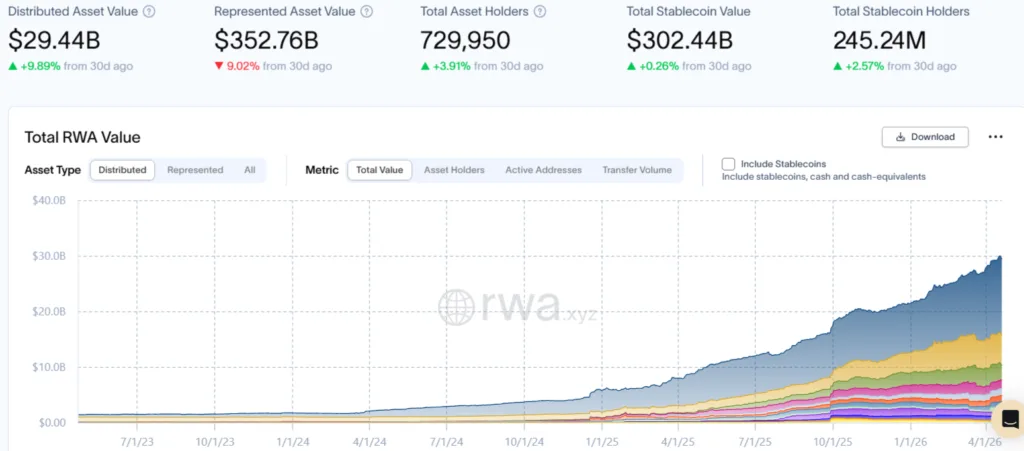
The tokenized RWA has continued to grow. Total on-chain RWA value rose 9.89 percent in the last month to $29.44 billion.
The represented asset value fell 9.02 percent over the same period to $352.76 billion. The number of asset holders increased to 729,950, up 3.91 percent.
According to the International Monetary Fund (IMF), tokenization may enhance efficiency in the financial market by lowering the costs and accelerating settlements.
Nevertheless, it also cautioned that adequate regulation, risk management and system stability will play a crucial role as the adoption expands in the global financial systems.