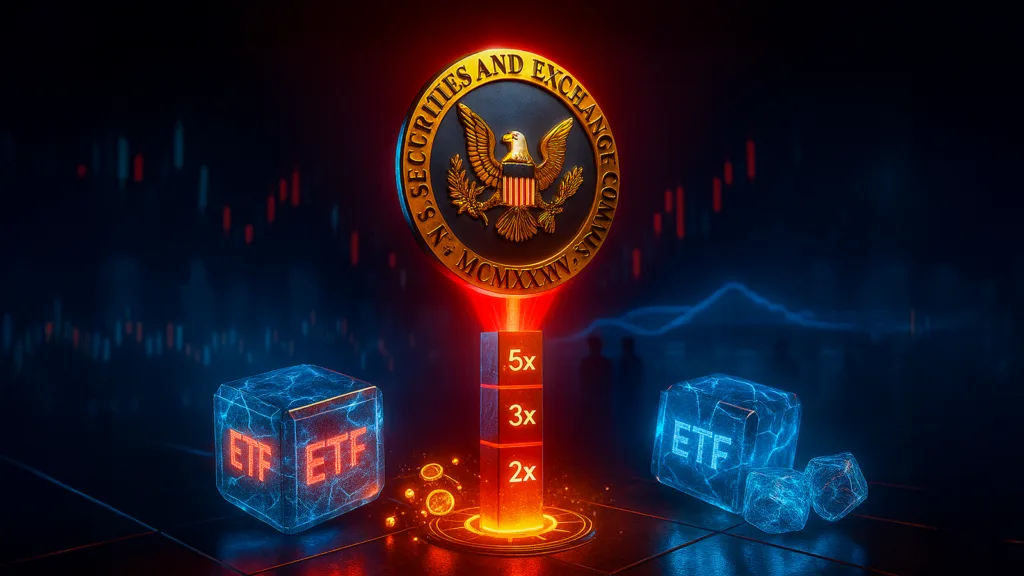



The SEC has put a stop to several applications for exchange-traded funds that want to offer leverage above the federal investment laws’ 200% maximum. The Investment Company Act of 1940 says that companies like Direxion, ProShares, and Tidal cannot proceed forward with their plans for 3x to 5x leveraged ETFs.
According to the regulation, funds must base their exposure on a “reference portfolio” of unleveraged assets or indexes and can’t go above twice the value-at-risk of those baselines. Regulators emphasized in their letters that the reference portfolio establishes the standard for measuring leverage risk. The SEC told issuers to lower the amount of leverage they were proposing before any more examination.
The agency made the letters public on the same day they were sent, a quick disclosure that Bloomberg described as an uncommon action indicating the SEC’s intention to alert investors about the risks of leveraged products.

Concerns about leverage grow after a historic liquidation event
The warnings come at a time when people are paying more attention to the volatility in crypto markets caused by leverage. A dramatic plunge in the market in October caused around $20 billion in liquidations, which was the biggest one-day loss in the history of digital asset trading. The event brought back discussions about how much leveraged holdings affect the stability of the market.
The Kobeissi Letter’s analysts said that the amount of leverage in crypto has gone much beyond what is reasonable. According to data from Glassnode, this cycle’s daily liquidations have jumped to nearly $68 million for long holdings and $45 million for short positions, which is about three times the average for the previous cycle.
Traders are betting on a better regulatory atmosphere for digital assets after the 2024 U.S. presidential election, which has led to higher demand for leveraged exposure.
Demand for ETFs grows despite more warnings about risk
Unlike regular crypto futures, leveraged ETFs don’t have to deal with margin calls or automatic liquidations. Even so, the structure of leveraged ETFs can quickly erode investors’ capital in declining or stagnant markets, as losses accumulate more rapidly than gains.
Even though there are concerns, investors are nonetheless interested. Demand for leveraged crypto ETFs has been growing all year, thanks to traders who want more exposure without having to go into futures markets directly. The SEC’s action now makes it obvious how aggressive those products can be in the US.