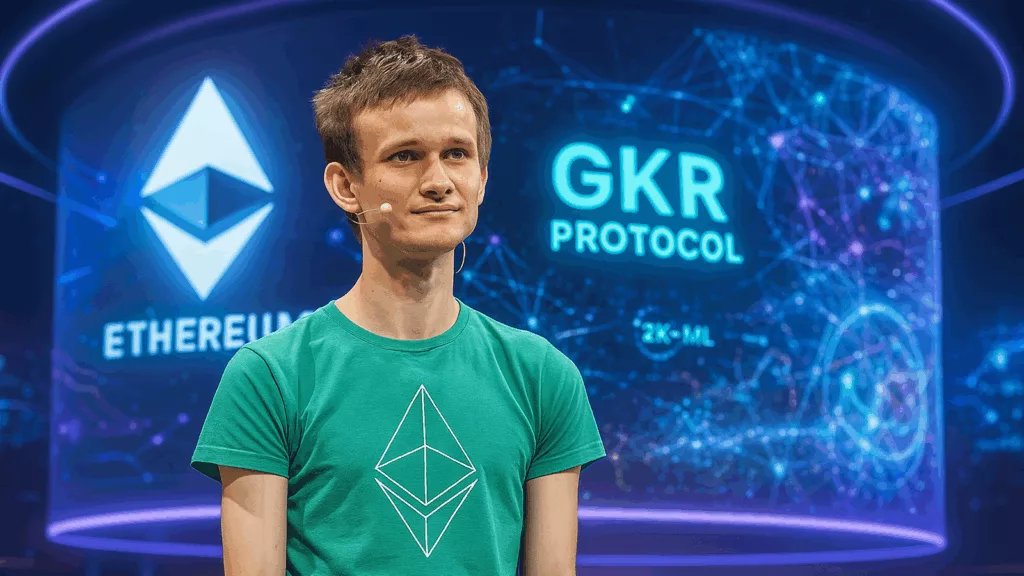



Ethereum co-founder Vitalik Buterin has published a technical tutorial outlining how the GKR protocol (Goldreich–Kahan–Rothblum) can serve as a foundational upgrade to Ethereum’s cryptographic scaling stack. In the article, he uses the Poseidon2 hash function as a concrete example. He also breaks down the details of how multi-layer ‘batch’ computations can be optimized via GKR.
What does the GKR upgrade mean for Ethereum?
By adopting GKR, Ethereum’s roadmap gains a powerful scaling lever. ZK-EVM rollups typically face high overhead in prover time and proof size. This is mainly because of systems that post-validated proofs to the main chain. Now with GKR’s design these overheads shrink substantially because it will look at only input/output commitments, efficient ‘sumcheck’ rounds, and linear batching techniques. This means rollups, layer-2s, and even zero-knowledge proofs for large-language model (LLM) inference (zk-ML) could run more cheaply and quickly.

For the Ethereum network, the upgrade signals stronger throughput, lower cost for ZK-proof publishing, and potentially faster finality for rollups that rely on those proofs. As ZK infrastructure becomes more efficient, L-2s built on Ethereum stand to gain competitiveness versus alternative chains. Moreover, the ability to embed zk-ML workloads more efficiently could open new classes of applications on Ethereum.
But Buterin also flags off a couple of risk factors. Firstly, GKR by itself does not provide zero-knowledge privacy, but only succinct proofs. That means, GKR still needs to be wrapped in a ZK-SNARK or ZK-STARK to give privacy protections. He also warns about ‘predictability’ vulnerabilities when using Fiat-Shamir transforms in these circuits.
While this isn’t an immediate protocol fork or final upgrade announcement, it marks a crucial step in Ethereum’s ongoing drive to scale via ZK techniques.