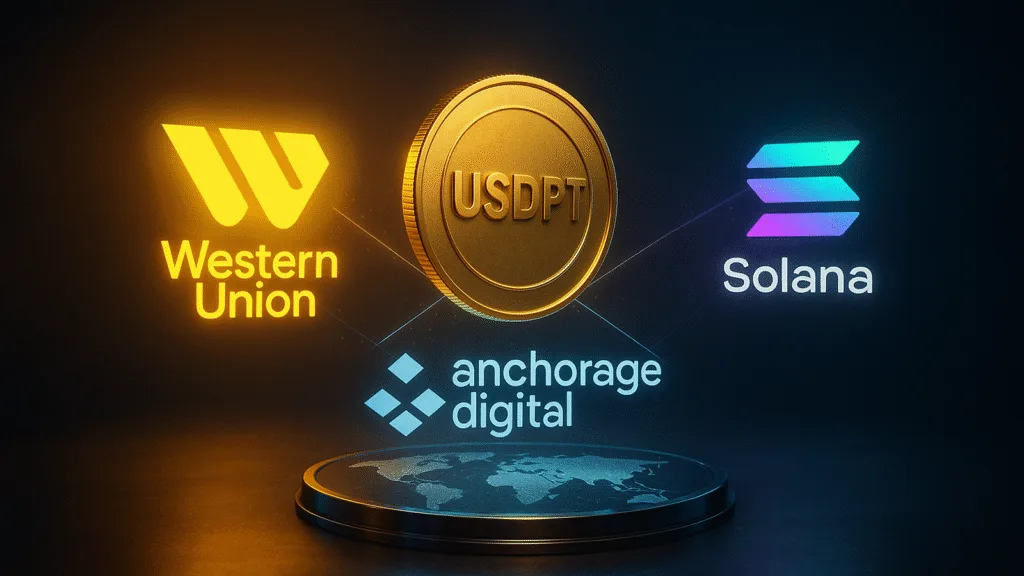



Western Union (WU), a legacy remitter, is launching USDPT, a U.S. dollar-backed stablecoin, which will be built on the Solana blockchain. Anchorage Digital Bank will issue the coin, which Western Union aims to roll out by the first half of 2026, the company announced in its latest press release.
Why did Western Union pick Solana?
Western Union selected Solana as the foundation for its USDPT stablecoin and Digital Asset Network because of a shared commitment to transforming global financial infrastructure. Solana’s high-performance blockchain, combined with Anchorage Digital Bank’s regulated issuance and custody capabilities, aligns with Western Union’s goal of expanding digital asset access in a secure, compliant, and scalable way.

By partnering with platforms that prioritize institutional-grade security and robust compliance, Western Union is reinforcing its dedication to user safety and trust. Solana’s appeal also lies in its high throughput, low transaction cost, and ability to handle large volumes. All these features are critical when dealing with global remittances spanning more than 100 million customers.
Devin McGranahan, President and CEO of Western Union said, “As we evolve into the digital assets space, Western Union’s USDPT will allow us to own the economics linked to stablecoins. Separately, we are excited to announce our Digital Asset Network, a solution for the last mile of the crypto journey by partnering with wallets and wallet providers to provide customers with seamless access to cash off-ramps for digital assets by leveraging our global network”.
Moreover, in July 2025, the U.S. passed the GENIUS Act, offering a clearer regulatory framework for dollar-backed digital tokens. That regulatory clarity appears to have been a trigger for Western Union’s decision.
Thus, the decision to issue USDPT and build a ‘Digital Asset Network’ stems from three main motivations. Firstly, to cut settlement times, to reduce reliance on legacy correspondent-banking infrastructure, and to reclaim economics around money-movement rather than outsourcing them to external stablecoin issuers.