



The Fermi hard fork for BNB Chain goes live on Wednesday. It will lower BSC block times from 0.75 seconds to 0.45 seconds and make the requirements for quick finality stricter.
The Fermi upgrade for BNB Chain, which goes live on Wednesday, will slash block times for BNB Smart Chain (BSC) from 0.75 seconds to 0.45 seconds and make transactions final in “around one second”. This will make the network one of the quickest significant Ethereum Virtual Machine chains.
Completion of the short block interval initiative
The hard fork is the last step in BNB Chain’s “short block interval” plan. It is presented as an increase to performance and reliability rather than a cosmetic change.

With Fermi, BSC validators will make blocks every 0.45 seconds. This will cut the time it takes for transactions to be validated onchain by about half. The goal is “faster without compromising reliability. This means that shorter blocks will be paired with stronger fast-finality criteria, ensuring that confirmation guarantees remain consistent even during periods of high traffic.
The patch improves the network’s consensus rules so that validators can still agree even when the block scheduling is tighter. BNB Chain’s literature says that Fermi also adds stronger rules for propagation and voting to speed up finality when the network is crowded.
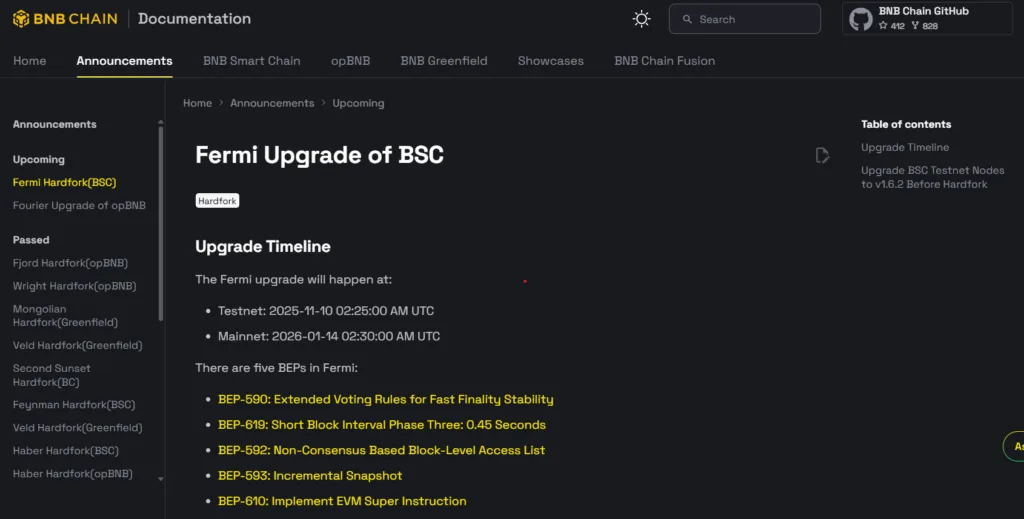
Source: BNB Chain documentation
Target use cases and developer considerations
BNB Chain is marketing Fermi to apps that need low latency, like on-chain trade, real-time decentralised finance (DeFi) protocols, and interactive gaming decentralised applications (DApps).Rong said the improvement is meant to make “real-world performance” better, not only peak throughput. It will focus on times when network activity is high and confirmation times need to stay steady for users and traders.
Most DApps and smart contracts won’t need to have their code changed, and the switch should go smoothly for most users. Rong, on the other hand, said that teams who depend on exact block timing should double-check their assumptions because blocks will now come much faster than they did previously.
Lessons from past congestion events
Like other high-throughput chains, BNB Chain has had problems with congestion and bad user experience during times of heavy trade volume and speculation.
Rong says that the events helped shape Fermi’s design. The upgrade makes voting rules and validator cooperation stricter in order to maintain the chain responsive and confirmation times predictable when there is a lot of traffic.
She stressed that the improvements are meant to make sure that validators “stay in sync to keep the network stable,” even as block production speeds up. The network has also setup post-fork monitoring and a follow-up release to clean things up and stabilise them. This gives validators the tools they need to swiftly find and fix problems if they come up.
In terms of transaction volume and user engagement, BNB Chain was one of the busiest blockchains of 2025. It had about 3.89 billion transactions, making it the second busiest blockchain after Solana.
BNB Chain remains a platform compatible with the Ethereum Virtual Machine (EVM), but it differs from Solana, which is a non-EVM blockchain designed for ultra-high throughput. This appeals to developers seeking rapid performance while maintaining compatibility with the EVM ecosystem. BNB Chain’s technology roadmap extends to include Fermi until 2026. This roadmap focuses on building high-performance infrastructure, making latency more predictable, and scaling the base layer to handle heavier, more sophisticated workloads.