



In a significant regulatory shift, the Federal Aviation Administration (FAA) has agreed to partially restore Boeing’s authority to issue airworthiness certificates for certain 737 MAX and 787 aircraft. The move reverses years of tight oversight that the aircraft manufacturer was put through. Under the new arrangement, Boeing and the FAA will alternate weekly in issuing certificates, a hybrid model that begins next week.
The announcement triggered a sharp climb in Boeing stock, with shares rising around 3.49% in trade on Friday. Investors have welcomed the loosening of delivery bottlenecks and regulatory constraints.
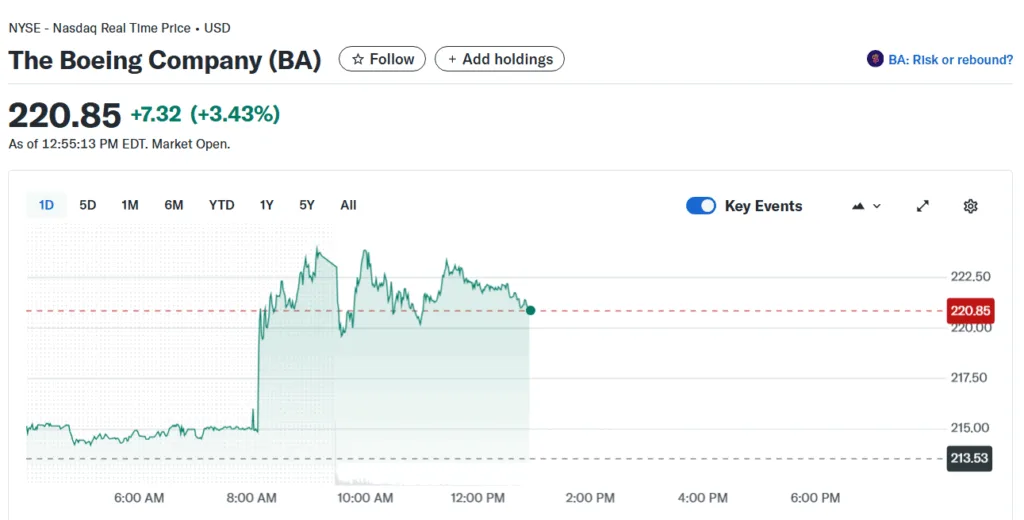
Source: Yahoo Finance

Why were the restrictions placed on Boeing?
After two fatal 737 MAX crashes in 2018–2019, Boeing was stripped of its authority, under the FAA’s Organization Designation Authorization (ODA) program, to self-certify individual aircraft. Instead, each new 737 MAX and 787 had to undergo direct FAA inspections before delivery.
In early 2024, further scrutiny followed a cabin-plug blowout event on an Alaska Airlines MAX 9, where four fasteners were missing. That incident prompted continued production caps at 38 planes per month and tighter inspection regimes.
On the 787 front, Boeing had already lost delegated certification privileges in 2022 amid quality-control and delivery issues. Deliveries were paused until Boeing submitted rework and inspection plans satisfying the FAA.
Operational efficiency gains
Restoring partial certifying authority should help Boeing reduce FAA backlog delays, accelerate aircraft handovers, and clear delivery logjams. Less reliance on FAA inspection resources may reduce uncertainty in delivery schedules and improve Boeing’s credibility with airlines. Peers like Airbus may feel pressure to emphasize their regulatory robustness or highlight delivery reliability as a selling point.