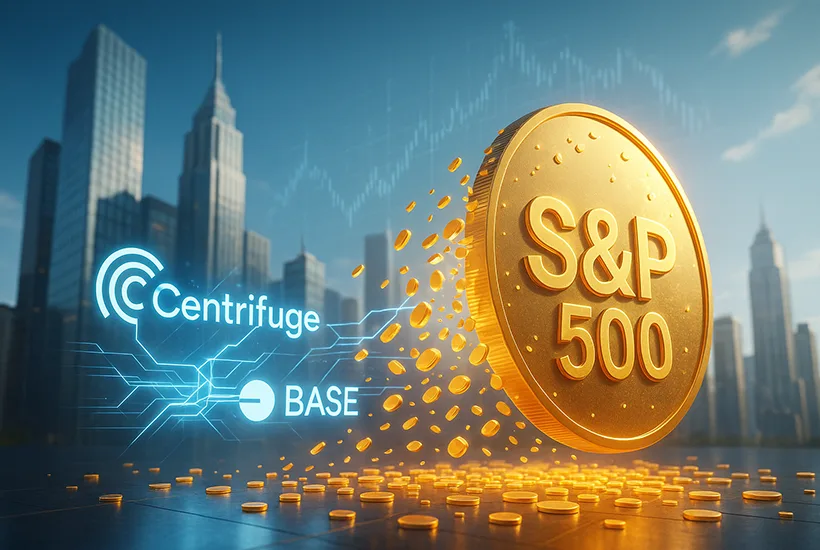



Blockchain infrastructure firm Centrifuge announced that it has launched the first licensed tokenized S&P 500 index fund, called SPXA. The fund will trade on Coinbase’s Base Layer-2 network. The announcement coincided with the release of its update on the Centrifuge blog and via an X post on 25 September 2025.
This SPXA token is built on proof-of-index infrastructure, a system developed by Centrifuge in collaboration with S&P Dow Jones Indices (S&P DJI), allowing the official S&P 500 benchmark to be brought on-chain. The SPXA fund will be co-managed by a team at Janus Henderson and Centrifuge’s own asset management arm, Anemoy. FalconX will serve as an anchor investor, while Wormhole will support future cross-chain expansion.

How does a tokenized S&P Index Fund work?
A tokenized index fund like SPXA works by wrapping real-world index exposure into digital tokens via smart contracts. Rather than trading underlying stocks individually, the fund holds basket assets representing the S&P 500. Token holders can then own claims on that basket. Because it’s on-chain, the tokens can be traded at any time, can be composited with DeFi protocols, and the holdings are fully transparent and verifiable.
This structure allows continuous pricing, instant settlement, and more flexible accessibility than traditional ETFs that trade only during market hours.
From RWA to equity, Centrifuge evolves
“Launching SPXA with Centrifuge is a natural progression of our blockchain strategy, bringing the world’s most important equity index to a new generation of investors,” said Nick Cherney, Head of Innovation at Janus Henderson.
The announcement builds on a prior July 2025 licensing agreement, where S&P DJI granted Centrifuge the rights to embed S&P 500 exposure into on-chain products, with Janus Henderson and Anemoy acting as licensed fund managers.
Centrifuge, which since 2017 has focused on tokenizing real-world assets such as debt instruments, credit, and fixed income, now positions SPXA as its foray into equities. It acts as an inflection point by combining debt and fixed income into broad equity benchmarks, paving the way for interoperable, on-chain versions of familiar index products.