


Some politicians can still disagree on decentralised finance, stablecoins, and ethical issues even if the CLARITY Act is set to be marked up on Thursday.
This week, US senators will mark up a major measure about the structure of the crypto market. Industry experts are talking about possible changes that could affect whether stablecoin investors can earn interest and prizes.
The Digital Asset Market Clarity Act, which came out on Monday, says that “a digital asset service provider may not pay any form of interest or yield just for holding a payment stablecoin.” This means that people can’t earn passive interest on their stablecoin balances.

Limits on stablecoin rewards leave room for incentives
The draft allows for structured incentive systems, since stablecoin payouts wouldn’t be banned in some cases, such as “providing liquidity or collateral” or “governance, validation, staking, or other ecosystem participation.”
The draft showed that lawmakers might be open to criticism, pushing for clearer rules for interest rates and prizes on stablecoins. But certain banking groups have fought against these kinds of stablecoin payouts under the GENIUS Act, which became law in July.
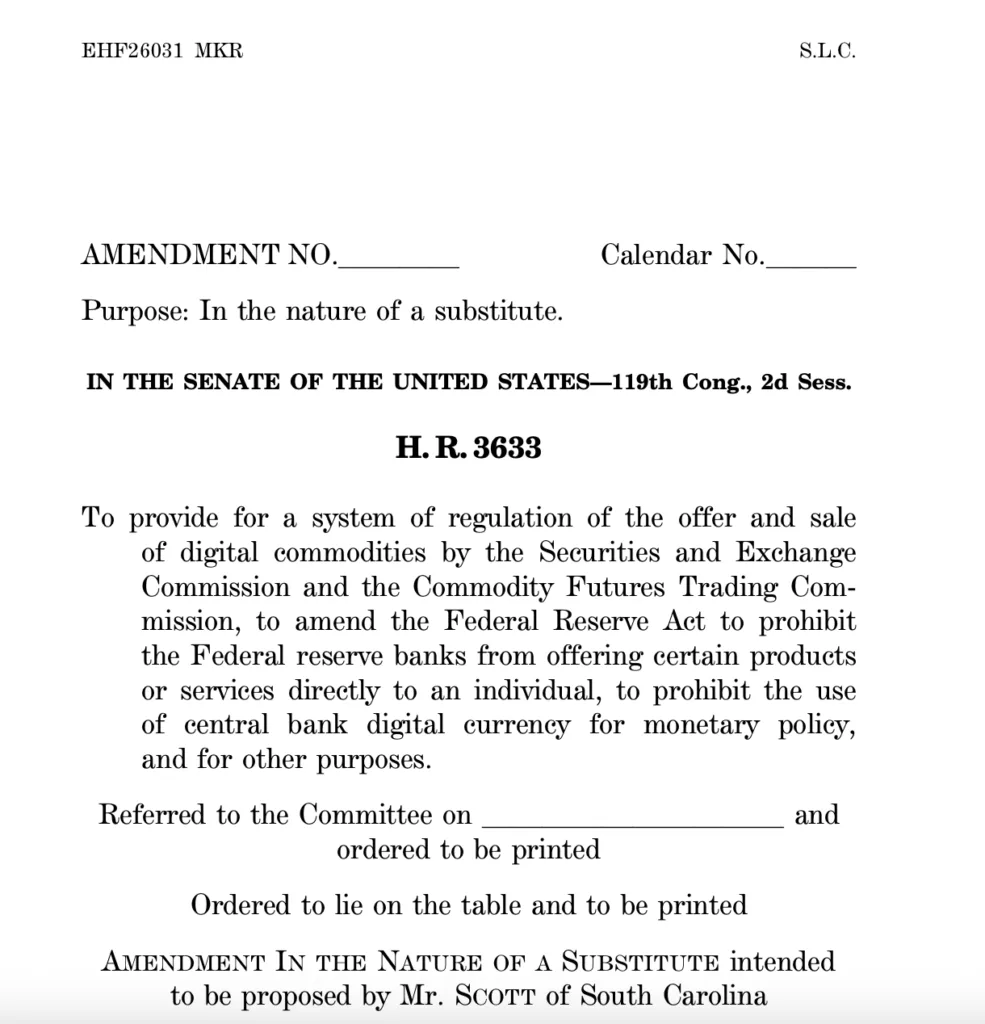
Source: US Senate Banking Committee
Industry reactions highlight banking and competition concerns
Nic Puckrin, a co-founder of Coin Bureau, says that Senate members were trying to find a middle ground between what the industry wanted in terms of yield flexibility and what banks didn’t want in terms of competition for deposits.
The Senate’s compromise on stablecoin yield in the proposed amendments to the crypto market structure bill is a clear sign that the powers that be are committed to ensuring stablecoins remain attractive to end users, while placating banks that have lobbied heavily against such rewards.
Regardless of what happens, it’s clear that stablecoins will still compete with bank deposits. Unless all rewards are banned, banks will have to deal with this new reality.
On Thursday, lawmakers on the Banking Committee will hold a markup on the bill. This could move it forward for a vote on the Senate floor. The Senate Agriculture Committee, on the other hand, stated on Monday that it wouldn’t look at its version of the measure until the end of January.
Ethics provisions and election timing raise further questions
The law could face other problems besides the ones about stablecoins, which are important to many banks and businesses. At least two Senate Democrats have said that the CLARITY Act should have protections to stop public officials, such US presidents, from making money by investing in digital asset companies.
Some experts are also worried that the law would get support from the US midterm elections in November. TD Cowen’s Washington Research Group said that the bill was more likely to pass in 2027 because Democrats are thinking about whether Republicans could lose control of Congress following the midterms.
Paul Atkins, the chair of the US Securities and Exchange Commission (SEC), said on Monday that he thought Trump would sign the measure into law by the end of 2026. The latest drafts of the bill say that it would set up rules for the SEC and the Commodity Futures Trading Commission to follow when they watch over digital assets.