


U.S. President Donald Trump said on Tuesday via Truth Social that countries like the U.K. should build up “courage” and go get their own “jet fuel”.
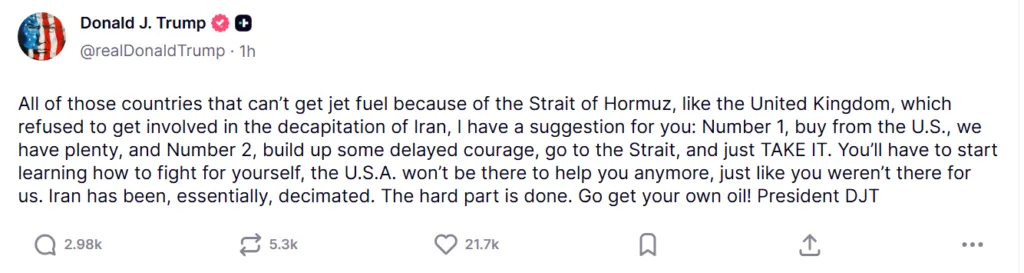
Source: TruthSocial
Oil markets continue to remain in the spotlight as the Strait of Hormuz—while not fully closed—continues to cut off countries around the world from a vital route for imports and exports of crude, driving scarcity and prices of the commodity up.

The update comes after the U.S.-Iran conflict crossed one month, marking a continued prolongation of the conflict between the two powers.
“In periods like this, the market stops caring about supply and demand fundamentals, it starts pricing in whether barrels can actually get from point A to point B, and whether anyone trusts that they will.” said Deriv’s Chief Growth Officer Prakash Bhudia.
“Until there is consistent evidence that barrels can move safely and reliably through key routes, the market will remain headline-sensitive, with sharp moves in both directions.”
GCC economies are now in the midst of rolling out emergency measures to keep liquidity and businesses propped up. Qatar recently introduced an emergency liquidity scheme under which banks could repurchase as much of the Qatari currency as they liked in exchange for long-term bonds held.
The ruling prince of Dubai (Sheikh Hamdan bin Mohammed bin Rashid Al Maktoum) rolled out a support package worth AED 1 billion to help support businesses and individuals in the region facing financial burdens.
Prices of the following commodities were as follows:
- WTI crude: $102.5 (-0.33%)
- Brent crude: $117 (+3.77%)
- Murban crude: $120.9 (+3.75%)
- OPEC basket: $117.1 (-0.84%)
- Indian basket: $121.2 (-22.85%)
“The closure of Hormuz remains bullish for oil,” said Century Investment Officer Vijay Valecha.
While the U.S. indexes, such as the Brent crude and WTI crude, are either trading relatively even or rallying, the OPEC and Indian basket remain down, with the latter index down by 22.85%.