
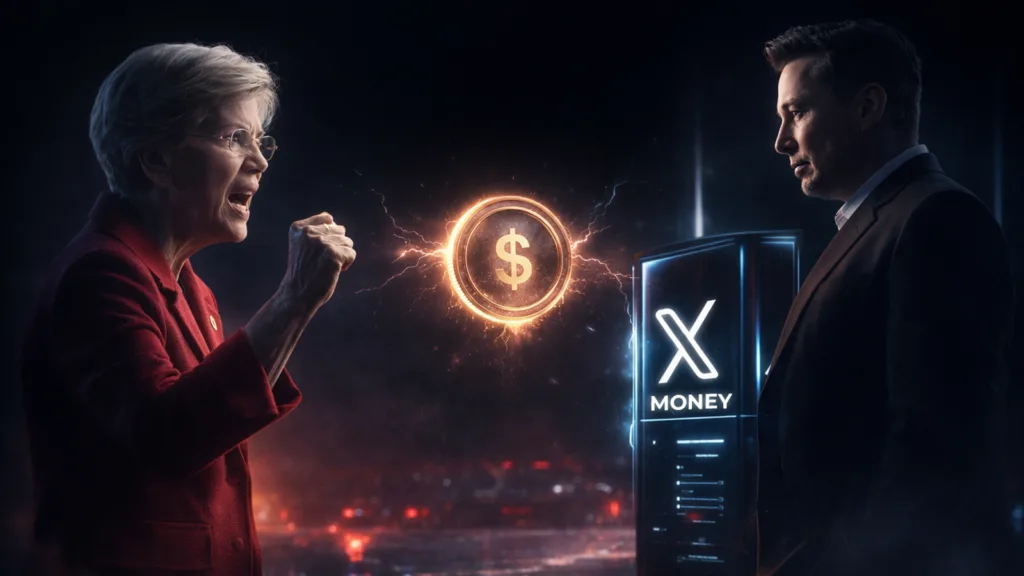



Senator Elizabeth Warren has pressed Elon Musk for answers about X Money, the payments product that X plans to launch in April.
In a letter dated April 14, Warren said the service could raise consumer, national security, and financial stability concerns.
She asked Musk to explain how X Money will handle fraud controls, user funds, data use, and any crypto or stablecoin plans, and she set an April 21 deadline for a response.

Warren tied the new letter to Musk’s wider push to turn X into an “everything app.” Her office said X has already secured 40 state money transmitter licenses ahead of the launch.
The same letter also said preview material points to a product that may offer deposit accounts with yields of up to 6 percent and may work with Cross River Bank, which Warren cited as another reason for closer review.
Warren focuses on safety, deposits and stablecoin questions
Warren’s message centered on how X Money would protect users if the service moves from social media into payments and stored balances.
In the letter, she warned that “consumers, our national security, and the stability of the financial system may be at risk” if X runs financial services the same way it has run the social platform.
She also questioned whether users would clearly understand what protections apply to funds held through the service.
Moreover, the letter also raised questions about crypto. Warren said Musk has already suggested that X Money could include crypto features, and she asked whether that could extend to stablecoin issuance under the GENIUS Act.
Her office argued that the law leaves room for private commercial firms to enter the stablecoin market, and she asked Musk to clarify whether X plans to use that route.
FDIC rules add another layer to the debate
Part of Warren’s argument focused on deposit protection. She pointed to the risk that users may assume stablecoin-related balances or payment funds carry the same protection as regular bank deposits.
That concern lines up with recent FDIC guidance, which said payment stablecoins are not subject to federal deposit insurance and cannot be marketed as if they carry that protection.
FDIC Chair Travis Hill also said the agency plans to address whether pass-through insurance could apply to payment stablecoins.
In a March speech, Hill said treating stablecoin holders as insured depositors seems inconsistent with the GENIUS Act. That does not settle every question around fintech partnerships, but it does show why lawmakers now want direct answers from Musk before X Money reaches users.
X keeps building finance tools
The scrutiny arrives as X keeps adding finance products inside the app. On April 14, X rolled out Cashtags on iPhone in the United States and Canada.
The feature lets users tap stock or crypto cashtags to view price charts and related posts, and X also started a pilot with Wealthsimple that lets eligible Canadian users move from market data to trading inside the app.
Nikita Bier, X’s head of product, described that release as more than a chart tool. He wrote that “Cashtags are just the first step” in X’s effort to become a destination for finance and crypto users.
In addition, he said trading should be “frictionless” and linked the rollout to broader product plans. Those comments did not confirm a crypto payments launch, but they added more context to the market’s view that X wants finance to become a larger part of the platform.
The latest posts from Bier followed earlier signs that X was moving toward a broader payments debut. On March 10, Musk said X Money would enter early public access in April.
A week later, Bier publicly complained about iOS app review delays, saying approval was taking longer than building the features themselves. Those remarks added to speculation that rollout work was entering its final stage.
Bier also posted this week that crypto has had a rough year and suggested X should launch something to help fix it. That post fueled fresh talk about whether crypto rails could sit closer to X Money over time, even though X has not confirmed such a product.
Separate xAI lawsuits add to scrutiny around Musk
Musk also faces new legal pressure outside X Money. On April 14, the NAACP sued xAI and subsidiary MZX Tech, alleging they illegally operated 27 gas-fired turbines in Mississippi to power the Colossus 2 data center before obtaining the required air permits.
As we reported, the lawsuit says the companies violated the Clean Air Act and exposed nearby communities to harmful emissions.
In a separate case, xAI sued Colorado on April 9 over the state’s AI law, which is scheduled to take effect on June 30.