


Ethereum is intended to be so decentralised that it can continue to function in the absence of the foundation, according to the non-profit organization.
The Ethereum Foundation, a non-profit group that oversees the growth of the Ethereum ecosystem, released its mission on Friday. This document confirmed its purpose and the main ideas behind Ethereum.
The Ethereum Foundation’s mandate says that the two key goals are to keep Ethereum decentralised and to let users have a “final say” over their on-chain assets and data.

The letter added that Ethereum’s essential features, including as censorship resistance, open source code, privacy, security, and technology that protects freedom, will be upheld.
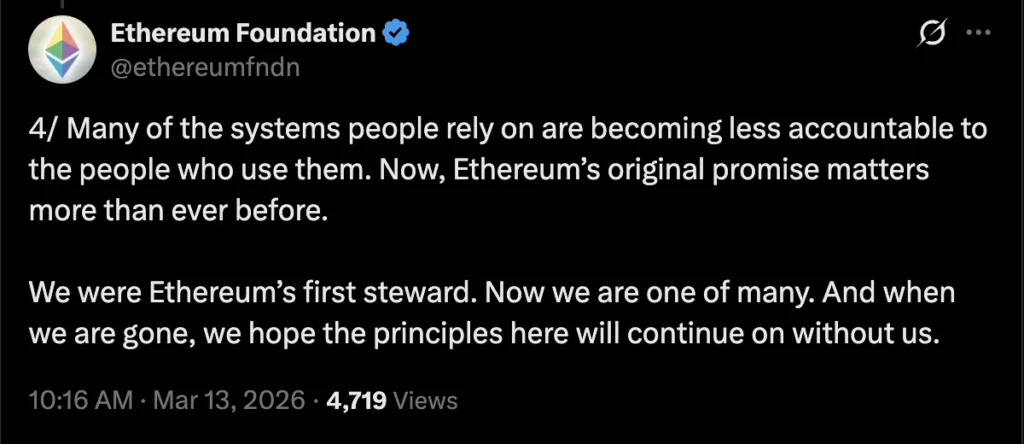
The Ethereum Foundation said it will keep working on fundamental protocol changes, “long-horizon research,” cybersecurity, and giving Ethereum developers tools, but it will try to stay out of the way as much as possible. The mandate declared, “Our ultimate goal is for Ethereum to pass the walkaway test: its protocol and core application layers become strong enough that they would keep working and evolving even if the Foundation and today’s core developers disappeared tomorrow.”
The Ethereum Foundation claimed that it wants to focus on jobs that become less important over time by taking things away.
Source: Ethereum Foundation
Layer-2 scaling debate intensifies in the Ethereum ecosystem
The directive comes after a tough year for the protocol. Ethereum co-founder Vitalik Buterin said that Ethereum’s way of scaling through layer-2 networks “no longer makes sense,” and that many L2s are centralised projects.
Buteirn stated that many layer-2 networks contain centralised centers of control, such as private trusted networks and centralised sequencers. They also don’t plan to switch to a completely decentralised approach.
“The original idea of L2s and what they should do in Ethereum doesn’t work anymore. We need to find a new way,” Buterin mentioned this in February.
Buterin said that a layer-2 project that can handle 10,000 transactions per second (TPS) but needs a multi-signature bridge to talk to the layer-1 protocol is not growing the Ethereum ecosystem in a decentralised fashion.
Buterin contended that scaling the network shouldn’t rely on the numerous layer-2 networks within the Ethereum ecosystem. Instead, they should focus on a specific area, such privacy, identity solutions, finance platforms, or social media apps. This got conflicting comments from L2 initiatives.