



The EU wants to stop any crypto transactions with Russia by shutting down all associated channels, but analysts aren’t convinced if this would work.
The European Union is putting the finishing touches on a new set of penalties that will close gaps that officials say have let Russia utilize cryptocurrencies to get around current prohibitions.
The Financial Times said on Tuesday that the EU wants to “ban all cryptocurrency transactions with Russia” as part of the next round of penalties.

Unlike past attempts to go after Russia-linked businesses that were already on sanctioned platforms, the current proposals are more general and aim to completely remove Russia’s crypto loophole.
The FT quotes an internal European Commission paper on the planned fines as saying, “Any further listing of individual crypto asset service provider is therefore likely to result in the set-up of new ones to circumvent those listings.”
Expanded sanctions package targets banks and financial institutions
The European Commission President Ursula von der Leyen indicated last week that the latest sanctions package, which is still being worked on and is anticipated to be approved on February 24, will target 20 more Russian regional banks and a few institutions in other countries.
On Monday, Reuters reported that the EU wants to punish two Kyrgyz banks, Keremet and OJSC Capital Bank of Central Asia, as well as banks in Laos and Tajikistan. If the proposal is accepted, the named institutions will not be able to do business with people and businesses in the EU.
In order to ensure that sanctions achieve their intended effect [the EU] prohibits to engage with any crypto asset service provider, or to make use of any platform allowing the transfer and exchange of crypto assets that is established in Russia.
Focus turns to A7 and the A7A5 stablecoin
In 2025, the sanctioned A7A5 became one of the biggest stablecoins that wasn’t based on the dollar.
The report says that the actions may be aimed at A7, a payment platform related to Russia, and its stablecoin A7A5, which is tethered to the currency. The operator has denied helping anyone get over sanctions, saying that these charges are political and not backed by proof.
Even though it went through several rounds of sanctions, A7A5 became one of the fastest-growing non-dollar stablecoins by market value in 2025, according to CoinMarketCap and DefiLlama.
Some analysts, on the other hand, were not sure how reliable the token’s reported activity was.
Global Ledger, a business that analyzes blockchains, claimed it found patterns that are typical of wash trading. These patterns may have made A7A5’s volumes seem higher and made it look like there was more demand. Global Ledger also said they weren’t sure if the EU could completely stop crypto transactions with Russia.
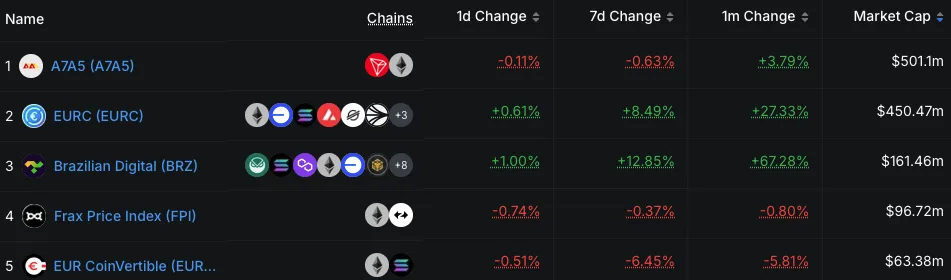
Source: DefiLlama
Enforcement challenges in decentralised markets
Analysts are unsure if the EU can properly implement crypto sanctions. “The EU’s recent move to impose a blanket ban on Russian cryptographic activity, specifically targeting the A7A5 stablecoin, shows a basic lack of understanding of decentralised liquidity.”
People who own tokens like A7A5 can trade them for stablecoins that are traded all over the world through autonomous on-chain liquidity pools. They don’t have to rely on centralised intermediaries that do compliance checks.
Whenever assets flow via big global exchanges and liquidity centers, it gets harder and harder to trace transaction histories. At this point, it is technically impossible to distinguish these funds from legitimate market activity. If European exchanges were to impose such a restriction, they would have to stop all flows from major global trading hubs. This would stop the legitimate crypto market in its tracks.
Sanctions may be able to stop Russian businesses from using regulated European platforms, but Fisun warned that decentralised infrastructure is still hard to filter directly, so a full technical embargo is unlikely.
As Russia moves forward with new laws about digital assets, these events happen. On Tuesday, Russian lawmakers enacted a law on its third reading that set the rules for freezing and taking away digital currency.