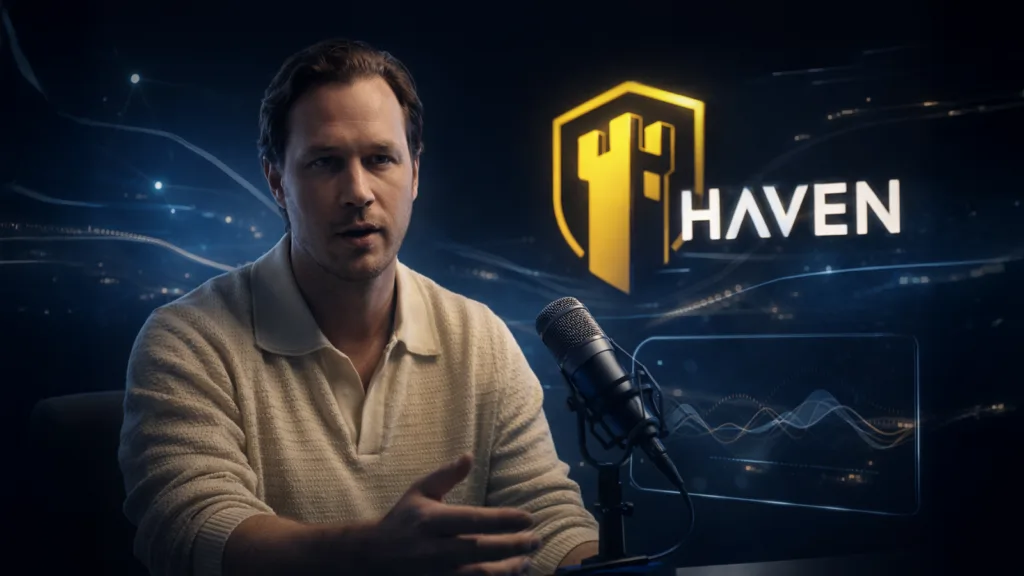


(Note: This interview was conducted on the 28th of January, 2026. It has been edited for clarity, as at some points in the interview, both Jones and I elaborated quite a bit on most questions and responses.)
Today, the daily crypto investor dips his toes into the market with a sense of caution. News headlines, multi-billion dollar fraud, and pump-and-dump schemes are often part of a larger medley of reasons for his or her hesitation.
And why shouldn’t he or she be careful?

Consider the takedown of a $15 billion pig-butchering scam by the U.S. government. Or the $7 billion Ponzi scheme carried from 2014 to 2017, but is only being addressed properly as late as last year. Scams and rugpulls are endless in this niche, so much so that one could make a list out of them.
After seeing a news cycle filled with this kind of stuff, one accumulates scar tissue. An apprehensive eye watches for the next big scoop.
Of course, you do meet someone who appears to be well-intentioned in the space sometimes, but you find them in the oddest parts of the cryptocurrency market
CEO Matthew Jones of Haven Wallet is just that very person who has a cryptocurrency wallet company called Haven, with an ICO attached to it. As per my understanding—which I got from a small conversation after the interview—he shuttles back and forth between offices in Dubai and the U.K.
After losing a lot of money in Europe in a situation about which he could do virtually nothing, he opened an office in Business Bay, Dubai, to help kickstart his enterprise. He says the intention of setting up an ICO was to include a select group of investors instead of going through traditional financial routes such as debt or equity financing.
Initial appearances suggest he seems to be a person with good intentions who got scammed in a very bad way.
But am I letting go of the proverbial pinch of salt between my fingers every time I hear of a cryptocurrency presale? Absolutely not.
Happy reading.
Johann
We’ll start now. So Matthew, if you could just give me a brief rundown of what your experiences were like in Europe.
As per my understanding, you were scammed for quite a bit of money, I think around in the hundreds of thousands, if I’m not mistaken. So, if you could tell me what your experiences were like in Europe…how did law enforcement over there handle your situation?
Matthew
Yeah, so in Europe, I’ve had a couple of scenarios. One in particular…in Amsterdam, they represented themselves as a corporate entity that passed due diligence.
What we found out later is that they’d actually taken the names of the directors, and they’d got fake IDs so that when we ran our due diligence on them, the names all correlated with the backgrounds of the companies.
So we were happy to sit down and engage in a test, which was successful. Then I transferred a large amount of Bitcoin, well, significant enough, about half a million dollars at that point, which they never paid on. All of a sudden, they’re running out of the roomm and they were chased down. So that scenario was quite bad in terms of the financial loss.
But then, you know, in other areas I’ve had experiences, more scams, which were people misrepresenting the ownership of the wallets that I’m sitting down and trying to buy.
So they were doing particular movements to show control (over the wallet), etc. And then once I pay, there’s an excuse. There’s an excuse. I mean, realise what’s happening. But, you know, they promise it will be resolved, and there’s never a resolution. So that was particularly within Europe.
I’ve had the scenario also where a lawyer stole the money from escrow. That was in the US, and my partner at the time successfully took him to court. I say successfully in court, he declared bankruptcy, which means we can’t go after him.
So that was another unfortunate ending. But unfortunately, these things are much more common than people are aware of. I think people are aware of phishing scams, where you make some money back on the trading scheme or whatever it is, then you invest in scams.
And yeah, there’s a whole lot. Unfortunately, they’re everywhere. But this is not a new thing. You know, ultimately, where there’s money, there’s fraud, and there’s theft. Unfortunately, it’s an environment where the amount that can be taken is….there’s no restriction on how much you can empty your wallet as opposed to how much you can empty a bank account. So the risk tolerance is higher, and actually, to some degrees the risk is lower for the perpetrators because they are largely uninvestigated (these crimes).
Johann
What percentage of the cryptocurrency market do you think is filled with scams such as these? And what percentage of cryptocurrency investors do you think are susceptible to hacks and scams of these kinds? What percentage?
Matthew
So, first question, what percentage of the crypto market?
I think it’s difficult….most banknotes have residue of drugs, which is representative of the amount of drug use. And I think it’s somewhat similar to that scenario now, where so much crypto at some point has passed the wallet or the wallet of a scammer…is tainted in some way. The question is to what degree and how bad.
And the second part of your question was, I think primarily the point is, is anybody untouchable? And the answer is not. The larger you get as an individual or a corporate…what I’ve seen is there’s this history, there’s the repetition now of a big problem, which is leasing of wallets.
People are leasing wallets, and they pay a large amount, maybe $50,000, $100,000 to effectively borrow control of wallets with tens of millions of dollars.
Why are they doing that? They’re only doing that to misrepresent ownership. And why are they doing that? To commit fraud.
I have an associate I know very well in the U.S. He has a large amount of crypto and was constantly being taken to court to prove that he was not part of the fraud that was being used by misrepresenting his assets.
Johann
In the case of a niche sector like cryptocurrency, where do you think final responsibility lies?
Do you think governments need to do more to give that last layer of protection to investors?
Do you think crypto hardware wallets like Ledger and other brands are simply not doing enough? Or do you think the buck lies with, ultimately, the individual investor who has decided to, you know, make the choice to invest in crypto? Is it the governments that need to take more responsibility? Is it the crypto hardware wallets or is it the individual investor?
Matthew
So if we start with the governments, it starts at the top. Yes. I don’t think they can. I think that digital assets and cryptocurrencies have come onto the stage like a tsunami and taken over the world, and changed how we view currency transaction protocols.
Now, the amount of theft and fraud that goes on, what I’ve experienced firsthand, is also how the police and the FBI deal with it. They will do their best, but there’s so much that they cannot scratch the surface in terms of investigating the amount of crime that there is. It’s virtually impossible for that to be an eventuality.
So we have to rule that out and go to the next step. Is it institutions? Largely, I think that to effect change requires change to be effected in the security protocols and to enable adequate insurance to be afforded to crypto holders.
And I think that in the future is a big movement to security. If we can have insurance, greater insurance on institutional custody, but also the biggest leap would be to be able to bring insurance to private custody. That means to centralised wallets, all holdings.
But then we come down to the next level, which is the individual. They are the most important factor in protecting their own assets. That comes with education. And it comes with the biggest hurdle, which is probably naivety. “It won’t happen to me”. If you have crypto, you’re a target. Understand that, take the appropriate action to protect yourself and your data.
I was told about a software, I’m not going to say where I was told it originates from, but it grants access through a normal-looking mobile application. It will go through your photos looking for seed phrases, and they use AI to understand what seed phrases might be. And they will report those back to the developers.
So you’re taking photos of seed phrases, which is not safe or writing them down in a book.
There was another case I read about….they saw a seed phrase, and they stole more or less a million dollars. These things, if they’re written down, people know what they are nowadays. They see 12 random words, people will assume it’s a seed phrase, and they will go and take that from you because it’s untraceable.
Johann
And you know…there was a Khaleej Times article where a lady had come in for what seemed to be a legitimate transaction, but just as the transaction was over, she swapped the actual hardware wallet for her, you know, fake, made-up piece and then tried to steal that.
Cases like these do come up occasionally in Dubai. That brings me to a question of…we’ve been told that hardware wallets, like, you know, the ledger….they’re always much more safer. But if something like this can happen….are hardware wallets safer or are software wallets safer?
Matthew
The thing about hardware wallets is that you have a greater chance of them (criminals) being prosecuted and found in the UAE for sure.
But that scenario means you’ve already suffered a loss, and the likelihood of you recovering those assets is just as unlikely as anywhere in the world and obviously, both regions are different. Which means that both the people (hardware and software wallets) involved would feel susceptible to different kinds of scams.
Johann
You’ve lived in both cities. Based on the cultural context, what type of scams do you think people in the UAE are more likely to fall for? I think there are a lot of cryptocurrencies used in larger transactions now. What should people be aware of in the UAE?
Matthew
In my opinion, cryptocurrencies can be used for more transactions at a higher level. So the misrepresentation of ownership is probably the biggest. What does that mean? People saying, oh, I can pay you with this cryptocurrency, this USDT, whatever it might be. Here’s my wallet, I’ll prove ownership.
Doesn’t mean they own it. Doesn’t mean it’s theirs to pay. And I think that that fraudulent misrepresentation probably leads to the greatest loss at the moment, in my opinion. And that doesn’t mean greatest in volume of incidents, but greatest in volume of financial volume, value.
Johann
Do you think that a romance scam would be more likely to happen in Dubai, in Europe, or in the UK?
Matthew
Anywhere in the world, people fall in love, and we do things, you know, we’re romantic, I think, it’s in our DNA.
I don’t think that that is, I don’t think there’s a barrier to where that happens or a frontier to where that happens or doesn’t happen. Of course, there are many forms of recognition today for security systems.
Johann
So there’s 2FA, of course, there’s facial fingerprint. Why did Haven settle on facial recognition as its main security system? I think on the website it says that it’s facial recognition. So why did you choose that?
Matthew
It’s a very clever piece of tech. So it’s patented tech that we license, whereby it’s continual. It’s continual facial recognition. Biometrics that you are familiar with and that we all have on our mobile devices nowadays, fundamentally, it’s a lazy password because you can override it with a password, with a PIN code. What we use is continuous, so multiple times a second.
It’s a binary answer, meaning yes, it matches, or no, it doesn’t match. so if I’m using the phone or I’m using my Haven wallet and I’m transacting it’s checking continually is this matthew is this matthew is this matthew multiple times a second the minute it is not me if i put the phone down it was taken out of my hands if someone takes it from my hand instantaneously it stops the action which means that now we can attribute also any action to the owner It means that if you have access, it proves to you. So this misrepresentation, it doesn’t exist.
If you can show that you can control that wallet, it’s intrinsically attached to you. But then why do we choose this? What we do is we take, you do a biometric scan. It’s stored on your device only, and it’s encrypted. So there’s no data that can be, if you steal something, it’s gonna be code. If someone steals that backup file from your phone, it’s code. They won’t know who you are. so we’ve been able to utilize this in a manner which means no data is required either we have no passwords we have no pin codes to sign up to haven you we need your email address which is your email address can be as anonymous as you want it to be. That’s it.
We don’t ask for your name. We have no data that can be stored. Therefore, no data that can be compromised, stolen, misused, lost, misplaced, or mismanaged. No seed phrases.
Johann
I was doing a bit of checking, and I think Haven wallet right now has a pre-sale token, right?
Matthew
We’re doing an ICO, but the issue is I didn’t want Haven to be attached to ICOs. They are a wonderful thing, but there have been too many ICOs that are mismanaged.
Johann
And the obvious thing is, some of the ICOs and pre-sales themselves were scams.
Matthew
Yeah, yeah, absolutely. Or if a scam is mismanaged liquidity, which means they promised that it’s launching at X value…yeah…I realised that a lot of that is not…the responsibility is in the company’s hands.
So with Haven, but it doesn’t mean to say that it’s everybody, it’s the company’s fault necessarily. It’s just poor execution. So we are doing an ICO, but it’s private.
We will check every investor and authenticate every investor who will be invited, essentially to join the private round. But it’s predominantly going to be institutional and high-net-worth investors. And anybody can join, anybody can request. The point was, we want to make sure that there is not a large volume of people that can essentially short sell on launch, and best manage the liquidity to provide launchability.
Johann
Wouldn’t you feel that right now…the focus right now, as I see it, is on developing and marketing the wallet, right?
Wouldn’t you feel that right now an ICO is premature, considering that maybe you’ve not sold as many wallets to get funding…wouldn’t you have preferred to go in traditional equity financing or debt financing to fund your enterprise?
Matthew
It’s a great question. It’s a really good question. So far…it’s 100% self funded. And we’ve got to the point where I wanted to reach the success of having a live product that works, that people can test and use and that way they would understand the technology.
The next step in why I have the ICO was because. If we opened it to corporate funding, then they would benefit.
And the whole point of this is to change for the individuals and for the public, and have greater access to better security solutions. Why are we doing a token in the first place is another question. And the reason is, at the moment, Haven is on an application level. But the security wants to be on an infrastructural protocol level. So it will become the blockchain. We intend to develop the Haven blockchain, where biometrics will be stored with your address on the Haven blockchain.
So it’ll be the first blockchain whereby misrepresentation, fraud, theft of the assets is fundamentally at a core protocol level impossible. Now, the blockchain will be driven by the token.
So that comes back to why an ICO, because it’s the entry point to people being able to believe in the technology, join that earlier on, test it as we roll out new security features and move into the development of the blockchain itself. We want as many people as possible to challenge the functionality and usability to help us create the best products that we possibly can for the global stage.
Johann
Now, of course, I’m sure you also must know, being in the space, that there are hot wallets and cold wallets, where your hot wallet is plugged into the internet, and your cold wallet is kept isolated.
Is it better to have your hard wallet hot or cold, and for the majority of the time that you have it, what is usually better?
Matthew
For me again, both of them have seed phrase backups.
Johann
The idea that Ledger might be doing an IPO, and there was a recent Financial Times article that said that it’s quite possible this year. Do you think that this year will be the year where all the crypto wallets start doing their public IPOs, their call for equity financing?
Matthew
I think it’ll be this year…I think that we will start to see those moves this year. I think that what’s happened in the last year is very interesting…high expectations on bitcoin going significantly higher, and whether we’re entering a crypto winter…crypto is moving and finance moves in cycles
Crypto is having less extreme cycles of highs and lows, in my opinion, because the foundations of who’s holding those cryptos, the investment foundations, have changed.
There’s more of a greater liquidity that’s controlled by institutions, which is creating greater stability in the crypto markets. Why is that relevant to your question? It shows adoption on a global industrial scale. The more the original core markets and institutions that are holding crypto as part of their portfolios, that are adopting cryptocurrencies and digital assets globally, the more stable it’s going to be.
And the more widely accepted it is, then the more companies are going to feel like IPOing is a logical step, a safer step, and in many ways, a more traditional avenue and a more trusted avenue than the ICOs and the token sales that we’ve seen before.
Johann
So what you’re saying is we’re likely to see more crypto wallets (companies) do their IPOs because crypto in itself is now becoming mainstream.
Matthew
All crypto institutions will migrate to traditional finance avenues—such as IPOs—more than they were able to in the previous years….they’re going to have greater options to pursue those channels now.
And why, who wouldn’t want to be one of the first? Which companies wouldn’t want to take that step? I think there will be more and more, whether it’s exchanges or hardware solutions, crypto words, that will be taking those steps in the coming years.
Johann
Thank you so much, Matthew Jones. I think I have more or less asked every question.