


F/m Investments wants the SEC to let it record ownership of its $6 billion Treasury ETF on a permissioned blockchain as tokenisation becomes more common on Wall Street.
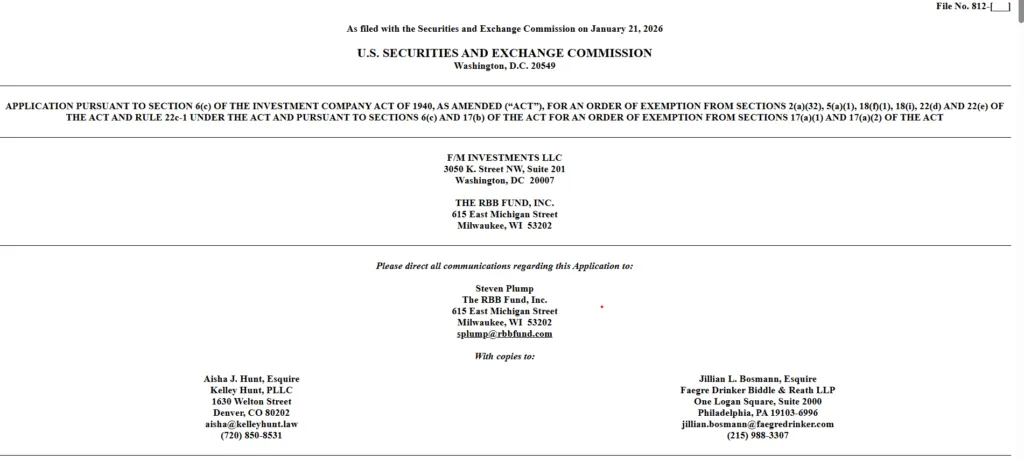
F/m Investments requested the SEC, or the US Securities and Exchange Commission, to let it tokenise shares in its main Treasury exchange-traded fund (ETF).
The $18 billion asset management company applied on Wednesday for special permission so that its F/m US Treasury 3 Month Bill ETF (TBIL) can keep track of ownership of its approximately $6 billion in shares on a private blockchain while still being a regular 1940 Act exchange-traded fund.

In its news release, F/m calls the submission the “first of its kind” from an ETF issuer looking for US regulatory relief for tokenised shares of a registered investment company.
Source: SEC
Tokenisation as a record-keeping mechanism
The company said that the on-chain representation would have the same Committee on Uniform Securities Identification Procedures number and the same rights, fees, voting power, and economic terms as TBIL shares do now. This means that tokenisation is just another way to keep track of who owns the shares, not a new asset.
F/m’s method is very similar to what Franklin Templeton, a big US asset manager, has been doing lately. Franklin Templeton has started blockchain-enabled US government money market funds and other tokenisation pilots. For example, they moved share ownership records for their on-chain US government money market fund to a public blockchain while still keeping the product under the Investment Company Act.
Expanding tokenisation beyond money market funds
In F/m’s scenario, tokenisation would be added to a listed Treasury ETF instead of a money market mutual fund. This might make more regulated fixed-income products available that can use tokens.
The company compares its technique to “stablecoins or unregistered digital tokens,” and it stresses that TBIL’s tokenised shares will still be subject to independent board scrutiny, daily portfolio transparency, third-party custody and audit, and the stronger protections of 1940 Act funds.
If the SEC gives the requested relief, F/m claims that TBIL would be able to offer both traditional broking rails and digital-native, “token-aware” platforms with only one share class, without changing its investment goal or portfolio.
The proposal came just a few days after the New York Stock Exchange announced plans for a new venue that would allow for 24/7 trading and on-chain settlement of tokenised equities and ETFs. This is because tokenisation is moving from trial projects to mainstream markets.