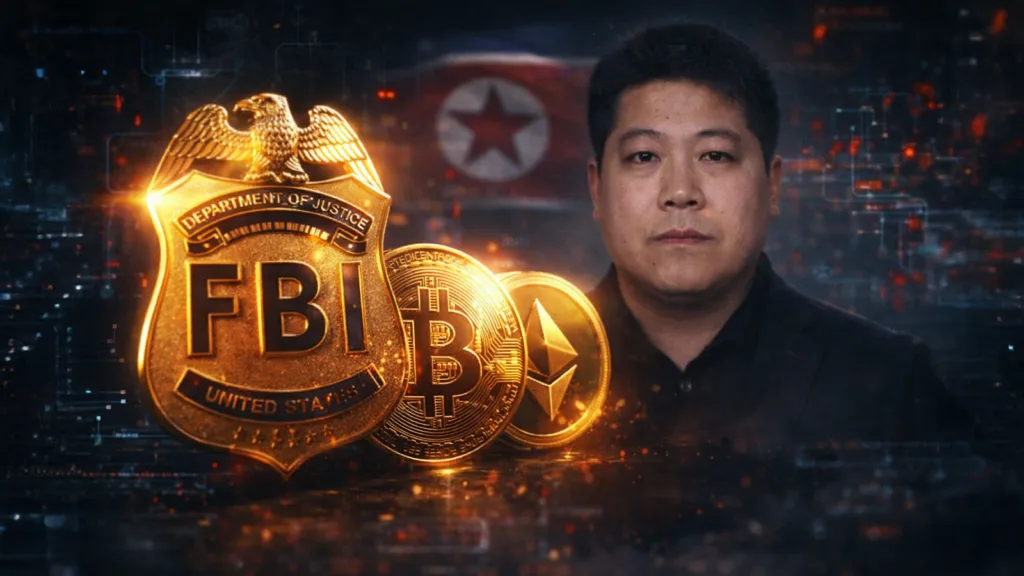



For years, U.S. investigators say he moved money for Pyongyang in the shadows, laundering stolen cryptocurrency across borders and buying everything from Marlboro tobacco to helicopters. Now the Federal Bureau of Investigation (FBI) has put a $7 million price on Sim Hyon-sop, an alleged financial fixer for North Korean leader Kim Jong-un’s regime.
U.S. authorities believe Sim played a central role in laundering cryptocurrency stolen by North Korean IT workers and hackers, converting the proceeds into cash used to purchase goods for the Pyongyang regime.
As of mid-2024, more than 50 North Korean bankers were operating outside the country, the Wall Street Journal reported Wednesday, citing materials from the Financial Action Task Force (FATF). Among them, the newspaper highlighted Sim, who allegedly operated mainly in the Middle East under aliases such as “Sim Ali” or “Sim Hajim.

A graduate of one of Pyongyang’s elite universities, Sim is known to be fluent in English and Chinese. He was dispatched overseas as the head of a subsidiary of North Korea’s Foreign Trade Bank and worked in Kuwait and the United Arab Emirates (UAE).
Witness accounts detail money laundering methods and overseas operations
Ryu Hyun-woo, a former acting chargé d’affaires at the North Korean Embassy in Kuwait who defected in 2019, said he met Sim more than 10 times while stationed there.
Ryu told the WSJ that Sim “would pick him up in a Toyota Land Cruiser, and they would frequently dine with other North Korean operatives.” The defector also said that “Sim described to him how he would launder money, including how Sim moved it between different countries and shell companies, and paid brokers to obscure the sources of the funds.”
Ryu said many North Koreans worked in the UAE “as computer programmers, and some stole crypto on the side and someone had to handle their funds.”
North Korean IT workers and cryptocurrency hackers first sent their profits in digital assets to Sim. Sim or his associates then routed the funds through multiple digital wallets to obscure their origins before transferring them to brokers in the UAE or China.
The brokers converted the cryptocurrency into cash and deposited it into bank accounts belonging to shell companies. Sim then used the funds to purchase goods for the North Korean regime a process Pyongyang believed would help it evade international sanctions by keeping the money from passing directly through North Korean accounts.
Sanctions, banking exposure, and international manhunt
The items Sim allegedly procured ranged from raw materials used to produce counterfeit cigarettes bearing brands such as Marlboro to communications equipment and even helicopters. Sim is believed to have lived a lavish lifestyle in return.
However, the illicit funds eventually drew scrutiny when they passed through the payment systems of major U.S. banks such as Citibank and JPMorgan Chase, as well as European lenders including Deutsche Bank and HSBC.
“In one of Sim’s schemes, U.S. banks, including Citibank, JPMorgan, and Wells Fargo, unknowingly processed at least 310 transactions worth about $74 million for Pyongyang, according to one of the indictments and related court documents,” the WSJ reported.
The UAE revoked Sim’s residency visa in 2019 in line with UN sanctions against North Korea, though his actual departure was delayed by nearly three years due to the Covid-19 pandemic.
The FBI has since raised the reward for information leading to Sim’s arrest to $7 million. He is wanted on several charges, including conspiracy to commit bank fraud, money laundering, and evasion of sanctions against North Korea. His whereabouts remain unknown.
The U.S. Treasury Department believes Sim travelled to Dandong, a Chinese border city, after being expelled from the UAE, though the assertion has not been confirmed.
Beijing’s Foreign Ministry said in a statement to the WSJ that “China is unaware of Sim’s activities and is opposed to what it sees as unilateral U.S. Treasury sanctions,” according to the U.S. news outlet.