


The design of smart contracts requires their execution to yield identical results because they lack any methods of making decisions through their execution process. The DeFi system operates because of its predictable behavior but the system fails when there are changes in its operational environment. The market experiences sudden disruptions through three specific phenomena which include market fluctuations and liquidity crises and oracle response delays and correlation spread events. The system experiences operational failure because its fixed contract terms cannot handle the arrival of unexpected events which need more time to activate their protective measures.
AI-augmented smart contracts use a design pattern which enables their systems to execute predetermined processes through “adaptive logic” while maintaining transparent operation of their systems. The goal of the system establishes restrictions which prevent a model from choosing outcomes at will. The system allows verified signals to change security protocols in real time because it improves market conditions which require higher collateral at tail risk and lower thresholds after market stabilization and it adjusts borrowing rates through actual market conditions and actual market conditions and actual market conditions and actual market conditions. The feature operates through two main elements which include adaptive contract terms and AI risk scoring which is built into DeFi control mechanisms.
The core idea
The AI-powered smart contracts use learned models and model-driven signals to perform three functions which include optimization and decision-making and dynamic condition management. The contract does not “predict the future” inside the EVM. The system operates by using model outputs as limited input parameters which it processes through defined rules that can be verified.

The system architecture separates different functions into distinct components. The AI generates three outputs which include a risk score and regime label and parameter recommendation. The smart contract establishes operational limits through its boundaries and rate restrictions and circuit termination points and governance regulations. The model operates as a sensor which does not have complete control over its functions.
Why this matters now
DeFi has evolved into a liquidity system that operates across multiple venues and supports multiple assets while experiencing stress-related issues that spread more quickly than governance systems can address. Many protocols still rely on static collateral factors, linear interest-rate curves, and liquidation mechanics tuned for “normal” conditions. But normal conditions are a luxury. When correlations spike, liquidity disappears, and oracle updates lag, the same parameters that maximize capital efficiency in calm markets can become liquidation accelerants in chaotic markets.
AI is relevant here because DeFi risk is not one-dimensional. Utilization alone is not risk. Volatility alone is not risk. Liquidity alone is not risk. Risk evaluation requires us to consider all distributions which include volatility together with depth and funding stress and on-chain leverage behavior. AI models are useful because they can compress multi-factor signals into a single, continuously updated state variable that contracts can respond to instantly.
Mechanism 1 Adaptive contract terms
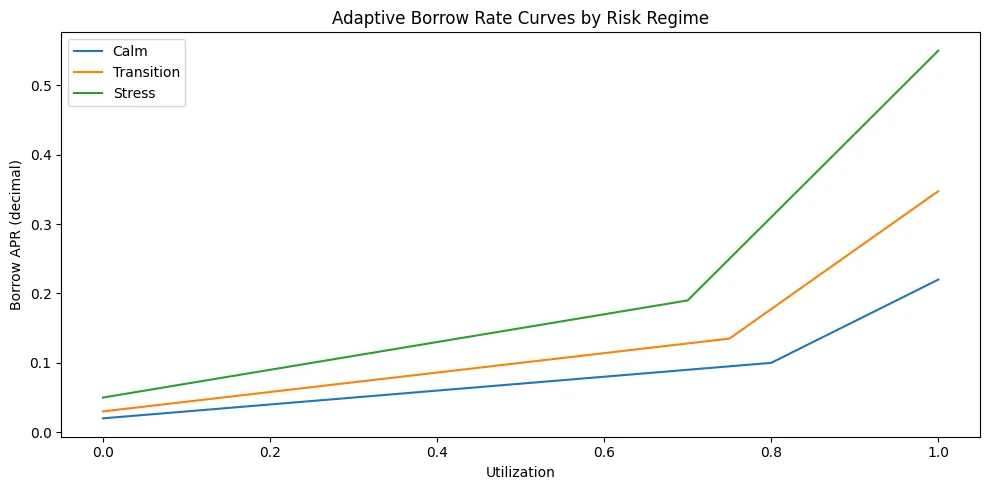
The contract terms of adaptive contracts change their parameters whenever verified data shows existence of established rules. The contract remains deterministic. The adaptation process follows established rules. The rules undergo modification because they now react to more complex situations. The lending markets establish interest rates and collateral haircuts based on both asset usage and other market conditions. The system uses regime labels which include “calm” “transition” and “stress” to determine current state according to observable indicators. The contract allows during stress to use steep borrowing curves which create stronger liquidation incentives while enforcing strict LTV limits and decreasing grace period lengths. The system allows organizations to reduce operational limits during calm times which enables better resource management.
Pricing tiers and fees in DEX and LP systems adjust according to trends in harmful trading activity. The contract establishes multiple fee levels which start at one rate during normal times and then switch to higher rates during periods of increased operational risk before returning to lower rates when trading conditions improve. Liquidity providers stop being punished for providing liquidity exactly when it is most needed. A system needs to define specific limits which determine its capacity for change. The contract should prevent immediate switches from “friendly” to “punitive” parameters without requiring time delays and throttle controls and multiple update confirmations.
Mechanism 2 AI risk scoring embedded into DeFi
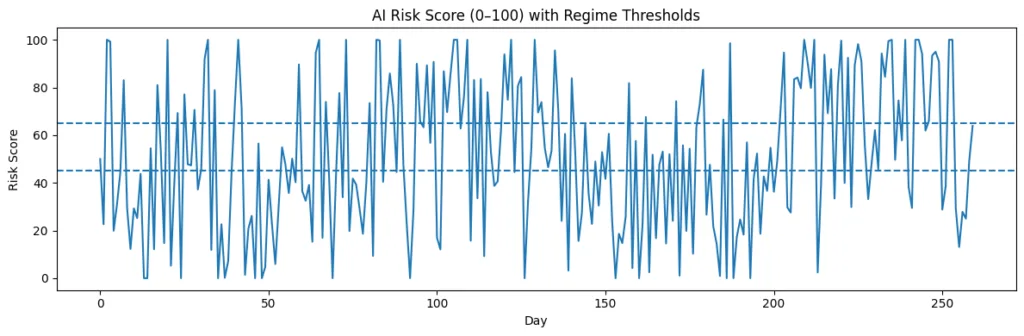
The AI risk scoring system continuously updates its risk signals which determine changes in exposure and collateral requirements and risk limits. The risk score is not a mystical number. It is a standardized control variable with a clear interpretation such as expected shortfall proxy and liquidation probability proxy and liquidity-adjusted volatility and system stress index.
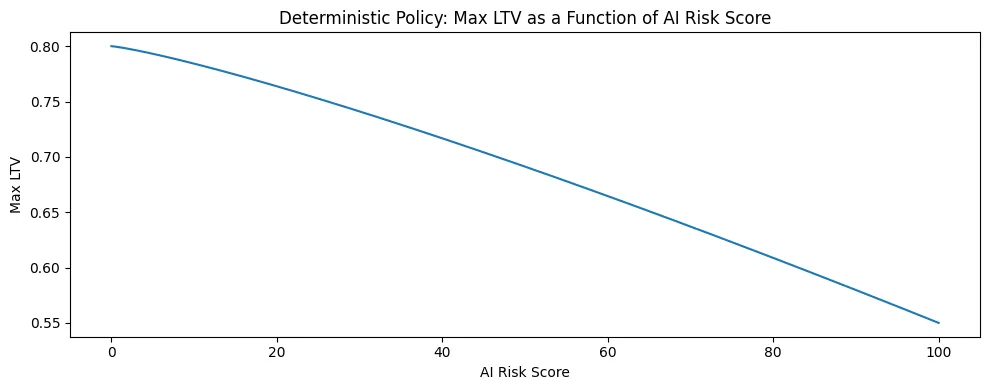
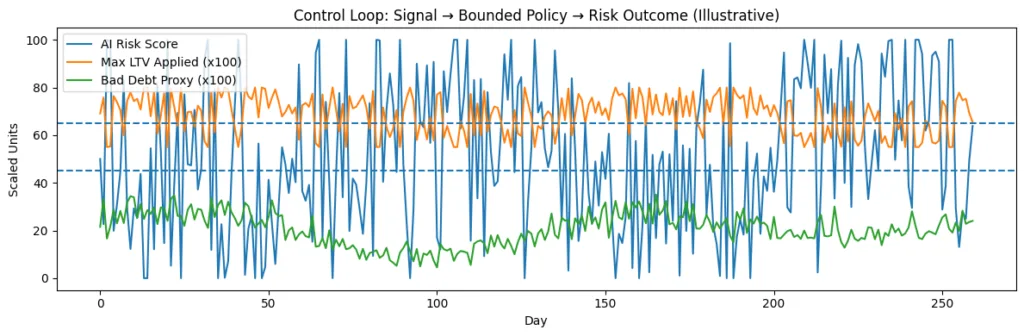
The protocol uses that score to create deterministic actions which include adjusting LTV and increasing margin requirements and reducing borrow caps and changing liquidation penalties. The contract automatically reduces maximum borrow limits for new positions when tail risk crosses a defined threshold while keeping existing positions intact which prevents sudden mass liquidations. The system increases required collateral for incremental borrows only which causes leverage expansion to decrease at a natural pace. This method allows you to control risk without initiating an automatic crisis response.
Architecture how you make AI and smart contracts coexist
Current on-chain machine learning processes maintain high operational costs according to their existing limitations which force most production systems to implement off-chain models that use on-chain verification methods and protective measures. The standard pattern is:A model runs off-chain using on-chain data, market data, and protocol telemetry.The model outputs a signal which includes a risk score and regime class and recommended parameters.
The decentralized oracle or trusted execution environment broadcasts the signal onto the blockchain network.
The smart contract reads the signal and applies it through bounded rules.The important design decision is not “which model.” The system establishes two main access points which determine who can publish signals and create contractual protections against signal-based damage. The system uses decentralized validation methods together with redundant systems as its core product offering. The system requires multiple independent publishers to operate median aggregation and update frequency limits while it detects any unusual activities. The contract should treat model outputs like oracles which provide utility but show hostile behavior until proven safe.
What makes this institutional-grade
The fear of automation exists for organizations. Organizations fear automation when its workings remain hidden from them. The moment an AI signal can move prices, liquidate positions, or change collateral requirements, it becomes a market-integrity component. The system needs to provide traceable evidence which shows how it produces results through its input process. The implementation of institutional-grade AI-augmented contracts requires organizations to establish the following requirements.
The score needs a transparent definition which shows its calibration method. The organization needs to make public an official policy which connects score ranges to specific parameter ranges. The organization needs to establish a procedure which determines when updates will happen and which circumstances will lead to emergency freeze operations. The system needs to include a complete set of monitoring metrics which allow risk teams to identify potential losses.
Risk surface what can go wrong
The implementation of artificial intelligence brings about additional security vulnerabilities and operational breakdowns. If you do not design for them, you are building a liquidation machine with a fancy label.Oracle manipulation leads to model manipulation. If attackers gain control over features, they will use their power to modify system scores. Model drift produces a gradual failure process that renders assessment scores useless when system conditions undergo transformation. The danger of over-reaction exists through the possibility that rapid enforcement of rules will lead to financial system collapses.
The danger of under-reaction exists because the score appears stable yet actual liquidity has vanished. Parameter controls become very flexible which enables organizations to dominate governance systems. The defense system consists of multiple protection layers which include restricted actions and security limits and delayed response to critical events and multiple publishing agreements and emergency systems that return to basic operational settings when essential information is missing or shows discrepancies.
How to measure success
The protocol must establish its success criteria through two metrics which track reduced bad liquidations and improved stability, instead of using increased revenue as the sole success factor. The quality of liquidations improves when both extreme slippage liquidations and transient oracle gap liquidations are reduced. The capital efficiency of an operation system improves when its stable periods enable increased resource use without raising risks of extreme losses.
The key protocol metrics experience decreased volatility, which includes three specific metrics: utilization spikes and bad debt formation and liquidity withdrawal cascades. The system now responds to stress events by initiating its protective measures before damage occurs, which makes the response process more predictable because it uses smoother operating patterns.
Where this goes next
The combined system of AI-augmented contracts with cross-chain liquidity and intent execution and account abstraction creates a system that delivers enhanced operational capabilities. The contract can adapt not only to price risk but also to settlement risk which includes bridge congestion together with MEV intensity and chain-level finality stress. Over time, protocols will compete on the quality of their risk sensors and the elegance of their control loops, not just on token incentives. The endgame is not “AI controls DeFi.” The endgame is “DeFi becomes resilient by design” because contracts learn to treat risk as a living variable instead of a fixed assumption.