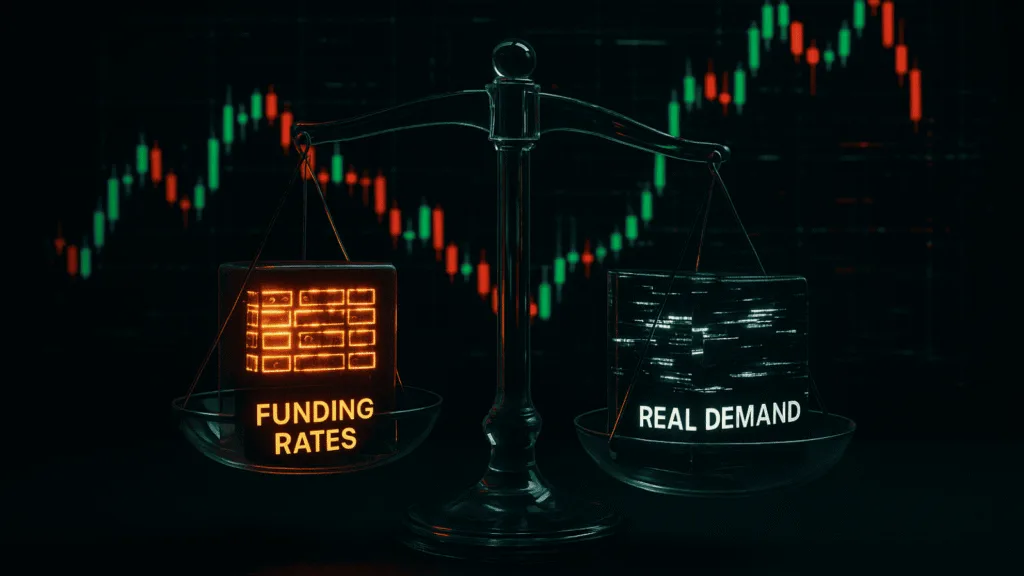



The original promise of funding rates
The purpose of perpetual futures was to address a fundamental issue in cryptocurrency markets: how to trade leverage without expiring. The fundamental mechanism that linked eternal pricing to spot markets and produced a constant incentive for balance was funding rates. Longs pay shorts when funding is positive, indicating bullish pressure. Shorts pay longs when financing becomes negative, indicating a bearish stance. For many years, traders used funding rates as a near-real-time indicator of directional conviction and market mood.
This association mostly remained true in the early crypto cycles. Deeply negative funding emerged during panic and surrender, while aggressive positive funding was associated with exuberant rallies. Funding was a signal, not merely a cost. However, the signal’s simplicity started to deteriorate as market structure changed.

The rise of structural distortions
Speculative directional traders are no longer the main players in the contemporary derivatives market. Market makers, arbitrage desks, delta-neutral funds, and yield-seeking tactics currently dominate it. These players engage with funding rates as a source of income rather than as a sentiment indicator.

During times of high yields, cash-and-carry trades where money goes long spot and short perpetuals to harvest funding have been a standard tactic. Positive funding in this setting may just indicate the existence of cash ready to mechanically absorb longs rather than a bullish belief. Similarly, when hedging activity outpaces speculative flows, negative funding may continue even if spot demand is still high.
As a result, positioning incentives rather than actual demand are increasingly reflected in funding rates
When high funding no longer means euphoria
Persistently positive funding during stagnant or even dropping price action has been one of the most deceptive signs in recent cycles. In the past, persistent positive funding indicated an overheated market that was susceptible to liquidation cascades. These days, it can just mean that smart players who don’t care about the short-term direction of prices are hoarding leverage.
This change is particularly evident in Bitcoin, where institutional involvement has increased significantly. Because leverage is more widely dispersed and supported by better balance sheets, funding can stay slightly positive for extended periods of time without causing violent corrections. The reflexive liquidation dynamics that formerly made funding an early warning system have been mitigated by the existence of ETFs, OTC desks, and structured instruments.
The decoupling of perps and spot demand
The growing difference between permanent volume and spot volume is another significant shift. Perpetuals now account for the majority of trading activity in many assets, which means that spot-driven demand may be momentarily overpowered by derivatives price discovery. When this occurs, internal derivatives positions rather than real purchases or sales of the underlying asset may be reflected in financing rates.
In high-beta cryptocurrencies, where narrow spot liquidity increases the impact of leveraged flows, this decoupling is especially noticeable. In these markets, financing spikes frequently anticipate volatility, though not always in the direction that the funding itself suggests. Weak on-chain activity, dwindling spot bids, and falling fundamentals can all coexist with positive funding.
The signal is still present, but it is now contextual rather than absolute.

The role of liquidity engineering
Liquidity provisioning techniques that actively control volatility have a significant influence on contemporary cryptocurrency markets. In order to maximize fee capture and funding efficiency, professional traders moderate dramatic swings, while exchanges encourage deep order books. Funding rates can be purposefully stabilized in this setting to avoid the extremes that previously provided clear directional insight.
A market where leverage can develop covertly without overt signs of stress is created by this liquidity engineering. Risk builds up through open interest increase, maturity mismatch, and correlation clustering across assets rather than sharp funding spikes. Funding is still stable, but underneath the surface, fragility is growing.
When stress does eventually surface, it frequently does so suddenly and without the customary funding warning indicators that traders anticipate.

In contemporary cryptocurrency markets, smoothed volume trends conceal conventional stress indicators by revealing liquidity management and participation compression.
What actually matters more than funding now
For funding rates to have any significance in the current market structure, they must be interpreted in conjunction with other data. Growth in open interest in relation to spot volume sheds light on whether pricing is being driven by leverage. Basis spreads across maturities show if a position is hedged or speculative. Determining whether derivatives activity is linked to actual asset movement is made easier by on-chain flows and exchange balances.
Funding by itself is no longer a sufficient signal. It is no longer the headline indication it once was, but rather a part of a larger derivatives mosaic.
Implications for traders and analysts
The risk is not that financing rates are worthless, but rather that they can be misunderstood. False contrarian trades, missed trend continuation, and early shorting result from using financing as a stand-alone sentiment indicator. The frameworks that are used to assess markets must also evolve.

Funding in the current cycle is not so much a direct expression of belief about price direction as it is a reflection of incentive alignment inside derivatives markets. Traders need to investigate more to determine who is paying whom and why when perps cease to reflect actual demand.