

Bitcoin (BTC) volatility returns as the market resets into December
Market overview
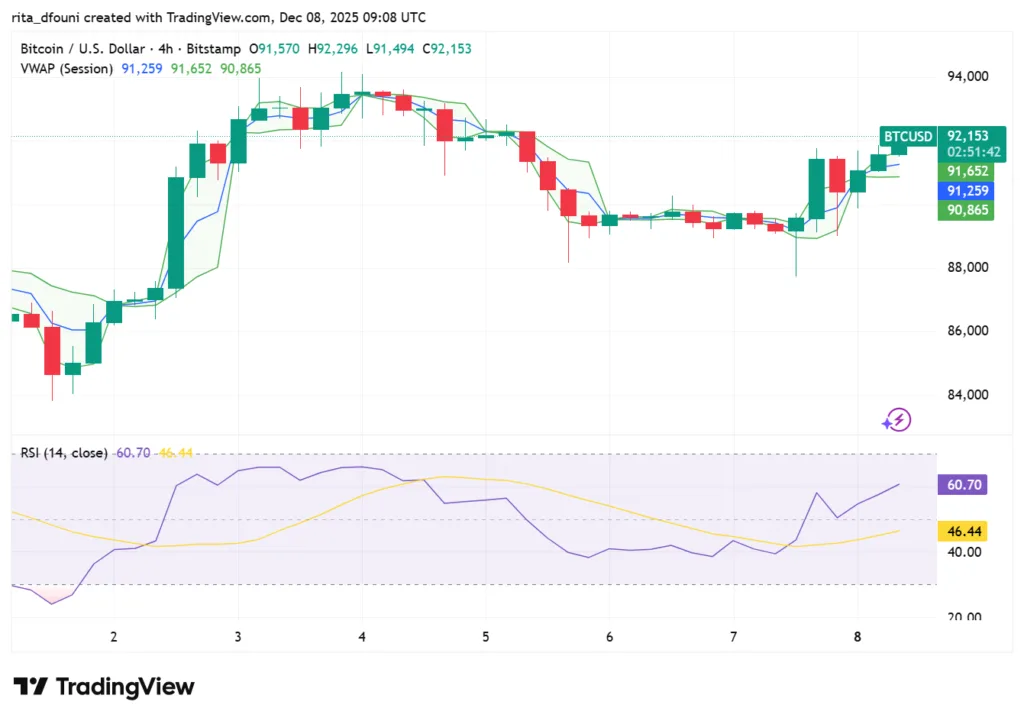
Following the strong shakeout that began the month, Bitcoin starts the 8 December session trading just above the USD 90,000 handle. A significant block of long leverage was flushed and sentiment was momentarily jolted by the early-December plunge into the mid-USD 80,000s, but the market’s reaction has been impressively resilient ever since. Once more, order books are fairly deep, spreads contract shortly after each volatility spike, and intraday drops toward the high USD 80,000s find buyers fast.
Bitcoin currently trades in a more serious environment where all sides of the tape are involved, as opposed to the brittle, one-way exuberance that predominated late November. Although traders admit that volatility has returned, the general consensus is that the correction cleaned up rather than destroyed the structure, so the tone is cautious but far from depressing.
Technical structure
Technically speaking, Bitcoin has moved from a narrow November compression to a wider, higher range. The first significant line in the sand beneath the location and the bottom boundary of the existing structure are still marked by the high absorption around the USD 85,000–85,500 area. A functional corridor between the high-USD 80,000s and the low-USD 90,000s has been delineated by recent price action above that, with selling activity emerging as the price moves toward previous local highs and frequent rebounds from the lower end.

The backbone of the broader uptrend is maintained by the deeper November accumulation zone, which is located around USD 83,000–84,000 and has not been touched on closing basis. The RSI has recovered from its dip during the flush back into neutral territory, the MACD has rolled into a slower, flatter configuration, and the volatility bands are still wide, all of which are consistent with an ongoing discovery phase where the market is figuring out its new equilibrium. These momentum indicators show a market that has expended a burst of downside energy but has not flipped into a structural bear phase.
Derivatives and positioning
The futures environment revealed that the early-December move was largely a leverage event. Funding rates, which had been comfortably positive until late November, fell back into neutral due to the forced unwinding of overextended longs. As futures open interest has dropped from Q4 levels, a substantial layer of speculative exposure has been removed. Because there are less fragile positions put on top of spot, Bitcoin is now less susceptible to sudden cascade occurrences caused by relatively small movements.
The options markets show a balanced approach: traders still carry bullish calls targeted at levels above recent highs, but downside protection is still obviously needed, especially in strikes grouped around and below the high USD 80,000s. Since dealer gamma appears to be light around spot, suggesting that hedging flows are unlikely to hold the price in place, the next big move is anticipated to be driven more by real flows and macro headlines than by mechanical derivatives feedback loops.
On-chain and ecosystem dynamics
Bitcoin continues to appear robust rather than troubled on-chain. There is little indication of widespread capitulation in long-term holder behavior; the majority of coins that have lain inactive for extended periods of time are still in place. Miner transfer patterns resemble regular treasury management rather than panic selling, and exchange balances do not show the kind of abrupt inflows that would suggest urgent liquidation demands.
Even while short-term flows fluctuate with risk appetite, structural adoption channels such as custodial products, institutional access rails, and ETF-style vehicles remain operational. This on-chain background indicates that while the fundamental generation is still highly committed, the early-December decline was mostly absorbed by derivative and short-horizon players.
Macro alignment
The primary external factor influencing Bitcoin’s medium-term trajectory is still macro circumstances. The market is torn between optimism about future rate reductions and worry that statistics on GDP and inflation may compel policymakers to maintain tighter regulations for longer. Bond markets continue to price some likelihood of easing farther out, stocks are wary rather than crashing, and the dollar is robust but not in runaway mode. In that regard, Bitcoin trades like a hybrid, underpinned by its story as a scarce, non-sovereign asset but extremely vulnerable to fluctuations in risk sentiment.
Rather than responding to a single catastrophic shock, the market is repricing expectations, which is consistent with the increasing volatility at the beginning of December. This year, Bitcoin enters the middle of December from a position of reset rather than tiredness. December is typically a tumultuous month for cryptocurrencies.
Investor psychology
In terms of psychology, BTC investors and traders have shifted from self-assured linearity to cautious respect. While long-term holders mostly see the drop as just another chapter in a well-known tale, momentum chasers who assumed straight-line continuation have been reminded of how rapidly over-leveraged structures can unravel. Social sentiment has cooled from ecstatic to analytical; the discussion has returned to levels, ranges, and macro catalysts rather than continuous top-calling or moon-calling.
A healthier market structure is indicated by this cooling of emotion. The memory of the recent rally has tempered enthusiasm, but it has not completely disappeared. This tends to make subsequent rallies more sustainable because they are based on more informed conviction rather than mindless chasing.
Outlook
Instead of being broken, Bitcoin is in a recalibrated condition going into mid-December. The market will increasingly see early December as a successful structural reset and begin eyeing previous highs and fresh extensions as feasible goals if it can continue to defend the high USD 80,000s on declines and progressively gain acceptance above the low USD 90,000s. Another move higher would be possible if there was a clear, sustained break over the current resistance band; if there was a failure and Bitcoin fell back below the mid-USD 80,000s, the consolidation would continue and the deeper November anchor zones would resume. Rather than rolling over from a final peak, the overall picture still matches the definition of a market that has been tested but not fallen, getting ready for its next big move.
Ethereum (ETH) structure intact after a sharp repricing

Market overview
After a significant but brief repricing at the beginning of the month, Ethereum starts trading above USD 3,000 on December 8. Due to its stronger beta to risk rotations, ETH experienced a larger percentage decline than BTC when the market as a whole deleveraged, but the recovery that followed was just as quick. The price swiftly recovered around the psychologically significant round number after intraday pushes below USD 3,000 were bought. Around that area, there is still a lot of liquidity, both buyers and sellers are active, and the tape resembles a market processing a volatility event rather than one dissecting a structural theory. Longer-term participants still seem to be more concerned with ETH’s function as the settlement layer for DeFi, NFTs, and Layer-2 ecosystems than with the noise of a few volatile sessions, while short-term traders have been compelled to reconsider positions close to the highs.
Technical structure
Technically speaking, rather than being a failure, ETH appears to be a high-beta uptrend that has seen a controlled reset. With dives into the upper USD 2,000s finding demand and rises into the low USD 3,000s encountering measured selling, the USD 3,000–3,100 area has established itself as the center of the current range. The medium-term structure is still anchored by the deeper support band in the upper USD 2,000s that was established during a prior consolidation. The narrative presented by momentum indicators is comparable to that of Bitcoin, but with more pronounced fluctuations: During the early December flush, RSI momentarily left its neutral comfort zone before rising back when ETH recovered USD 3,000. Without announcing a significant downtrend, MACD moved over from a flat top into a mild bearish cross, indicating the lack of immediate upside momentum. After being constricted throughout the majority of November, volatility bands have expanded, giving ETH more space to oscillate within a wider corridor while it looks for a new equilibrium.
Derivatives and positioning
Cleaning out leverage has obviously been the goal of the December move in derivatives. When the selloff drove packed longs to sell, funding that had been slowly rising as ETH moved toward and over USD 3,000 in November reverted back toward neutral. Similar to the de-leveraging observed in Bitcoin, futures open interest has decreased from its prior highs, giving the market a leaner profile. The propensity for upward participation is still evident in options positioning: protective puts in the high USD 2,000s have drawn more attention, while calls are still concentrated in strikes above the current range, especially in the mid-USD 3,000s. This distribution suggests that traders are considerably more conscious of the possibility of another volatility surge but have not given up on the concept of higher pricing. Instead of being restricted to small dealer-controlled corridors, ETH is free to follow spot flows and macro impulses since gamma exposures surrounding spots are moderate rather than excessive.
On-chain and ecosystem dynamics
Ethereum’s on-chain and ecosystem signals continue to be one of its core advantages. Major Layer-2 networks are still experiencing strong activity, with rollups handling a significant amount of the transactional load and maintaining base-layer conditions. DeFi protocols, NFT markets, and applications can function without constant interruption since gas prices fluctuate but do not exhibit the persistent stress that characterized earlier boom phases. In validator and liquid-staking contracts, staking participation locks a significant portion of the supply, limiting the amount of ETH that can be immediately dumped when prices drop. Over a longer period of time, exchange balances have trended downward, indicating a shift toward yield and self-custody tactics. Developer activity is still active across clients, protocols, and apps, and continuous experiments and upgrades support the idea that the ecosystem is dynamic rather than static.
Macro alignment
Macroeconomically speaking, ETH is still positioned between infrastructure and pure risk assets. Although it frequently exaggerates BTC’s macro movements because to its sensitivity to changes in equities sentiment and liquidity constraints, it also gains from the structural demand created by its pivotal position in the crypto industry. The early December volatility coincided with a period of increased policy and growth uncertainty, which put pressure on high-beta assets in general. ETH has had time to reset and re-anchor around USD 3,000 as the initial fear has subsided and macro has returned to a more “wait and see” approach. Given its liquidity and narrative weight, ETH is well-positioned to take part if the data flow during the remainder of December shifts back toward risk-on through weaker inflation, clearer indications on future cuts, or higher growth without runaway inflation.
Investor psychology
A change from complacent optimism to cautious confidence can be seen in investor psychology surrounding Ethereum. The rapidity of the unwind has punished traders who packed into resistance close to the highs, and they are now entering fresh positions with greater consideration for leverage and levels. Rather than viewing the shakeout as a thesis-breaker, longer-term investors, particularly those involved in staking and the larger ecosystem, typically view it as a necessary clearing of speculative froth. The focus of professional and community discussions has shifted away from urgent breakout calls and toward topics like L2 adoption, staking yields, and protocol updates. Although the memory of the drawdown is still vivid enough to promote patience and discipline, fear has not taken over.
Outlook
Ethereum is in a controlled recovery position as it enters mid-December. The decline from the highs will increasingly be viewed as a reset rather than a reversal if it can maintain the USD 2,950–3,000 region on closing bases and progressively gain acceptance higher in the band. The way back toward earlier local peaks would be made possible by a successful recovery of resistance in the low-to-mid USD 3,000s, particularly if BTC also confirms higher. The story will return to deeper range-building if ETH is unable to defend the upper USD 2,000s and is compelled to look for support nearer to earlier consolidation lows. For the time being, the ecosystem and the chart both point to a market that has changed rather than given up.
Solana (SOL) high-beta leader absorbs a sharp reset

Market overview
After a fast ride during the first several days of the month, Solana begins the 8 December session trading in the mid-USD 130s. Compared to BTC or ETH, SOL repriced more aggressively as the market as a whole deleveraged, yielding a greater percentage decline without going into chaos. As is common with high-beta assets, order books thinned during the steepest part of the decline, but depth quickly recovered as the price gained acceptance in the mid-USD 120s. After that, Solana made a strong comeback, regaining a larger trading range and serving as a reminder to traders of why it is frequently chosen as the means of expressing directional opinions about the whole cryptocurrency complex. The environment surrounding SOL is one of cautious regard; market players are trading it in accordance with their knowledge that it can overshoot in both directions.
Technical structure
Technically speaking, Solana is still tracing a bullish pattern on top of a classic volatility event. SOL has been consistently pushing into a resistance zone in the USD 135–145 range prior to the reset, which was consistent with previous distribution and psychological focus. A return to the core November value range, which is roughly USD 125–130, where previous lows have gathered, resulted from the inability to get acceptance above that band. That region now serves as the primary short-term demand zone; the broader pattern of higher lows over longer time periods persists as long as daily closes stay above that band’s lower edge. Resistance is still centered in the USD 135–140 range on the upside, and a strong break above it is probably going to open up reasonably easily toward USD 145 and USD 150. The previous up-leg has cooled but not collapsed, according to momentum indicators: MACD has rolled over on short-term charts but maintains a positive tilt on higher frames, RSI has retreated from overbought territory into a neutral zone, and volatility bands are wide enough to allow for additional swings as the market looks for direction.
Derivatives and positioning
Solana is a cleaned-up high-beta asset in the futures market. During the crash, funding rates that had been obviously positive as SOL got closer to the USD 140s compressed toward neutral, reflecting a wave of protracted liquidations that removed a layer of speculative leverage. The most vulnerable posts have already been eliminated, as seen by the significant decline in open interest. The demand for upside calls is concentrated in strikes above the current spot, particularly in the high USD 130s and mid USD 150s, while protection puts are found in the USD 120 and USD 110 regions. This is a classic profile of options markets. This pattern implies that traders are no longer prepared to hold that opinion without insurance, even though they still see SOL as a strong prospect for upside if the market moves higher. Future actions are more likely to reflect actual shifts in emotion and flows and less likely to be controlled by reflexive cascades when positioning is lighter and less biased.
On-chain and ecosystem dynamics
Solana does not really resemble a project under pressure on-chain. With a combination of DeFi, NFT, and consumer applications supporting ongoing activity, transaction throughput is still among the greatest in the industry. Users who wish to retain cash inside the ecosystem while generating yield which links value to the chain and quickly lowers liquid float continue to be drawn to staking and liquid-staking solutions. Crucially, the makeup of on-chain activity has evolved: Solana now serves a wider range of users, including yield farmers, application users, and professional trading firms, rather than only being a playground for fleeting speculative manias. Once frequently criticized, network resilience has improved to the point that recent spikes in activity and volatility have not resulted in widespread disruptions. The rapid return of capital to Solana following each reset can be explained by the mix of throughput, utility, and stability.
Macro alignment
Macroeconomically speaking, Solana continues to be a leveraged wager on crypto risk appetite. It often performs better during periods of high risk-taking and worse when markets retreat to safety. SOL is in an intermediate position as a result of the current uncertain but not overtly risky environment: it was penalized during the shock due to its high beta, but it quickly recovered as conditions steadied. Projects that combine excellent on-chain fundamentals with deep liquidity are better positioned than those that rely solely on hype, as global markets are now more focused on distinction than on broad risk-on or risk-off. Solana matches that criteria. SOL is probably going to be one of the first and most astute responders if macro news in the upcoming weeks pushes sentiment back toward risk-on. On the other hand, Solana will most likely suffer more than BTC or even ETH if the macro clearly takes a turn for the bad, but the strength of its ecosystem indicates that such actions would be more indicative of risk aversion than of internal decline.
Investor psychology
Experience shapes investor mentality in Solana. Many traders and investors have adjusted in response to the numerous cycles in which SOL overshoots in both directions. After being flushed out, short-term speculators who packed into late-stage upside now approach the coin with greater humility. Long-term investors who support the chain’s direction are aware that investing in Solana entails taking on significant fluctuations in return for possibly disproportionate gains. People are still interested in SOL, but the tone has shifted from excitement to curiosity. Risk management, ecosystem analysis, and level-based strategy are more prevalent than indiscriminate pursuing. A high-beta leader who has passed several tests typically exhibits this combination of respect, caution, and persistent curiosity.
Outlook
Solana is in a dynamic but promising configuration going into mid-December. The recent decline will increasingly be viewed as a healthy shakeout and rebuild if it can maintain its defense of the USD 125–130 region and start recording higher lows inside that band. That opinion would be confirmed by a clear break above the USD 135–140 resistance area, which would probably lead to another try at USD 145 and USD 150. The market would return to test the deeper consolidation around USD 110–115 and change the narrative toward a longer reset if the present demand zone is not maintained, particularly if there is a persistent decline below USD 125. For the time being, SOL continues to be the sharpest edge of the majors, commanding respect from traders and investors who recognize its ability to magnify whatever the larger market chooses to do next.
XRP stability tested but not broken as the market resets

Market overview
In the middle to upper part of its multi-week range, XRP is trading slightly above USD 2.00 going into the 8 December session. In keeping with its emerging status as a mix between speculative asset and payments infrastructure, XRP fell lower in tandem with the overall market during the early December turbulence, but it did so in a regulated manner. XRP’s decrease was notable but orderly, with buyers jumping in close to previously identified support and liquidity staying available, in contrast to high-beta coins that saw outsized percentage drops and more dramatic order-book behavior. The rapid recovery to levels above USD 2.00 indicates that players continue to consider this region to be a suitable equilibrium given the current circumstances.
Technical structure
In theory, XRP still adheres to a clear range. The price has fluctuated between an upper boundary close to USD 2.10–2.12 and a lower barrier in the high USD 1.80s to low USD 1.90s for a number of weeks. Price momentarily fell to the bottom of that corridor due to the early-December flush before rising and reestablishing itself near the middle of the band. The range stays intact and the structure may be characterized as “tried but not broken” as long as XRP maintains above its lower support zone on daily closes.
A sustained break above the top barrier would indicate a significant change and create space for the subsequent liquidity pockets higher up. The upper boundary still serves as a distinct resistance point. The range narrative is supported by momentum indicators: volatility bands have widened just enough to allow for sporadic spikes without suggesting a directional trend, MACD flips gently between bullish and bearish configurations, and RSI oscillates between mildly oversold and mildly overbought without sustained extremes.
Derivatives and positioning
XRP is a comparatively calm, well-balanced asset in the futures markets. Perpetual futures funding rates have remained nearly flat, indicating that neither aggressive longs nor shorts dominate positions. Since the volatility rise, open interest has slightly decreased, indicating prudent de-risking rather than coerced capitulation.
Although XRP’s options markets are smaller than those for BTC and ETH, when they are active, the distribution of open interest appears to be fairly symmetrical: traders employ calls to take part in possible breaks above the range high and puts to guard against dives into well-known lower zones.
Since there is not much leverage on either side, XRP has been able to avoid the dramatic liquidations that may shatter its structure. Rather than controlling spot price movement, derivatives appear to be enhancing it.
On-chain and ecosystem dynamics
Instead than exhibiting the boom-and-bust patterns typical of purely speculative tokens, XRP continues to demonstrate consistent, utility-driven usage on-chain. Even while speculative flows fluctuate with market sentiment, transaction volumes pertaining to payments and liquidity provision stay constant. Large wallets and long-term holders do not seem to be leaving in large numbers; instead of showing the kind of surges that would suggest significant coordinated selling, exchange balances fluctuate within their typical bands.
Cross-border payment corridors and institutional integrations continue to make slow but steady development at the ecosystem level. These elements serve to explain XRP’s relative stability in the face of more significant market shocks and contribute to its image among the cryptocurrency majors as a mid-volatility, infrastructure-like asset.
Macro alignment
Macroeconomically speaking, XRP responds to shifts in the world’s risk appetite, but not as strongly as the most speculative coins. Despite larger dislocations in other assets, XRP has been able to retain its range due to the current macroenvironment of cautious but not catastrophic conditions. Although risk appetite and, consequently, XRP’s flows are influenced by bond yields, equity indices, and the dollar index, the token’s connection to utility-based demand offers an extra anchor.
XRP is undoubtedly under pressure as macro concerns worsen, but because of its steady use-case and modest volatility, it typically maintains its structural levels better than many altcoins that are just interested in narrative-driven flows.
Investor psychology
Investor sentiment regarding XRP is remarkably stable. Instead of seeing it as a short-term speculation, many long-term investors see it as a multi-year play on changing financial plumbing, which influences how they react to volatility. Although retail sentiment fluctuates, the general tone is more realistic than extreme; investors are aware that XRP’s trajectory usually entails lengthy stretches of range trading interspersed with shorter trend bursts rather than continuous explosive movement.
More and more traders use XRP as a stabilizing element in portfolios that also contain smaller-cap coins or more volatile names like SOL. This view supports the chart’s behavior, which shows that XRP typically does not lead during euphoric risk-on periods but also holds up fairly well during abrupt risk-off bouts.
Outlook
XRP is in a structurally sound position going into mid-December. During the recent volatility, it has protected its important support zone and is still safely within its defined range. A clear break above resistance becomes a plausible scenario if it can maintain acceptability above USD 2.00 and progressively increase pressure on the range high. This would probably attract more momentum traders and push the price into higher consolidation areas.
As long as structural fundamentals, derivatives balance, on-chain steadiness, and ecosystem advancement are intact, the market will perceive the move as a deeper retest rather than an instant breakdown if XRP fails to maintain its lower boundaries and returns to the bottom of the range. As a token that withstood the market-wide reset with relatively little structural damage, XRP currently stands out among the majors.
Cardano (ADA) quiet resilience at the edge of its range

Market overview
After a turbulent start to the month that momentarily drove it below this crucial psychological threshold, Cardano opens December 8 trading barely above USD 0.40. ADA had been trading in a very narrow range throughout November, gradually establishing what appeared to be a base between the lower and mid USD 0.40s. The market had to determine whether it still want Cardano at lower prices after the early-December deleveraging wave pushed the price into the high USD 0.30s.
So far, the response has been in the affirmative: spreads normalized, liquidity replenished, and buyers emerged with sufficient conviction to drive ADA back into the lower portion of its previous range. The Cardano community’s sentiment is still measured and patient, reflecting a long-standing familiarity with lengthy structural periods interspersed with sporadic dramatic swings.
Technical structure
In a technical sense, ADA is currently testing whether the previous floor may be successfully reclaimed as support by standing close to the lower border of its original base. The pivot is now the USD 0.40–0.41 area, which was formerly the lower limit of the November range. The price has consistently snapped back over USD 0.40, indicating that buyers are prepared to defend this territory, rejecting intraday lows into the extremely high USD 0.30s. The mid-USD 0.40s, where earlier attempts at a rally failed, continue to be the center of resistance.
This tug-of-war is reflected in momentum indicators: While MACD has rolled over on short-term time frames but is still more sideways than strongly bearish on higher ones, RSI fell into oversold territory during the flush and has now risen back into a low neutral range. As the market determines whether this is a new, slightly lower consolidation or a staging ground for a comeback toward the old range, volatility bands have widened from their previous tight state, allowing ADA to move.
Derivatives and positioning
Cardano has benefited from its comparatively small footprint in derivatives. Even throughout the worst portion of the selloff, funding rates were nearly neutral, suggesting that neither a big wave of late shorts coming in on the downside nor a mass liquidation of fragile longs occurred. Instead of collapsing in a spike, which is typical of a market where members are consciously lowering risk, open interest moved downward.
The ADA options markets are small but informative: protective puts at recent lows have attracted some interest as traders hedge against the chance of another sweep, while upside calls at higher strikes are still open but with more conservative sizing. Overall, it appears to be a coin whose price is primarily influenced by investor belief and spot decisions rather than by extreme leverage dynamics.
On-chain and ecosystem dynamics
Cardano’s intrinsic trend appears to be more stable than its price chart might suggest, according to on-chain and ecosystem data. There are fewer tokens available for quick sale during times of anxiety since staking participation is still high and a significant portion of the supply is assigned to stake pools and generating yield. Unstaking and exchange inflows from long-term holders have not significantly increased, suggesting that the core investment base is not giving up.
DeFi protocols, tools, and scaling initiatives are all still being developed at a steady rate. Even though these efforts do not necessarily result in quick price increases, they are important for medium-term narratives because they demonstrate how the network is continually developing and expanding its capacity for future use.
Macro alignment
Compared to high-beta majors like Solana, macro factors have a more subtle but nonetheless significant impact on Cardano. Capital tends to concentrate in Bitcoin and later Ethereum as global risk sentiment declines, frequently at the expense of smaller or slower-moving ecosystems. Flows gradually return to large-cap altcoins with robust communities and development plans when conditions improve or settle, and ADA typically appears in that second wave of risk-taking.
Cardano has been able to regain some of the lost territory as fear subsided and bleed in an orderly manner during stress thanks to the current climate of caution without a full-blown disaster. Although its substantial staking base and steady ecosystem progress help mitigate excessive reactions, it is nevertheless subject to the overall tone of risk markets.
Investor psychology
Investor perception of ADA is influenced by endurance and experience with lengthy cycles. Many holders are at ease with the notion that Cardano’s core story frequently evolves more quickly than its price because they have experienced numerous boom-and-bust periods. They consequently do not usually chase every rally or freak out at every drop.
While the core community is still focused on long-term positioning, development updates, and staking incentives, short-term traders who bought close to the top of the November range have suffered and are now more cautious. Although social attitude is more subdued than it was during bull-market peaks, it is nonetheless characterized by a combination of sustained conviction in the project’s long-term promise and irritation with the glacial price motion.
Outlook
Cardano enters the middle of December in a precarious but steady stage in its development. The latest break below the USD 0.40–0.41 area will more resemble a liquidity sweep within a bigger basing pattern if it can remain above that range and progressively make higher lows.
That would pave the way for a fresh effort to recover the mid-USD 0.40s and, with more market support, to reach USD 0.50 and higher. Instead, the market will perceive the November base as broken and start looking for a new equilibrium further down, probably close to the earlier volatility lows, if ADA fails once more at the regained floor and returns to the upper USD 0.30s.
Even in that case, any prolonged downturn is probably going to be mitigated by the high level of staking involvement, ongoing development, and patient investor base. For the time being, ADA continues to be what it has frequently been: a large-cap altcoin that is quietly robust, moving down but not out, and waiting for the next stage of the cycle to bring its price and fundamentals back into closer alignment.
- Rather than a structural collapse, the early-December volatility served as a healthy reset for all of the main cryptocurrency assets.
- Following the leverage flush, Bitcoin, Ethereum, Solana, XRP, and Cardano all maintained important support levels and restored stability.
- On-chain data do not indicate any indications of ecosystem fragility or long-term holder capitulation.
- The market is able to regain equilibrium going into mid-December since macro conditions are cautious but not hostile.
- All things considered, the majors seem durable, recalibrated, and ready for their next big move once general sentiment gives them guidance.