



Bitcoin (BTC) – market overview and technical structure
Market overview
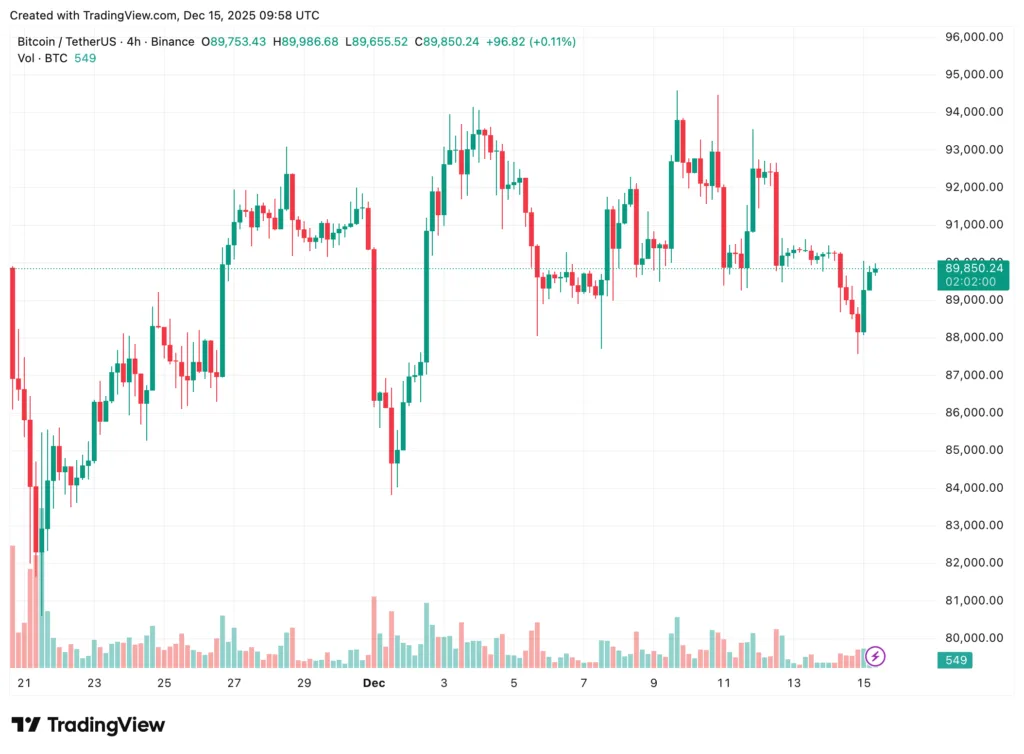
With a slight increase of about 2% over the previous day, Bitcoin is trading close to the $91,500 mark as of December 8, 2025. This rebound comes after a turbulent weekend session in which Bitcoin briefly fell below $88,000 before quickly regaining the $91K level. Even though the price is still around 27% below the all-time high of over $126,200 that was reached in early October, Bitcoin has had a structurally solid year-to-date performance and is still the major anchor of the digital asset market.
The market has entered a more cautious consolidation phase as a result of the recent decline from the $93K–$95K range, which has tempered the euphoria that marked late Q3 and early Q4. This cooling is indicative of digesting following an explosive rally rather than necessarily being bearish. The $88,000–$90,000 range, which has been widely recognized as a crucial support level, is being keenly watched by market participants. This zone corresponds with a historically active demand region from earlier in the year and the 0.382 Fibonacci retracement of the 2025 bull rally. Buyers have so far continuously intervened anytime the price dropped below $90K, supporting the
The market is still struggling with uncertainty, as evidenced by the high intraday volatility. BTC fluctuated between roughly $87,800 and $91,740 in only the last day. These abrupt fluctuations show a struggle between opportunistic buyers building on weakness and cautious sellers reducing exposure. Despite this volatility, the market value of Bitcoin is still over $1.8 trillion, or roughly 57% of the total domination of the cryptocurrency industry. This dominance demonstrates Bitcoin’s ongoing position as the cryptocurrency ecosystem’s preferred store of value, especially during times of risk recalibration.

The general tone of the Bitcoin market is best characterized as cautiously hopeful. The asset has not broken its structural uptrend, but it is no longer in euphoric price discovery mode. Rather, Bitcoin is consolidating at historically high levels, which might eventually fortify the groundwork for the subsequent directional shift.
Technical structure
Technically speaking, Bitcoin is in a precarious balance between continuance and correction. The main uptrend continues on longer time periods, and weekly charts continue to show higher lows. However, caution has been added to short- and medium-term signals due to the strong retreat from October’s top. Right now, Bitcoin is slightly above its 0.382 Fibonacci retracement, a technically important mark that frequently serves as a boundary between deeper pullbacks and shallow corrections.
The technical narrative would be significantly changed by a decisive daily close below the $88K range, which may confirm a bearish reversal pattern and expose Bitcoin to a deeper fall toward the mid-$70Ks, an area linked to the April consolidation zone. On the other hand, the overall structure supports consolidation over collapse as long as BTC stays above this support.
Importantly, on-chain liquidation data indicates that a break above $93K could trigger a cascade of short liquidations, with estimates indicating more than $700 million in short positions vulnerable above that threshold. Such a move could quickly accelerate upside momentum through forced buying. On the upside, immediate resistance is clustered between $93,000 and $95,000. This zone capped multiple rebound attempts over the past week and now represents a key battleground.
The picture painted by momentum indicators is varied but getting better. The daily RSI does not indicate an overbought or oversold situation; it stays in neutral region. During the decline from $95K to $88K, the MACD recently displayed a bearish crossover, indicating a slowing upward momentum. However, as the price stabilizes, the histogram has started to turn higher once more. This slight change implies that selling pressure is decreasing rather than increasing.
Sharp wicks and range-bound behavior have been the hallmarks of price activity during the previous week, especially during weekend sessions with minimal liquidity. These actions seem more in line with leverage flushes than with natural trend reversals. The quick rebound from Sunday’s decline below $88K supports the notion that institutional and algorithmic buyers are actively defending important levels.
In conclusion, Bitcoin’s technical stance is still cautious but constructive. The crucial turning point is shown by the $88K area. While a prolonged advance over $93K would probably rekindle positive momentum and restore confidence in the larger upswing, holding above it preserves the consolidation thesis.
Derivatives and positioning
The futures market for bitcoin shows a de-risking and stability phase. Open interest in futures and perpetual swaps decreased somewhat following the late-November collapse, suggesting that traders cut back on leverage rather than aggressively increasing directional bets. The market is now fundamentally sound as a result of this decrease in leverage, which has assisted in reducing immediate systemic risk.
Low liquidity can magnify swings, eliminating both longs and shorts in a matter of hours, as demonstrated by the weekend’s dramatic collapse and return. A dense cluster of short stop-losses at $93K is visible in data from on-chain analytics systems, supporting the notion that any breakout through resistance could result in a quick short squeeze.
After momentarily becoming negative during the $88K decline, funding rates in the main perpetual markets have returned to almost neutral. When neither longs nor shorts are willing to pay a premium, the market is in balance, which is reflected in neutral funding. This indicates hesitancy, but it also suggests that many traders might be unprepared for a strong move in either way.
Implied volatility in options markets is currently comparatively compressed. This indicates that options traders are pricing in near-term calm and stands in stark contrast to the realized volatility observed over the previous week. Large directional shifts have historically been preceded by such volatility compression because complacency develops before being upended by a catalyst.
Another level of complexity is added by whale behavior. Increased exchange inflows in November indicate that some major holders took profits in the $95K–$100K range. These flows have subsequently stabilized, though, and there is little sign that long-term investors are continuing to distribute. The put/call ratio is still somewhat above one, which is more in line with a hedging-focused market than an outright negative stance.
The derivatives measures for Bitcoin show a coiled market overall. Volatility expectations are low, positioning is balanced, and leverage has decreased. Once a catalyst appears, this combination frequently precedes abrupt changes, rendering the current equilibrium intrinsically unstable.
On-chain and ecosystem activity
Despite recent price pullback, Bitcoin’s on-chain fundamentals are still strong. Daily transactions and active addresses are close to multi-month highs, indicating consistent network activity. This consistent use shows that the health of the Bitcoin network is not declining in tandem with price fluctuation.
A notable contributor to on-chain activity is the continued evolution of the Ordinals and BRC-20 ecosystem. These innovations have expanded Bitcoin’s block space utility beyond simple value transfers, driving renewed interest and transaction volume. While fee spikes occurred during periods of heightened volatility, median transaction fees remain manageable, indicating sufficient network capacity.
Metrics from mining are very promising. The hash rate of Bitcoin has hit new all-time highs, and mining difficulty keeps rising. Strong miner confidence and investment in network security are indicated by these patterns. There is minimal sign of miner capitulation, and public mining businesses are claiming strong profitability with Bitcoin in the $90K range. In actuality, a lot of miners seem to be buying instead of selling, which lessens the incentive to sell in the near future.
The story is further reinforced by advances in institutions and ecosystems. Adoption of the Lightning Network is still expanding, especially in areas like Africa and Latin America where it is being utilized more and more for micropayments and remittances. In addition to its store-of-value function, this subtle growth strengthens Bitcoin’s usefulness as a settlement layer.
Data on whale accumulation is still encouraging. Since Q3 2025, wallets with more than 1,000 BTC have generally continued to grow, buying into declines rather than distributing. This indicates that long-term conviction is still present.
When combined, Bitcoin’s ecosystem and on-chain metrics show underlying strength. The idea that the recent consolidation is a market reset rather than a fundamental decline is supported by the fact that network utilization, miner confidence, and long-term holder behavior are still mostly unrelated to short-term price swings.
Macro alignment
The macroenvironment for bitcoin is mixed but becoming more favorable. With markets pricing in at least one rate cut in the near future, expectations of monetary easing in 2026 have boosted risk assets in the second half of 2025. This change has helped Bitcoin, which frequently trades in line with broader risk sentiment.
Short-term sensitivity to Federal Reserve communications is still very high, though. Excitement has frequently been muted by hawkish tones or data-dependent caution, as demonstrated when Bitcoin retreated from close to $100K in response to more circumspect Fed communications. This demonstrates Bitcoin’s dual nature as a macro hedge and a risk asset.
Conditions related to liquidity are also crucial. Spot trade volumes are declining annually, especially around year-end, which intensifies price responses to macro news. Short-term challenges could include a sharp decline in the value of the US dollar or an abrupt sell-off in the stock market, but improving financial circumstances would probably rekindle the upward trend.
The outlook is still positive in the medium term. The idea that Bitcoin is a non-sovereign store of value is nonetheless supported by ongoing worries about inflation and anticipations of future easing. Bitcoin is in a strong position to continue its upward trend if macro conditions stabilize and liquidity improves in early 2026.
Investor psychology
Since the highs in October, investor sentiment has significantly changed. Sentiment indicators moved into dread area as a result of the market’s strong decline from $126K to the upper $80Ks. Profit-taking and persistent doubt about whether the surge can continue are both reflected in this change.
Consolidation is seen as a healthy pause by long-term holders, who are largely unaffected. Newer entrants and leveraged traders, on the other hand, show more anxiety, reducing their exposure and waiting for more precise signals. The $100K milestone has a significant psychological impact, and the inability to firmly recapture it has encouraged reluctance.
Sentiment is further complicated by whale behavior. While some regard subsequent accumulation as confirmation of long-term bullish confidence, others view profit-taking by major holdings close to the highs as smart money caution. Range-bound trading and erratic price movement are caused by this divergence.
In general, the best way to characterize Bitcoin psychology is as cautiously optimistic. Euphoria has given way to fear, but there is no panic. This emotional reset frequently comes before more long-lasting trends, indicating that once conviction recovers, the following action may be significant.
Forward-looking outlook
The short-term prospects of Bitcoin depend on its capacity to hold onto important support and recover resistance. Continued consolidation above $88K, followed by a breakout over $95K, might rekindle momentum toward $100K and higher in a bullish scenario. Short liquidations and fresh institutional interest would probably intensify such a move.
In a more balanced situation, Bitcoin would be between $85K and $100K until early 2026 as it builds a base and absorbs gains. This wouldn’t be harmful and might pave the way for a stronger rally after the halving.
There are still bearish concerns, especially if support levels fail or macro conditions worsen. Although such levels would probably draw significant long-term buying interest, a break below $85K would pave the way for a deeper decline toward the mid-$70Ks.
All things considered, Bitcoin’s trend is still upward-biased but demands patience. Leverage has reset, the market has cooled, and the fundamentals are still solid. Rather than internal weakness, economic drivers and liquidity conditions will probably drive the next big decision.
Ethereum (ETH) – market overview and technical structure
Market overview
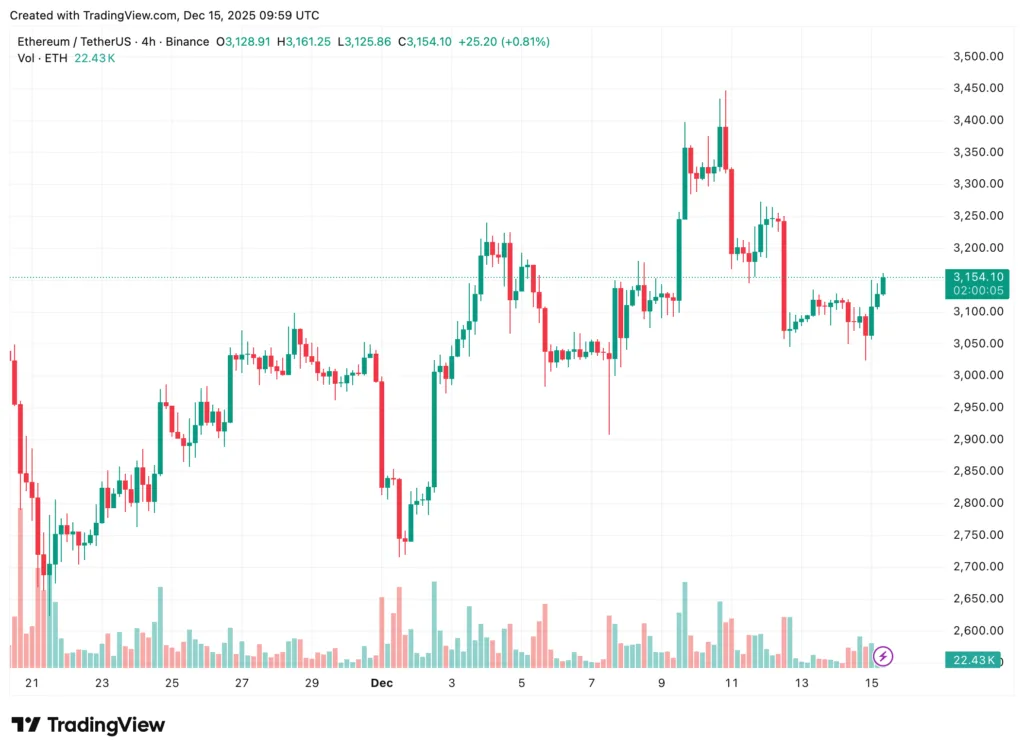
As of December 8, 2025, Ethereum is trading close to $3,130, showing a slight recovery following a period of volatility during which the currency momentarily dropped below the psychologically significant $3,000 mark. Even if ETH has increased by about 3% in the last day, its overall market position is still softer than that of Bitcoin, which is a result of both recent volatility brought on by liquidations and a persistent shift in capital toward BTC in the latter part of 2025.
Recently, there was a dramatic but controlled decline. Over the weekend, Ethereum fell to $2,900, its lowest point in almost two months, before swiftly rising back above $3,100. This quick recovery shows that, despite increased sensitivity to leverage flushes, the market is still structurally supported. ETH has underperformed Bitcoin over the most recent leg of the cycle, as evidenced by the fact that it is still about 37% below its all-time high of $4,954, which was attained in August 2025.
With a market capitalization of around $377 billion, Ethereum makes up about 12% of the entire cryptocurrency market. Ethereum is still the foundation of decentralized finance, NFTs, and smart contract settlement, even though its dominance has slightly decreased as Bitcoin’s share has grown. After a robust but erratic run earlier in the year, the current consolidation phase shows a recalibration of expectations rather than a loss of relevance.
ETH has been trading between roughly $2,930 and $3,150 over the past 24 hours, indicating that intraday volatility is still high. As traders cut leverage and wait for more precise macro and technical signals, these wide ranges reflect decreasing liquidity and cautious positioning approaching year-end. The general mood of the Ethereum market may be characterized as positive yet cautious, with buyers holding onto important levels while waiting for proof that the downward impetus has completely subsided.
Technical structure
Technically speaking, Ethereum is trying to establish a foundation after a significant correction. Although the market’s quick defense of the $2,900 region helped sustain the structure, the $3,000 drop momentarily changed mood. This region has technical significance because it is close to the 100-day moving average and corresponds with previous demand zones from earlier in 2025.
Since then, ETH has returned to the $3,100 mark, although there is still significant overhead resistance. The 50-day moving average and the lower edge of a falling channel that has directed price movement since the August top converge in the $3,150–$3,200 range. The first significant trend reversal indication would be a persistent daily close above this area, which might pave the way for the $3,300–$3,400 level.
Momentum signs point to a possible improvement. Relief purchasing rather than fresh positive momentum is indicated by the daily RSI’s recovery from oversold circumstances into the mid-40s. After weeks of negative readings, the MACD histogram has started to turn slightly positive, suggesting that if price can keep rising, there may be a momentum inflection.
On the downside, ETH would be exposed to deeper Fibonacci retracement levels if it failed to hold above $2,900, with $2,700 appearing as the next significant support. But for the time being, it seems like the market is creating a stabilizing range between about $2,900 and $3,300.
One important intermarket indicator is still the ETH/BTC ratio. The pair is trading close to multi-month support at 0.034 BTC per ETH. Further weakness would imply sustained dominance of Bitcoin, while stabilization or reversal here would probably indicate capital rotation back into Ethereum and other altcoins.
Derivatives and positioning
During the recent sell-off, Ethereum’s derivatives markets underwent a significant reset. The most well-known incident was a well-publicized whale liquidation that was set off when ETH fell below $3,000, causing forced sales and quickening the downward trend. Crucially, the same individual is said to have quickly reestablished long exposure, demonstrating the erratic nature of leveraged strategy as well as the enduring confidence of some major players.
During the liquidation cascade, open interest in all ETH futures fell precipitously, indicating a general deleveraging rather than a change to aggressive short stance. Open interest has started to steadily grow after the recovery, indicating that traders are re-entering positions with greater care than previously.
During the sell-off, funding rates for all perpetual contracts momentarily went negative, indicating forced long exits and short-term pessimism. Since then, these rates have returned to normal, suggesting a more balanced market. Put demand is higher than call demand in options markets, which is more indicative of a hedging-focused climate than of outright pessimism.
CME During the slump, Ethereum futures, which frequently mirror institutional sentiment, had a temporary decline but have since leveled off. Although confidence is still fragile, this normalization indicates that downside expectations are diminishing.
All things considered, Ethereum’s derivatives market indicates that excess leverage has been flushed and that positioning is currently being rebuilt from a cleaner basis. This dynamic makes subsequent directional moves more solid and lowers the possibility of immediate cascading liquidations.
On-chain and ecosystem activity
The on-chain fundamentals of Ethereum are still strong and are diverging favorably from the current decline in price. With daily transaction counts often surpassing one million and active addresses remaining close to multi-month highs, network activity is still high. Ethereum’s position as the preferred settlement layer during times of market stress was strengthened by volatility-driven surges in DeFi and stablecoin transfers.
The network’s resiliency and the efficacy of post-Merge modifications were demonstrated by the gas fees, which briefly increased during peak volatility but rapidly returned to normal. Crucially, periods of high fees led to a decline in the net ETH supply, which strengthened Ethereum’s deflationary dynamics when usage was strong.
Adoption of Layer-2 is still a key factor in growth. Rollups that increase Ethereum’s effective throughput while attaching value back to the main chain, including Arbitrum, Optimism, and zkSync, continue to achieve record usage. Even if activity moves off the mainnet, Ethereum’s long-term value capture is strengthened by this ecosystem dynamic.
With more than 28 million ETH locked, or about 23% of the entire supply, staking participation is still growing. During the current decline, net staking inflows indicate that long-term holders increased their exposure instead of leaving due to market weakness.
Development momentum is still robust, and Ethereum’s roadmap credibility is strengthened by advancements toward the Dencun upgrade and proto-danksharding. Tokenized bonds and settlement pilots are examples of institutional experimentation that strengthens Ethereum’s relevance outside of crypto-native use cases.
Macro alignment
Ethereum frequently acts as a high-beta proxy for risk appetite and is still quite vulnerable to macro liquidity conditions. ETH’s medium-term prognosis is supported by expectations of additional rate decreases, but near-term market behavior is still dependent on Federal Reserve message and attitude regarding global risk.
Additionally, regulatory factors are quite important. While Ethereum’s staking scheme creates legal ambiguity that occasionally affects sentiment, Bitcoin benefits more and more from commodity-like treatment. But the expectation of a future location A counterbalancing story is offered by ETH ETF, especially to institutional allocators.
Ethereum stands to gain from capital rotation into higher-beta assets if macro conditions stabilize and Bitcoin’s dominance plateaus. In the past, ETH has performed better when BTC consolidates following significant runs; this pattern may resurface in early 2026.
Investor psychology
Investor opinion in Ethereum is guarded yet cautiously bullish. Longtime supporters continue to have faith in Ethereum’s economic and technological underpinnings, especially its deflationary issuance and leadership in smart contract architecture. However, short-term traders are still cautious due to recent volatility and poor performance in comparison to Bitcoin.
The market is definitely in the “prove it” stage. While failing to regain important levels could prolong hesitancy, sustained price acceptance over $3,200 would probably rekindle confidence. A stabilizing psychological anchor that lessens reflexive selling pressure during drawdowns is provided by stakers, who are increasingly focused on yield accumulation.
Forward-looking outlook
Ethereum has a positive yet uncertain future. A persistent break above $3,200 would indicate a reversal in the trend and pave the way for $3,500 and possibly $4,000 if general market conditions improve. In the worst-case scenario, ETH would steadily regain momentum by trading between $2,900 and $3,600 until early 2026.
If macro conditions worsen or Bitcoin resumes dominance-driven outperformance, there is still downside risk. Staking dynamics, institutional interest, and solid on-chain fundamentals, however, indicate that Ethereum’s long-term trajectory is still intact.
Solana (SOL) – market overview and technical structure
Market overview
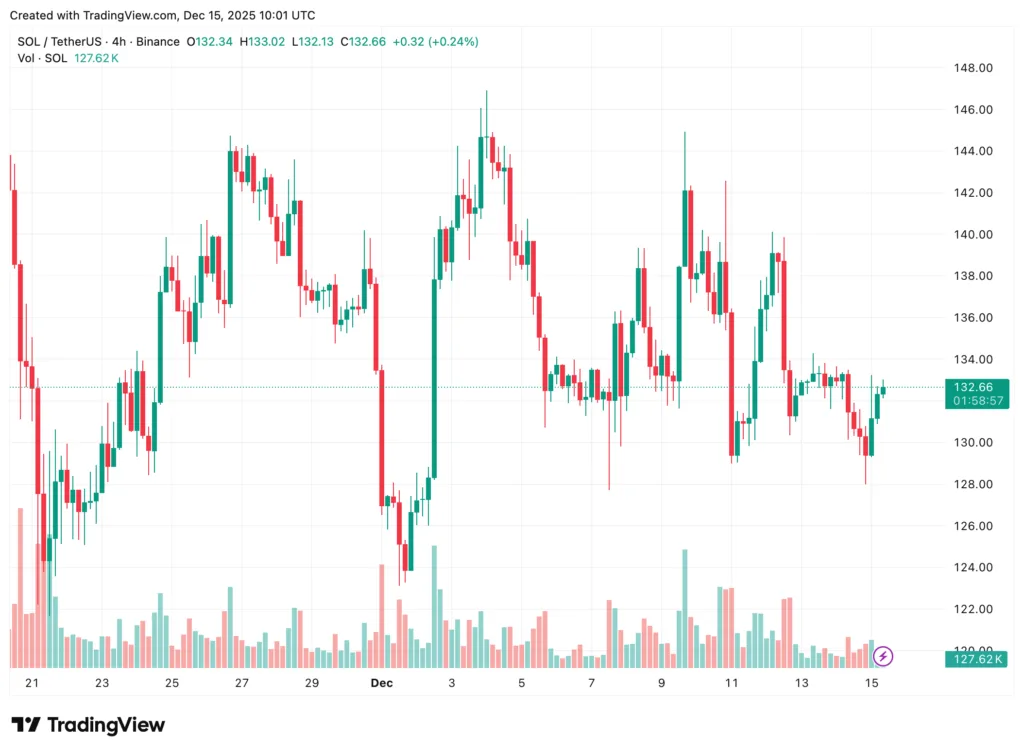
As of December 8, 2025, Solana is trading close to $135, showing a slight daily recovery after a period of increased volatility among digital assets. SOL’s recent price behavior has made it one of the most robust large-cap altcoins during the current consolidation phase, even if it is still far behind its January all-time high of $294. During the late November drop, Solana held structural support in the low-$130s and recovered with relative speed, in contrast to many mid-cap assets that broke sharply to new local lows.
With a market valuation of over $75–76 billion, Solana is still regarded as one of the best cryptocurrency assets and continues to draw interest from both institutional and individual investors. Since the ecosystem has mostly recovered from the reputational harm caused by the 2022–2023 period, the narrative around SOL in late 2025 is noticeably more positive than in previous years. Increased institutional access, a growing developer community, and improved network reliability have all combined to change the market’s opinion of Solana, turning it from a high-throughput, speculative experiment into a reliable smart contract settlement layer.
Instead of speculative enthusiasm, recent market activity displays careful accumulation. During general market weakness, SOL fell around $128 before rising toward the mid-$130s, suggesting the presence of responsive dip-buyers. This pattern indicates that longer-term holders’ belief is still strong even though their enthusiasm has diminished from earlier in the year. This opinion has been further supported by institutional movements, which indicate a gradual reallocation of capital back into higher-beta layer-1 assets after weeks of withdrawals into Solana-linked financial products.
All things considered, Solana’s market stance is best characterized as cautiously constructive. The asset has not surrendered, but it is no longer in a momentum-driven expansion phase. SOL, on the other hand, seems to be stabilizing within a higher range, setting itself up for possible continuation should overall market conditions improve.
Technical structure
From a technical perspective, Solana is trying to move from consolidation to a fresh upswing. Price has consistently defended the $132–$134 range, which is characterized by historical pivot activity, short-term moving averages, and the Fibonacci retracement confluence. SOL was able to break above a short-term declining trendline that had limited price activity since mid-November thanks to this crucial defense.
The technical bias changed from neutral to modestly optimistic when this trendline was successfully breached, indicating an improvement in short-term momentum. Momentum indicators have reacted appropriately, with MACD turning positive on shorter time frames and RSI holding levels above oversold territory during the decline. These indicators point to a significant weakening rather than an intensification of bearish trend.
The $140–$142 range, where previous supply appeared and Fibonacci retracement levels converge, is where immediate resistance is centered. The next significant technical challenge is this area. A clear closing above it would probably pave the way for $150, which is also in line with the 50-day moving average and is a psychologically significant level. After that, the $160–$180 range comes into play as higher-timeframe resistance and a crucial retracement of Solana’s drop from its peak.
On the down side, SOL would be exposed to the $125–$128 range, which has historically seen high demand, if acceptance was not maintained above $130. The positive technical thesis would be undermined by a breach below this area, which might also indicate a return to range-bound or corrective action. However, price structure now favors upside optionality and stabilization over breakdown.
Derivatives and positioning
After the de-risking period in late November, Solana’s derivatives markets show a slow recovery of confidence. During the overall market collapse, open interest in perpetual futures significantly decreased, suggesting that speculative leverage was decreased rather than reversed into aggressive short exposure. Open interest has started to rise again after the recovery, indicating that traders are reentering positions more cautiously.
The story that funding rates convey is complementary. Funding momentarily went negative during the decline, indicating short-term hedging or bearish stance. Funding turned back to slightly positive as the price stabilized and recovered, indicating a restoration of long bias without reaching levels suggestive of overheating.
Options markets exhibit a slight bias toward calls, especially at strikes above $150, despite being less liquid than those of Bitcoin or Ethereum. This posture indicates that traders are starting to price in positive outcomes while remaining cautious. Crucially, the market is not yet pricing in explosive changes because implied volatility has not increased enough.
Additional complexity is added by institutional positioning. Some larger allocators may see the current consolidation as a chance to re-establish exposure rather than a departure signal, as seen by renewed inflows into Solana-focused funds and ETPs. There is less chance of destabilizing liquidation cascades in the foreseeable future because overall leverage is still moderate.
On-chain and ecosystem activity
One of Solana’s greatest differentiators is still its on-chain principles. Tens of millions of transactions are still processed by the network every day, fueled by activity from DeFi, NFTs, gaming, and new social applications. Solana’s network performance has been remarkably constant throughout 2025, which has greatly increased its credibility among developers and consumers in contrast to previous cycles where high throughput was coupled by instability.
After the previous years’ environmental upheavals, DeFi activity on Solana has continued to rebuild. While NFT marketplaces continue to interact consistently, liquidity has progressively returned to decentralized exchanges and lending protocols. Use cases that are not feasible on more costly layer-1 chains are supported by the network’s extremely low transaction costs, which promote high-frequency interaction.
With more over 70% of SOL in circulation locked, staking activity is still very high. This dynamic strengthens the existence of long-term holders and decreases effective float. Hackathons, grants, and an expanding infrastructure tool ecosystem all contribute to the continued strength of developer activity.
A narrative change from speculative chain to scalable infrastructure is being facilitated by institutional experimentation with Solana-based applications. Solana’s long-term value proposition is strengthened by these changes, even though they are not immediately reflected in price.
Macro alignment
Solana is especially vulnerable to macro liquidity situations because it is a high-beta asset. While tightening conditions or a resurgence of risk aversion would put SOL under disproportionate pressure in comparison to Bitcoin, expectations of monetary easing and improved risk sentiment favor its medium-term prognosis.
Although the market seems to be discounting worst-case situations more aggressively than in previous years, regulatory uncertainty is still an external issue. The asset’s legitimacy within institutional frameworks is further enhanced by the introduction of regulated Solana investment vehicles.
Investor psychology
The way that investors see Solana has changed dramatically. While current price resiliency has bolstered confidence, survivorship through previous crises has produced a more resilient and devoted community. But enthusiasm is nevertheless restrained, reflecting the lessons that have been learned from previous turbulence.
Forward-looking outlook
Solana has an optimistic yet conditional perspective for the future. Momentum toward $160 and above would probably pick up speed if it were sustained over $140. Even if volatility is still a given, SOL appears to be in a strong position to continue recovering through 2026 based on strengthening fundamentals, institutional engagement, and network maturity.
XRP – market overview and technical structure
Market overview
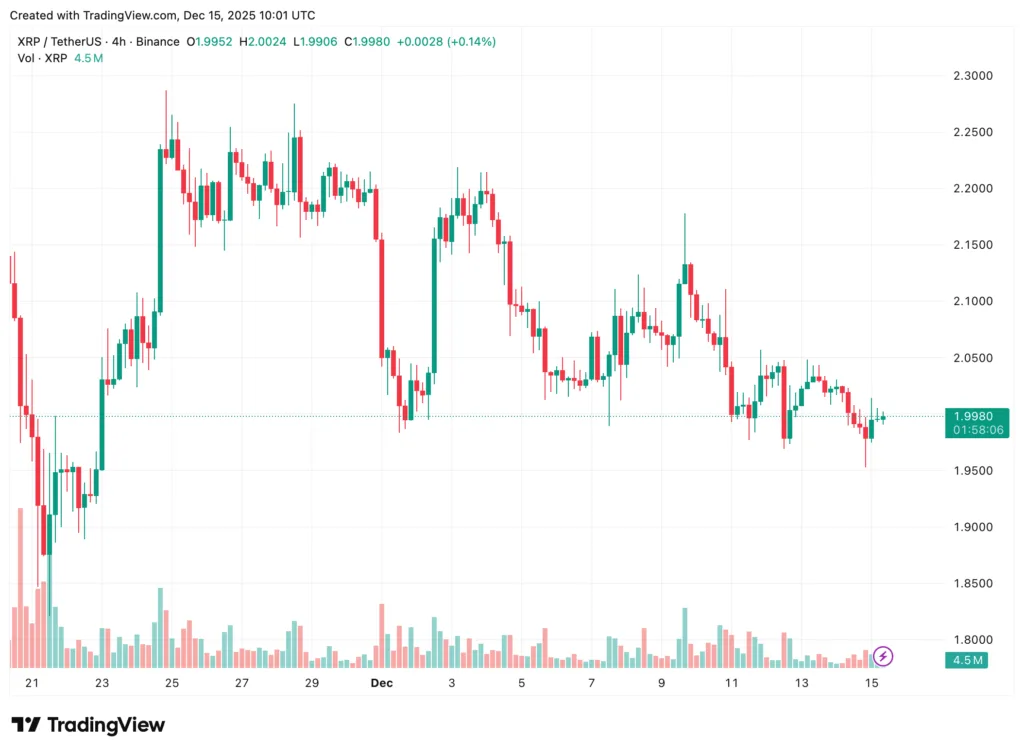
As of December 8, 2025, XRP is trading close to the $2.08 level, stabilizing above the structurally and psychologically significant $2.00 threshold following one of the biggest multi-month rises among large-cap digital assets this year. The appreciation of XRP has been supported by a unique combination of regulatory certainty, restored exchange accessibility, and a quantifiable increase in real-world utility through Ripple’s worldwide payments infrastructure, in contrast to many altcoins whose 2025 rises were mainly momentum-driven.
XRP has solidified its position as one of the most systemically significant digital assets, with a market capitalization of more than $120 billion. Both speculative interest and growing confidence in its function as a settlement and liquidity bridging asset are reflected in its present pricing. The market’s readiness to defend prices over $2.00 indicates a structural change in long-term perspective as this level has moved from resistance to a basic support zone.
Following a strong run that propelled XRP from sub-$1 levels earlier in the year to highs around $2.30, there has been a recent spell of consolidation. Profit-taking and volatility were inevitably brought about by such a quick repricing, but the downturn has been quite orderly. Instead of collapsing, the price has stabilized, suggesting that tactical repositioning rather than structural distribution has been the primary source of selling pressure. This characteristic sets the present phase of XRP apart from previous cycles, in which high rallies were frequently followed by similarly sharp reversals.
The liquidity situation surrounding XRP is still strong. Although spot volumes have returned to their peak levels, they still surpass long-term averages, indicating ongoing market participation. Significantly, XRP’s significant liquidity in both centralized and decentralized venues has reinforced its appropriateness for cross-border and institutional use cases.
Overall, XRP’s market posture can be described as consolidative but constructive. The asset is digesting substantial gains while maintaining elevated valuation levels, a dynamic that often precedes either continuation or extended range-building depending on broader market alignment.
Technical structure
Despite its recent decline, XRP maintains a structurally positive position from a technical perspective. The drop from the $2.30 area did not go against longer-term trend markers and respected important Fibonacci retracement levels. In line with previous consolidation areas and short-term moving averages, the $2.00–$2.10 range has frequently served as a demand zone.
The idea that the larger uptrend is still in place is supported by the daily chart’s persistence of higher lows. Although muted throughout the consolidation, momentum indicators are starting to stabilize. It appears that selling pressure has lessened rather than increased as the daily RSI has recovered from lower readings into neutral territory. In the meantime, MACD momentum seems to be flattening, which is frequently a sign that a trend will continue if volume supports it.
The next significant resistance zone on the upside is the $2.20–$2.25 range. This region represents the point where sellers previously claimed control and is in line with the upper limit of the current consolidation range. The way toward $2.50 and the psychologically important $3.00 level, where historical resistance becomes more noticeable, would likely be opened by a clear break above this zone, confirming the trend’s continuation.
As long as XRP stays over $2.00, downside danger is limited. Given XRP’s better fundamental backdrop, a sustained breach below this level would undermine the bullish thesis and expose the asset to a deeper regression toward $1.80, albeit such a move would probably face renewed demand.
Derivatives and positioning
After the dramatic surge earlier in the year, XRP’s futures markets have experienced a significant stabilization. Open interest increased quickly with the rise to $2.30, indicating increased speculative activity. Open interest fell together with price consolidation, indicating a decrease in leverage rather than an aggressive accumulation of short exposure.
In a balanced market where neither longs nor shorts are dominant, funding rates across perpetual contracts have stabilized close to neutral. This equilibrium implies that future price movements will be more influenced by spot demand and fundamental drivers than by leveraged positioning and lowers the likelihood of near-term liquidation cascades.
A complex positioning profile is revealed by options markets. There has been a discernible rise in open interest at higher strike prices, especially in the $2.50–$3.00 area, even though near-term hedging activity is still visible. This skew suggests that market players are selectively positioned for medium-term positive continuation while preserving downside protection.
Although less obvious than in BTC or ETH derivatives, institutional engagement seems to be growing through OTC flows and structured products. Professional allocators now have easier access to XRP due to its mature regulatory status, which has slightly changed the makeup of its derivatives market.
On-chain and ecosystem activity
The asset’s unique value proposition is strengthened by XRP’s on-chain and ecosystem properties. Transaction statistics on the XRP Ledger show continuous usage rather than speculative spikes. This stability highlights XRPL’s function as an operational settlement network as opposed to a purely speculative platform.
Adoption of RippleNet has increased in a number of corridors, especially in areas where efficient cross-border payments continue to be a major problem. A greater dependence on XRP as a bridge asset in actual payment transactions is indicated by the rise in on-demand liquidity volumes. A fundamental layer of support that is less susceptible to the mood of the market in the short term is provided by this functional demand.
By providing more liquidity and bolstering the ledger’s significance in stablecoin-driven settlement frameworks, the launch and expansion of RLUSD has further improved XRPL’s ecosystem. Crucially, XRP’s monthly escrow releases have persisted without interfering with the market, indicating that supply dynamics are adequately absorbed given the state of demand.
The technological features of XRPL, such as quick settlement, cheap costs, and excellent dependability, continue to be key differentiators. These characteristics put XRP in a favorable position as organizations and payment processors place a higher priority on operational effectiveness and regulatory clarity.
Macro alignment
The macro alignment of XRP differs slightly from that of altcoins that are only used for speculation. Its utility-driven demand adds a layer of protection against macro volatility, even though it is still susceptible to broader risk sentiment. Its medium-term outlook is supported by anticipated improvements in global payment digitalization and financial conditions.
One important macro catalyst is still regulatory certainty. The potential market for XRP grows as legal ambiguities continue to fade, enabling more institutions who were previously excluded due to compliance issues to participate. The market behavior of XRP may progressively change from that of a high-beta speculative instrument to that of a utility-anchored digital asset as a result of this dynamic.
Investor psychology
The way that investors see XRP has changed significantly. Strong conviction is displayed by long-term holders who experienced years of legal ambiguity; they see recent successes as confirmation rather than a conclusion. Newer players, on the other hand, take a more disciplined approach to the asset, striking a balance between optimism and past volatility.
Confidence has been bolstered by the market’s capacity to tolerate profit-taking without fundamental collapse. The current sentiment is one of cautious consolidation rather than surrender, with investors waiting for confirmation of the next course of action.
Forward-looking outlook
The future prospects for XRP are still promising. Sustained acceptance above $2.20 would probably rekindle momentum toward $2.50 and possibly $3.00, especially if favorable macro conditions and ongoing ecosystem growth are present. XRP’s improving fundamentals and regulatory positioning indicate that its long-term trajectory remains upward-biased into 2026, despite the fact that volatility is still inherent.
Cardano (ADA) – market overview and technical structure
Market overview
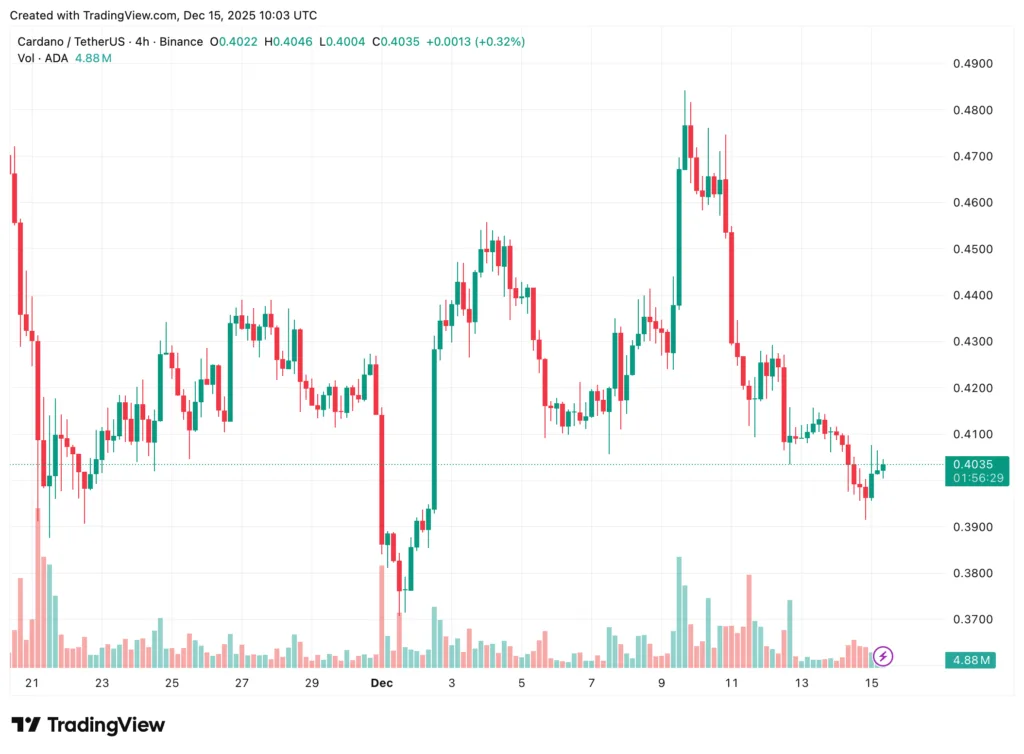
As of December 8, 2025, Cardano is trading close to $0.43 in an effort to stabilize following a protracted period of relative underperformance in the digital asset market. Signs of structural stability have started to appear after a protracted slump, even though ADA is still much below its historical all-time high and has trailed rivals like Solana and Ethereum in recent quarters.
Although slower ecosystem monetization and capital rotation into faster-growing networks have challenged market perception, Cardano, with a market value close to $15 billion, continues to be relevant as one of the most established layer-1 platforms. However, short-term mood has improved as a result of the recent defense of the $0.40 level, which implies that selling pressure may be nearing exhaustion.
Interest has increased as a result of the launch of new ecosystem efforts, most notably the Midnight privacy sidechain. These advancements have strengthened Cardano’s story as a steadily developing platform with a long-term goal rather than a speculative short-term play, even though they have not yet resulted in spectacular on-chain growth.
ADA’s liquidity situation is still moderate. The lack of panic selling indicates that the market is approaching a basing phase rather than a capitulation phase, however spot volumes remain muted in comparison to peak cycle levels, indicating cautious participation.
Technical structure
Technically speaking, Cardano is just beginning to try a structural reversal. Although there is still little proof, the break above a long-term declining trendline earlier in December indicated a possible change in momentum. Since then, price movement has stabilized above $0.40, which is currently a crucial support level.
Indicators of momentum have started to get better. While the MACD has somewhat improved, suggesting a possible trend inflection, the daily RSI has recovered from oversold position, indicating less selling pressure. These signals are still brittle, though, and they need to be confirmed by consistent price acceptance.
Multiple moving averages and past supply zones converge between $0.45 and $0.50, which is where overhead resistance is focused. A significant technical milestone would be reached if there was a clear break above this area, paving the way for $0.55–$0.60 and possibly higher retracement levels. Range-bound behavior would probably persist if this barrier could not be overcome.
If $0.40 fails, there is still downside risk. A break below this threshold would expose ADA to fresh selling pressure and weaken the emerging stability argument. However, purchasers seem prepared to defend this area for the time being.
Derivatives and positioning
The derivatives markets on Cardano show a comparatively tidy positioning environment. Over the past few months, open interest has significantly decreased, suggesting that speculative leverage has mostly been removed from the system. Funding rates for all perpetual contracts are almost neutral, indicating a lack of directional confidence and a balanced attitude.
This lack of leverage highlights the lack of strong speculative activity while also lowering the probability of sudden liquidation-driven actions. Therefore, spot accumulation and fundamental events are more likely to be the cause of any long-term trend reversal in ADA than leveraged momentum.
By lowering the circulating supply, high stake participation further reduces volatility. Although this dynamic promotes price stability, it may also restrict upside responsiveness when interest is revived.
On-chain and ecosystem activity
Cardano’s on-chain operations are nevertheless making steady progress. Because of Cardano’s strong academic and research-driven culture, developer involvement is still among the greatest in the industry. It is still difficult to convert this development activity into user adoption and revenue generating, though.
Cardano’s DeFi activity has gradually increased, and the total value locked has stabilized following previous drops. In comparison to ecosystems that move more quickly, NFT activity is still there but muted. The introduction of the Midnight sidechain is a calculated move toward privacy-focused use cases, and if it is executed well, it may create new avenues for adoption.
With a significant amount of supply locked, staking continues to be a defining characteristic of Cardano’s ecosystem. Although it may also lead to slower capital rotation dynamics, this long-term focus increases community loyalty and lowers speculative turnover.
Macro alignment
The macro alignment of Cardano prioritizes long-term, patient capital over short-term speculative flows. ADA might profit from increased interest in underperforming assets in a risk-taking climate with plenty of liquidity. Tightening conditions, on the other hand, would probably continue its relative underperformance.
Institutions looking for less governance risk may find Cardano’s regulatory-neutral stance and cautious development strategy appealing, especially as regulatory scrutiny increases throughout the industry.
Investor psychology
Investor sentiment toward ADA is resilient yet cautious. While more general market players take a wait-and-see stance, long-term holders continue to be dedicated to the platform’s objectives. Though confidence will depend on observable ecosystem expansion, recent events have somewhat raised morale.
Forward-looking outlook
Cardano’s future prospects depend on market alignment and execution. In a favorable macroenvironment, a sustained break above $0.50 would greatly enhance technical and psychological mood, possibly opening the door for a recovery toward $0.60–$1.00. ADA maintains optionality as a long-term infrastructure bet rather than a momentum-driven asset, even though improvement may continue to be incremental.