


Bitcoin (BTC) — Compression before confirmation
Market overview
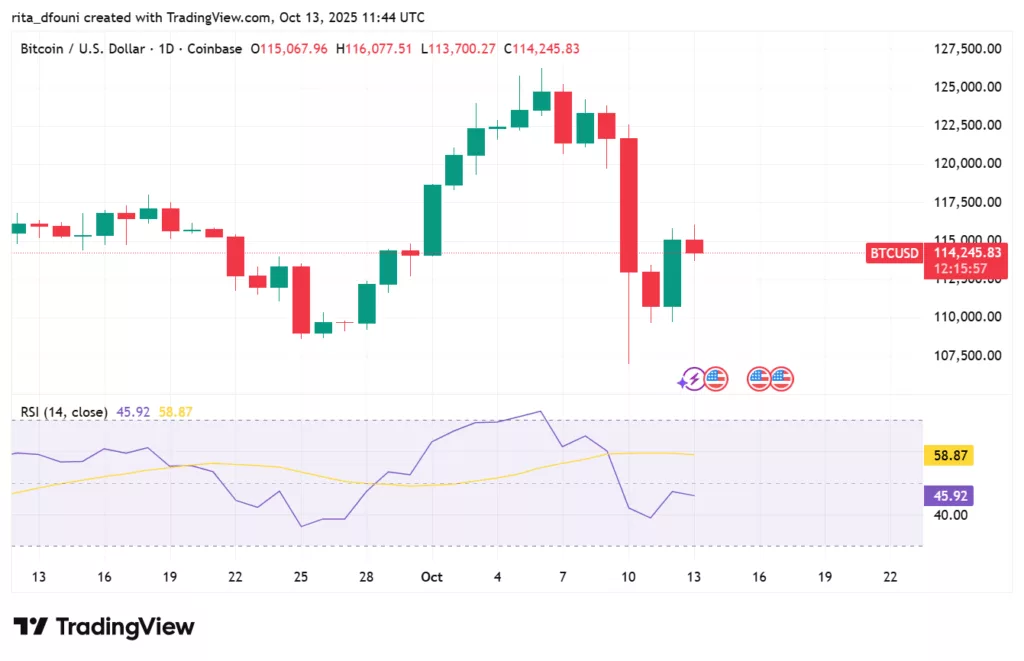
Bitcoin approaches the October 13 session in a typical holding pattern, fluctuating between $111,000 and $113,400, as price compression indicates a forthcoming surge in volatility. Following weeks of lateral trading, BTC maintains an unusually narrow realized volatility band, a pattern frequently occurring before significant price movement.
In spite of worldwide macro upheaval, Bitcoin’s intraday strength has been remarkable. Buyers consistently support levels below $111,000, whereas attempts to rise toward $113,000–$113,400 are continuously met with selling from profit-takers. This range has transformed into a mental battleground, with liquidity accumulating just below the breakout threshold, as derivative indicators suggest that investors are anticipating a “proof of direction” day.
Weekend activity stayed subdued at key locations, yet exchange order books show robust layering of buy orders between $110,800 and $111,200, with sell orders grouped above $113,300. Spot market depth is strong, with the majority of professional desks maintaining neutral net positioning, indicating indecision rather than lack of strength.

Technical structure
BTC’s chart shows a classic coiling triangle pattern, featuring increasingly tighter daily candles as the price consolidates. Support is identified between $110,800 and $111,000, while resistance remains between $113,200 and $113,400. A rise above $113,400 would signify the first clear breakout in almost three weeks, establishing the next technical target around $115,000, then $117,500 and $120,000 as projected goals.
On the other hand, not maintaining $111,000 could lead to a decline to $110,000, followed by $108,800–$109,000, where significant demand was detected in late September. RSI stays around 49, suggesting neutral momentum without any divergence alerts. The alignment of the moving average (50-day smoothing above the 100-day) indicates that compression energy is accumulating.
In terms of volume, turnover stays low, indicating a period of waiting instead of capitulation. When the range is breached, anticipate a spike in directional engagement, as stop clusters and algorithmic triggers are positioned near both limits.
Derivatives & positioning
Perpetual funding rates have returned to nearly zero after last week’s temporary optimistic sentiment diminished. Open interest, which surged to $14.2 billion during the early October attempt, has since leveled off to about $13.5 billion, a robust level that permits growth without over-leverage.
Options flow offers a clear perspective: significant call open interest is concentrated at the $115,000–$120,000 levels, whereas puts are more prevalent near $110,000–$108,000. The options skew is almost level, indicating balanced hedging behavior instead of directional belief. Implied volatility has reduced to around 40%, among the lowest levels observed in months, a situation that typically comes before significant single-day price movements.
On-chain & ecosystem
On-chain metrics continue to be positive. Exchange reserves have decreased slightly, indicating a net buildup. The Coin Days Destroyed metric remains subdued, indicating that long-term holders are not selling. Miner balances reflect small outflows, but there are no signs of financial strain.
In the meantime, wallet activity indicates a rise in medium-sized transactions, suggesting that institutions and larger retail groups are slowly coming back. Network transaction fees stay low, suggesting a lack of speculative excitement, which is a positive sign for accumulation periods.
Macro Alignment
Overall, Bitcoin continues to be linked to the wider liquidity story. The Federal Reserve’s careful shift has boosted risk assets, but bond-market fluctuations maintain a delicate sentiment. The U.S. dollar index (DXY) remains fluctuating around 103, establishing a neutral-to-optimistic environment for BTC in the near term.
Historically, BTC volatility contractions around significant macro events (such as this week’s U.S. CPI release and China’s GDP estimate) frequently culminate in robust directional movement. Institutional investors continue to focus on ETF inflows, which have stabilized without reversing, offering consistent demand trends.
Investor psychology
Investor sentiment is cautiously hopeful yet restrained. Retail traders show signs of exhaustion after weeks of volatility, whereas professional firms retain cash for confirmation trades. The Fear and Greed Index values remain in the “Neutral” territory, a psychologically balanced state that permits growth in both ways.
Traders are identifying this structure across social and derivatives channels as a “calm before the surge.” Historically, BTC’s most extended volatility squeezes during the year frequently lead to directional shifts of 10–15%. Consequently, current market psychology supports patience, looking for confirmation instead of speculation.
Outlook
The guide remains explicit. A daily close exceeding $113,400 validates breakout conditions and probably initiates a short squeeze toward $115,000–$117,500, with $120,000 as the subsequent attractor. If it fails to break and closes below $111,000, BTC will be pushed toward $110,000–$109,000, challenging dip strength.
Ethereum (ETH) — The quiet compression before the catalyst
Market overview
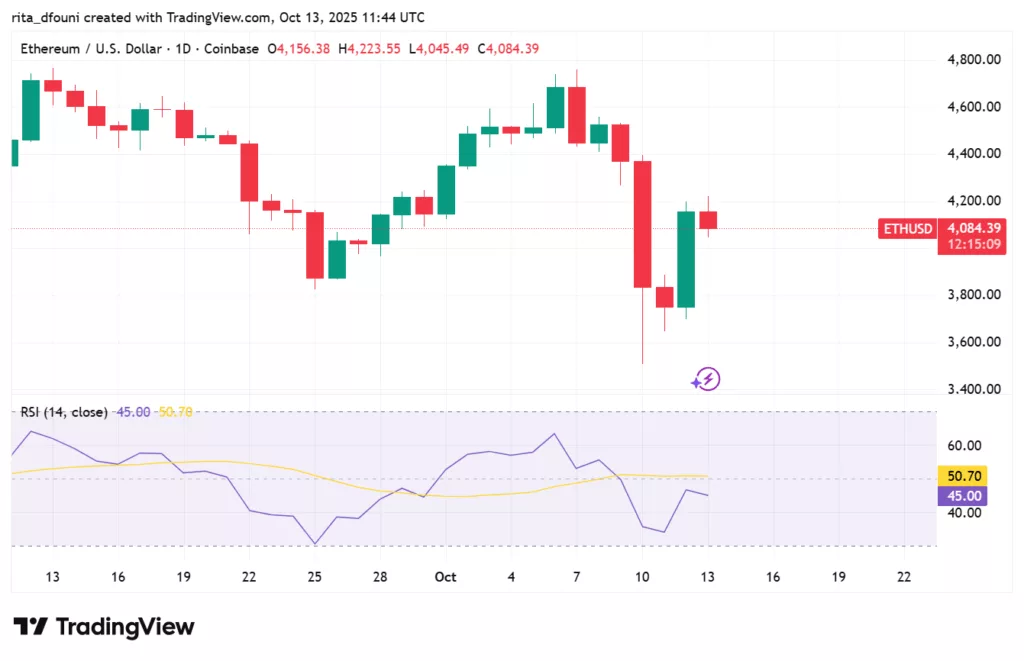
Ethereum starts the new week remaining in the USD 4,300–4,380 range that has characterized trading in October. The duo’s intraday volatility has decreased to one of its narrowest ranges in months, suggesting an increasing balance between leveraged traders and passive buyers.
In the last 72 hours, ETH’s relative strength compared to Bitcoin has eased a bit, yet the rotation flows continue to be measured instead of frantic. Every decline to USD 4,275 attracts buyers, whereas every rise over USD 4,360 encounters automated selling. The balance indicates structural positioning rather than emotional factors; investors are anticipating a macro or on-chain catalyst to warrant increased risk.
Liquidity charts from Binance and Coinbase indicate a rise in cumulative bid density in the USD 4,250–4,280 range, accompanied by a less substantial wall of sell orders above USD 4,400. This pattern is common prior to high-momentum breakouts, as stagnant liquidity serves as both a target and a catalyst when volatility increases.
Technical structure
The daily chart continues to appear technically flawless. Support is at USD 4,275, with the crucial USD 4,200 next and a structural barrier at USD 4,100. Resistance remains strong at USD 4,350–4,380, a level that has been tested numerous times since late September but has never closed above it. A validated daily close past USD 4,380 would represent a structural breakout, paving the path to USD 4,500, USD 4,650, and potentially USD 4,800 through measured-move extension.
Momentum oscillators remain close to balance: RSI ≈ 51, stochastic stabilizing at the midpoint, and the MACD histogram approaching zero. The 20-day and 50-day EMAs are coming together around USD 4,330, indicating a volatility squeeze akin to what was seen on BTC. Historically, these squeezes conclude with multi-session increases of 8–12%.
Volume profiles indicate that this neutrality turnover has fallen by 18% week-over-week, whereas delta metrics reveal balanced buying and selling pressure. Traders persist in betting against extremes instead of following trends.
Derivatives & positioning
ETH perpetual funding is slightly positive at +0.004%, indicating a small long bias but not excessive. Open interest is close to USD 8.6 billion, well below the leverage high from August. The options landscape reveals the most straightforward story: increased call open interest near USD 4,500–4,650, countered by protective puts focused at USD 4,100–4,200.
Implied volatility (IV ≈ 38%) reflects Bitcoin’s consolidation, reaching its lowest point since June. Dealers continue to hold short gamma close to the spot price, implying that a surge above USD 4,380 or a decline below USD 4,275 might initiate rapid delta-hedging flows, thereby intensifying any price movement. This active low IV along with dealer short gamma frequently produces abrupt intraday candles once the initial threshold breaks.
On-chain & ecosystem
Ethereum’s on-chain activity is gradually stabilizing following the surge in fees earlier this month. Average gas prices for the base layer are 21 activity, while L2 activity (Arbitrum, Optimism, Base, and zkSync) stays strong, managing over 62% of daily transactions throughout the stack. This migration bolsters ETH’s long-term deflationary hypothesis by maintaining fundamental demand while enhancing throughput.
Staked ETH has exceeded 33.4 million ETH, securing almost 27% of the total supply. Net staking inflows continue despite market stagnation, suggesting that investors favor yield generation over short-term speculation. Net issuance has continued to be negative since EIP-1559, and realized cap indicators indicate a consistent shift of capital from short-term holders to long-term wallets, suggesting a quietly optimistic foundation.
Macro alignment
ETH continues to be very responsive to liquidity indicators and the performance of AI-related stocks, which have emerged as a gauge for risk tolerance. As real-rate expectations decline and global M2 growth shows slight recovery, Ethereum is still gaining from a macro environment of mild easing. Yet, fluctuations in U.S. Treasuries continue to be the primary unpredictable factor; another decline in bonds could impact ETH solely through correlation.
The forthcoming CPI announcement later this week might act as the macro trigger necessary to break ETH’s tight coil. Historically, ETH USD pairs increase volatility by 12–15% within 48 hours of significant CPI events, irrespective of the direction.
Investor psychology
Sentiment resides in controlled hopefulness. Market participants are progressively recognizing ETH’s changing function as an “internet bond” that is yield-bearing, productive, and also cyclical. Social conversation highlights patience over enthusiasm, and funding actions support this. The market recognizes that the upcoming action, once initiated, will probably be enduring rather than temporary.
The collective mentality of traders mirrors late-stage accumulation: trust in fundamentals, uncertainty about timing. No surrender, no excitement, just balance poised to tilt.
Outlook
Ethereum’s roadmap for the week is binary:
- Bullish trigger: daily close > USD 4,380 → targets USD 4,500 → USD 4,650 → USD 4,800.
- Bearish trigger: close < USD 4,275 → tests USD 4,200 → USD 4,100 support band.
Until one of the boundaries is breached, anticipate ongoing compression with intraday reversals prevailing in the strategy. The more prolonged this volatility contraction continues, the more pronounced the eventual release will be. Traders who exercise patience now will probably seize the smoother part of the move afterward.
Solana (SOL) — Resilience in a tight channel
Market overview
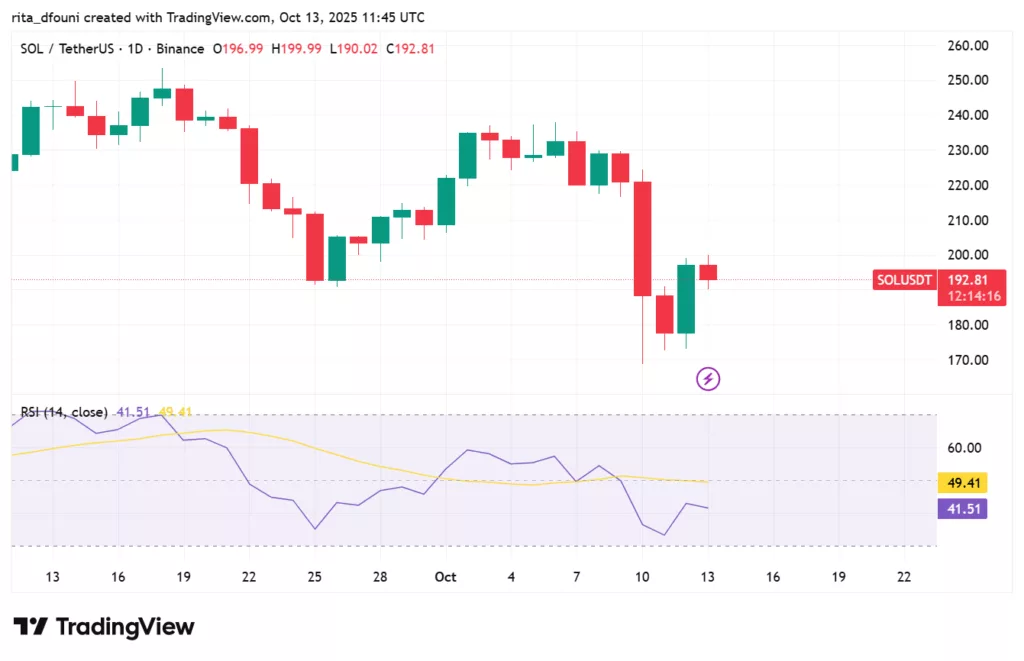
Solana starts the week stable around USD 223, moving within one of the market’s most technically responsive ranges. During the past ten sessions, the asset has adhered closely to a nearly ideal horizontal channel between USD 221 – 223 support and USD 235 – 236 resistance. This consistency has drawn systematic traders looking for mean-reversion opportunities and has also prepared for a significant breakout when volatility increases.
Trading volumes continue to be robust compared to the rest of the altcoin market: SOL’s spot turnover has averaged USD 1.6 billion per day across leading exchanges, a slight rise from late September. Liquidity heatmaps indicate that strong bids are concentrated between USD 220 and USD 222, while selling offers diminish significantly above USD 237, creating potential for price movement if a breakout happens.
The foundational tone stays positive. The correlation with Bitcoin (0.81 over 30 days) continues to tether SOL to macro risk sentiment, yet its relative strength index against ETH has subtly increased by 6% in the last week, indicating that capital rotation is once more favoring Layer-1 efficiency stories.
Technical structure
The foundational tone stays positive. The correlation with Bitcoin (0.81 over 30 days) continues to tether SOL to macro risk sentiment, yet its relative strength index against ETH has subtly increased by 6% in the last week, indicating that capital rotation is once more favoring Layer-1 efficiency stories.
On the negative side, a drop to USD 221 – 223 would trigger a move down to USD 210 – 205, the next high-liquidity zone corresponding with the 100-day EMA. Momentum indicators remain positive: RSI is around 58 (above neutral), stochastic turning upwards, and the MACD histogram has been favorable for four straight sessions. Volume analysis indicates that the on-balance volume has been rising since October 1, despite price remaining stable.Technicians describe this as “quiet strength”: compression supported by rising underlying demand.
Derivatives & positioning
Ongoing funding rates stay steady around +0.003%, highlighting stable leverage. Open interest is approximately USD 2.4 billion, roughly 5% lower than last month’s high, allowing for potential growth. Options data supports the balance: calls prevail at the 240/250 strikes, while puts concentrate between 210 and 215. The 25-delta skew is neutral, indicating that traders aren’t investing extra for downside protection, which subtly suggests a bullish sentiment.
Low implied volatility (≈ 42%) renders directional exposure quite inexpensive. Should the spot break through 236 with strong momentum, anticipate that delta-hedging activities from dealers who are short gamma will quicken the ascent toward 245 in a matter of hours instead of days.
On-chain & ecosystem
Essentially, Solana’s network engagement remains strong. Daily transactions surpass 48 million, preserving its dominance among non-EVM chains. NFT volume has held steady following the decline in September, whereas DeFi TVL remains slightly over USD 4.8 billion, increasing by 7% week-on-week.
The number of validators stays close to 1,900, maintaining decentralization. Even more significantly, the consistency of average block times has enhanced, as the 99th-percentile latency has dropped beneath 450 ms, marking a key achievement in the chain’s engineering story. These operational improvements have dampened earlier reliability concerns, strengthening the view that SOL is evolving from a speculative token into a robust infrastructure asset.
Investor sentiment reflects this development: a net outflow of 1.6 million SOL last week represents the biggest withdrawal since May, frequently signaling upcoming accumulation phases.
Macro alignment
Being a high-beta asset, SOL enhances the movement in the direction that BTC and ETH take. Should BTC surpass USD 113.4k and ETH exceed USD 4,380, SOL’s beta indicates a two-for-one percentage change. Macro liquidity continues to provide a supportive environment as global M2 expands, real yields ease, and speculative interest shifts back to growth tech, all reinforcing the argument for SOL leadership when volatility re-emerges.
Nonetheless, if risk sentiment worsens after CPI, SOL would probably initiate the decline; historically, its downside beta surpasses 1.3 in deleveraging periods.
Investor psychology
Market players consider SOL to be the “trader’s layer one.” Institutional desks acknowledge the chain’s rapidity and liquidity, whereas retail views it as a leveraged substitute for the wider crypto risk. The dominant attitude is proactive patience: belief in technology, carefulness regarding timing. Social sentiment metrics indicate a resurgence of optimism after a period of indifference, with references to “SOL season” appearing again on crypto Twitter a sentiment indicator that usually foreshadows moderate upward momentum.
Outlook
SOL remains the cleanest technical setup among major alts.
- Bullish trigger: daily close > USD 236 → targets USD 245 → USD 250 → USD 258.
- Bearish trigger: close < USD 221 → tests USD 210 → USD 205.
Until then, anticipate consolidation with a positive inclination. The probability skew leans towards an upward outcome: increasing OBV, consistent funding, and decreasing volatility indicate that pressure is accumulating below.
XRP — Magnetized to USD 3.00, waiting for confirmation
Market overview
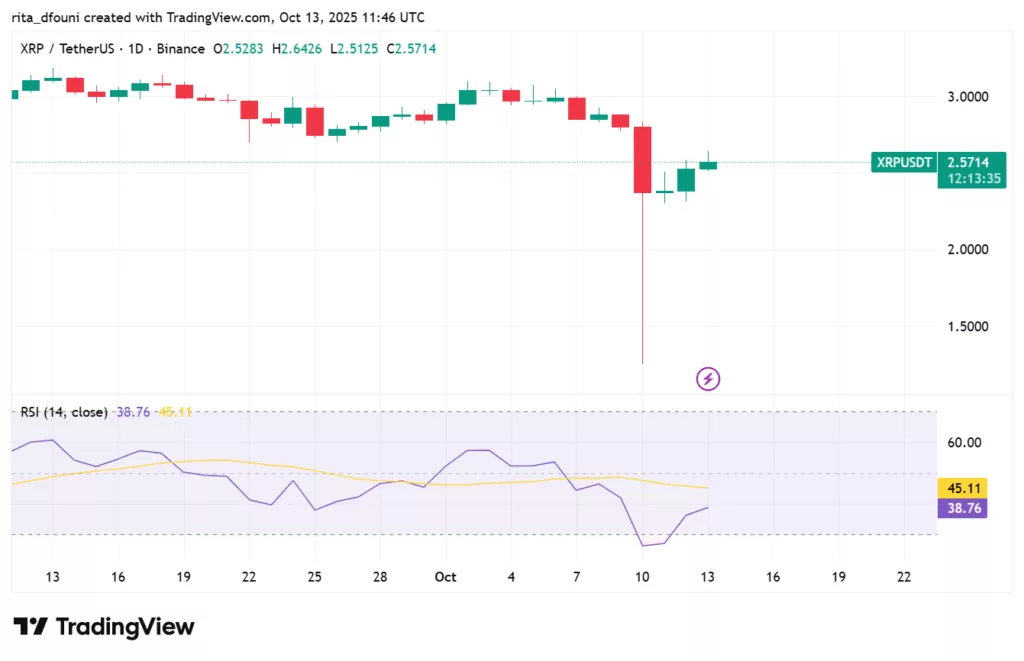
XRP begins the October 13 session stuck around the USD 3.00 mark, fluctuating between USD 2.95–2.99 on lower liquidity and surging toward USD 3.00–3.03 whenever major currencies strengthen. This has set the tone for weeks: systematic two-way trading within a limited range, where minor declines are swiftly absorbed and short surges recede just under the breakout point. The tone is calm instead of sluggish; the scope is sufficient, and order books are persistently restocking after every unsuccessful effort to break through the round number.
Technical structure
The diagram continues to exemplify a compression model. Immediate resistance stands at USD 3.03, a level that XRP has briefly surpassed multiple times but has failed to maintain on a daily closing basis. Clearing it would confirm a structural breakout and indicate USD 3.20–USD 3.30, where previous supply limited the June and September rallies. Below, USD 2.91–USD 2.95 acts as the immediate support; if that range is broken, the price may test USD 2.85–USD 2.88, the subsequent liquidity zone where buyers stepped in during late summer. Momentum indicators are even: daily RSI centers on neutral, and MACD histograms remain tight and flat, a common characteristic when volatility contracts before a directional movement. Daily moving averages (20/50) are converging slightly below USD 3.00, illustrating energy coiling at a psychological turning point.
Derivatives & Positioning
Perpetual markets show engaged but disciplined participation. Funding is close to flat, signaling the absence of one-sided positioning that could destabilize price on routine moves. Open interest has recovered from last week’s risk-off wobble but remains below overextended thresholds, leaving room for expansion if spot confirms. Options flows continue to favor near-dated calls in the USD 3.00–USD 3.20 corridor positioning that pays only if USD 3.03 is secured on a close while protective puts cluster around USD 2.85–USD 2.95. The 25-delta skew is near neutral, a tell that traders prefer defined-risk expressions over directional leverage until a trigger prints. Low implied volatility makes gamma hedging more sensitive; once spot escapes the band, dealer re-hedging can accelerate the move.
On-chain & ecosystem
The utility continues to be the foundation of XRP’s medium-term rationale. Cross-border payment routes utilizing Ripple’s infrastructure maintain consistent settlement volumes, achieving finality in seconds and incurring minimal costs, allowing throughput to remain robust even during lulls in speculative interest. Exchange balances have gradually decreased this month, aligning with a slow buildup. Network health indicators (transaction totals, validated transactions) remain stable, and enhanced partner connectivity in Asia-Pacific corridors maintains the emphasis on actual settlement instead of solely on trading momentum. These basics don’t necessitate a breakout, but they clarify why bids continue whenever the price tests the USD 2.90s.
Macro alignment
XRP’s market is affected by the same larger economic forces influencing major assets: a generally easing policy environment, volatile stocks, and occasional risk-related news shocks. Historically, XRP’s most sustainable gains happen once Bitcoin and Ethereum move upwards; the confirmation from the pair offers risk approval for investments to shift towards payment-focused assets. In the current scenario, it signifies that BTC achieving acceptance above USD 113,400 and ETH surpassing USD 4,380 would significantly enhance the chances that USD 3.03 eventually breaks. On the other hand, if the macro mood deteriorates after this week’s CPI and fluctuations in the bond market, XRP usually returns to its coil instead of establishing an independent trend.
Investor psychology
Sentiment is carefully optimistic. The community is acutely aware of the USD 3.03 hinge and displays minimal desire to front-run it; the majority of participants sell strength within the band and re-enter on dips. Long-term holders stress the utility narrative and perceive the narrow range as consolidation above a crucial structural area, rather than as distribution. The lack of euphoric financing or crowded long positions is a positive sign; it means there is capital available to invest on confirmation and lowers the risk of chaotic unwinds from a typical headline.
Outlook
The short-term map remains binary. A daily close exceeding USD 3.03 would validate a regime shift and probably drive the price toward USD 3.20–USD 3.30, where historical supply is located; options-related hedging might increase momentum and shorten the time to reach the target. If the price drops to USD 2.91–USD 2.95 upon closing, the market structure changes to a durability assessment at USD 2.85–USD 2.88, where the strength of dip demand will influence the outlook for the remainder of October. Until one boundary breaks, anticipate regulated fluctuations near USD 3.00, with rapid mean-reversion trades preferred during the day and patience yielding results on longer timeframes.
Cardano (ADA) — Grinding within the channel
Market overview
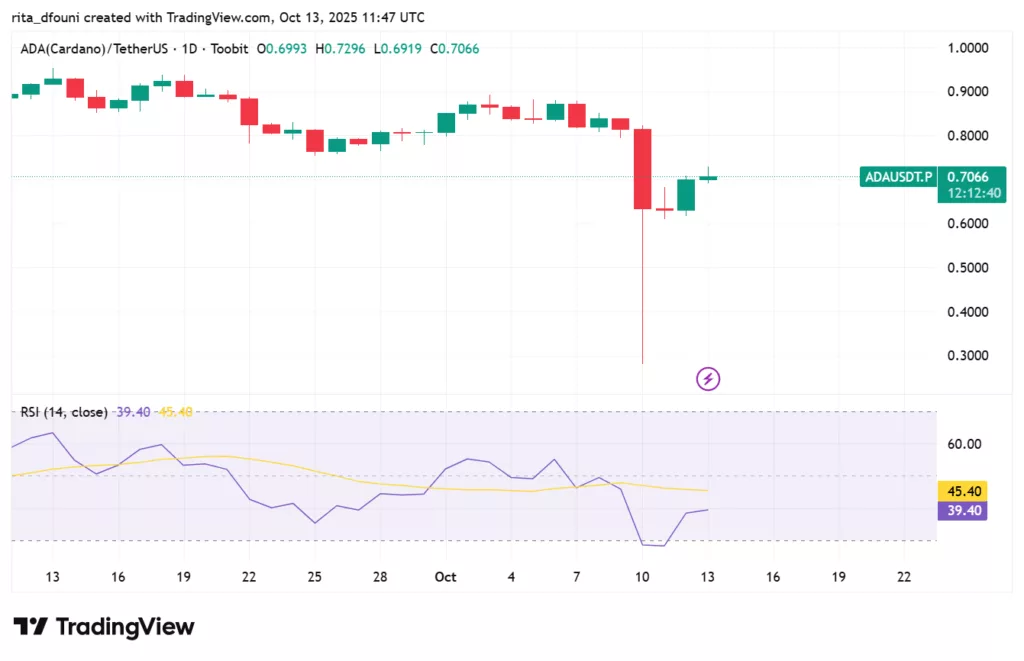
Cardano begins the October 13 session nearly the same as last week, fluctuating between USD 0.86 and 0.88 within a framework that has established its pattern since late September. Each decline towards the USD 0.82–0.84 support zone sees consistent spot buying, whereas every attempt at USD 0.90–0.905 triggers measured profit-taking. Liquidity conditions stay favorable: depth charts on Binance and Kraken indicate strong bid density down to USD 0.80, suggesting that many large traders consider current prices as value territory instead of engaging in momentum trading.
Relative performance indicators emphasize ADA’s tranquility. Its 30-day correlation with BTC is approximately 0.84, suggesting that macro flows continue to drive directionality. However, volatility is significantly lower, with realized volatility lagging behind ETH by nearly 25%. This low-beta characteristic makes Cardano a stabilizing force in high-beta alt portfolios, but it also results in ADA trailing when major cryptocurrencies surge.
Technical structure
The daily chart still shows a typical horizontal channel. Resistance peaks at USD 0.90–0.905, bolstered by several unsuccessful intraday wicks. Above it, USD 0.96 and USD 1.02 serve as consecutive measured-move objectives. Support is located at USD 0.82–0.84, with additional backing at USD 0.80; below that, USD 0.78–0.79 serves as the foundational level from which August’s rise commenced.
RSI is nearly entirely neutral at around 50. The 20- and 50-day EMAs have leveled off and merged at USD 0.87, forming a compression zone. MACD lines have intersected without certainty, showcasing indifference instead of tension. This arrangement of compressed averages, neutral momentum, and decreasing volume frequently foreshadows a multi-week expansion in either direction
Derivatives & positioning
Perpetual funding shows a slight positive trend (+0.003 %), indicating a mild preference for longs, though not overwhelmingly so. Open interest at key platforms stands at approximately USD 420 million, significantly lower than the speculative peaks seen in July. Options activity continues to be limited but informative: call interest gathers around USD 1.00, while puts focus near USD 0.80, outlining a clear probability cone. Implied volatility at approximately 44% is the lowest since April, making directional exposure cost-effective for funds expecting a volatility surge.
On-chain & ecosystem
Fundamentals keep pushing upward. The total value locked in Cardano’s DeFi ecosystem hit USD 520 million, reflecting a 6% increase from the previous week, driven by lending protocols and a recent rise in native asset issuance. Developer engagement tracked through GitHub commits stays within the top three networks, highlighting the chain’s gradual yet consistent progress. Staking involvement accounts for approximately 63% of the circulating supply, enhancing network security and mitigating sell pressure from short-term investors.
The Hydra scaling update introduced gradual enhancements in channel throughput this month, subtly increasing on-chain efficiency. Although these enhancements seldom lead to an immediate price increase, they enhance investor confidence that Cardano is progressing amid consolidation.
Macro alignment
ADA shows asymmetric sensitivity to macro risk: it gains less from optimistic risk-on spikes but experiences greater shallow declines during market corrections. As global yields are easing and liquidity metrics are stabilizing, the present situation supports balance over trend. If BTC and ETH establish upward movements, ADA usually trails by two to three sessions, frequently providing enhanced percentage increases as confidence expands.
Investor psychology
Market participants characterize ADA’s sentiment as “systematic.” Retail participation has diminished, resulting in a foundation largely composed of long-term investors and algorithmic range traders. Social sentiment has shifted to neutral-positive; the lack of excitement serves as an advantage, reducing volatility and promoting steady accumulation. Traders are eager to purchase verified breakouts above USD 0.905 but stay disciplined in avoiding premature leverage.
Outlook
The roadmap remains straightforward:
- Bullish trigger: daily close > USD 0.905, unlocking USD 0.96 → USD 1.02 with potential extension to USD 1.08 if volumes expand.
- Bearish trigger: close < USD 0.82, revisiting USD 0.80 → USD 0.78–0.79 for a durability test.
Until either edge breaks, ADA will likely continue its low-volatility grind inside the box, rewarding patience and punishing impatience.