



Bitcoin (BTC) compression before confirmation

Market overview
Bitcoin starts the November 3 session at about USD 114,500, a slight retracement from the previous week’s unsuccessful attempt to break above USD 115,800, but it is still maintaining its defensive structure. Instead of tiredness, the tone is one of quiet determination: sellers are still fading rallies into the USD 115,500–USD 116,000 range, while buyers have absorbed every dip into the USD 113,000–USD 113,500 band. Spot depth on key exchanges is still healthy, liquidity is orderly and balanced, and derivatives measurements don’t indicate panic or overextension. The market’s heartbeat is still robust even though its rhythm has slowed. This is a typical setup in which the next directional release is fueled by compression.
Technical structure
The technical image is still remarkably clear. At USD 116,000, the maximum limit of a horizontal coil that has lasted for more than two weeks, there is immediate opposition. The USD 118,500–USD 120,000 pocket, where overhead liquidity quickly thins and momentum traders are likely to re-engage, would reopen with a confirmed daily close above that level. There is still a layer of support: USD 113,000 serves as the first line of defense, followed by USD 111,500 and USD 110,000, which is the level that corresponds to the 50-day moving average. The MACD histogram is starting to curve upward just below the zero line, which is a tiny early indication of internal strength returning, while short-term momentum oscillators have flattened, suggesting equilibrium rather than divergence.This image is supported by volume analysis, which shows that accumulation footprints show up during low-volatility sessions, indicating that passive demand is still operating beneath the surface, whereas selling spikes have been shallow.
Derivatives and positioning
The majority of big venues quote +0.010% to +0.020% for perpetual funding, which is still slightly favorable but not overheated. This indicates a long-term, consistent conviction as opposed to a speculative pursuit. Following last week’s deleveraging event, open interest has leveled off close to previous highs, indicating that while leverage has reset, participation is still wide. While implied volatility is moving near the low-30s percentile, options traders are still concentrating their exposure around the USD 115,000–USD 120,000 strikes. The slight call preference displayed by the 25-delta skew is a sign of calm optimism without complacency. A prolonged run over USD 116,000 could potentially lead to forced hedging, which mechanically speeds up the breakout and adds momentum on top of actual demand. Dealers seem to be mildly short gamma around spot.In contrast, considering how low the overall leverage ratio is still, a decline below USD 113,000 is unlikely to trigger structural liquidation but would probably result in short-term deleveraging.

On-chain and macro context
A bullish undercurrent is confirmed by on-chain flows. For the first time since late September, realized cap growth has turned positive, wallet inactivity is still high, and exchange balances have continued their gradual decrease. After a brief period of profit-taking, miner reserves have stabilized, and stablecoin inflows onto exchanges have slightly increased, which is a leading indicator that sidelined liquidity is starting to seek exposure once more. The macroeconomic environment is still tepidly positive: risk assets throughout the world are calming down, the U.S. dollar index has slowed, and Treasury rates have cooled from their October highs. Bitcoin is still the most prominent high-beta indicator of that, making it less sensitive to changes in actual yields and liquidity.
Investor psychology
Alert patience defines sentiment. Traders are extremely focused on the daily closure instead of intraday noise following weeks of consolidation. The setting is healthier than it was during the spring surge since there is no longer any speculative leverage or meme-driven euphoria. While retail traders are discreetly shifting cash back into majors from peripheral cryptocurrencies, institutional desks continue to be active through basis and calendar-spread techniques. The market’s measured tone, which reflects investors’ optimism but discipline, is reflected in the fear and greed indices, which are in neutral zone.
Outlook
Confirmation is key to the trajectory of Bitcoin until mid-November. If futures hedging flows accumulate, a daily close over USD 116,000 will likely re-ignite momentum and push the price toward USD 118,500–USD 120,000. If this happens, there may be a chance for an accelerated extension. The consolidation is prolonged if the price doesn’t break higher, remaining in the USD 113,000–USD 116,000 range until macro catalysts or liquidity inflections step in. A closure below USD 111,500 would just re-calibrate the structure to the 50-day baseline around USD 110,000, but it would negate the immediate positive tilt. Before making a firm move to expand, the market is still technically coiled, fundamentally supported, and psychologically balanced.
Ethereum (ETH) the compression apex near $4,500

Market overview
Ethereum starts the November 3 session circling USD 4,345, staying inside a range that has come to represent its constrained yet coiled nature this quarter. The coin has fluctuated between USD 4,275 and USD 4,420 during the last three weeks, testing but failing to close above USD 4,450 and USD 4,500 on multiple occasions. The daily pattern is consistent: patient buyers reassert themselves close to the USD 4,275–USD 4,300 zone, while sellers lose momentum near the upper rail. The fact that liquidity is stable and dispersed equally throughout order books indicates that neither complacency nor panic are in control. The quiet before the impending volatility event is reflected in the market’s tone.Ethereum’s significance has not been lessened by the consolidation; on the contrary, it has been strengthened. Although ETH’s realized volatility fell to its lowest level since April in October, open interest and volume indicators indicate the market’s.
Technical structure
Ethereum’s chart continues to show equilibrium that is just waiting to be ignited. The crucial resistance level, which has been tested several times without confirmation, is still between USD 4,450 and USD 4,500. A definite regime shift would be indicated by a clear daily close above USD 4,500, which would validate the base and pave the way toward USD 4,650. From there, it would move into the psychological USD 4,800–USD 5,000 zone, where historical supply last absorbed rallies. The 20-day moving average provides immediate support at USD 4,275, while the 50-day MA and September breakout zone serve as a supplementary cushion between USD 4,200–USD 4,100.
Derivatives and positioning
The spot structure is echoed by derivative flows, which are silent but deliberate. Between +0.01% and +0.03%, perpetual funding is in a healthy range that indicates modest lengthy conviction without excessive leverage. The small 3% weekly increase in open interest in ETH futures indicates new involvement that is unbalanced. With a considerable call building at USD 4,500 and USD 5,000 for mid-November expiries, options posture is still concentrated around the USD 4,400–USD 4,600 strike corridor, suggesting that the compression will resolve upward. The fact that traders favor upside insurance over downside protection is confirmed by the 25-delta risk reversal, which is currently at +1.5, its highest positive reading in almost two months.
On-chain and ecosystem metrics
The principles of Ethereum nevertheless offer a subtly encouraging foundation. Staking deposits are still increasing gradually, gas prices have returned to multi-month lows, and daily transaction counts are still steady above one million. About 23% of the circulating supply, or more than 27.5 million ETH, is still locked in the Beacon chain, which tightens liquid float and serves as a structural supply limit. Validator exit rates are still very low, and net staking inflows have continued for eight weeks in a row.Any major move through USD 4,500 would trigger mechanical hedging and accelerate follow-through, as dealers are still short gamma near spot.
It appears that market participants are anticipating a volatility event but have not yet made a decision because indicated volatility trades at a slight premium to realized volatility. This combination of tight realized vol, moderately elevated implied vol, and short dealer gamma is the traditional precursor to an impulsive expansion.The principles of Ethereum nevertheless offer a subtly encouraging foundation. Staking deposits are still increasing gradually, gas prices have returned to multi-month lows, and daily transaction counts are still steady above one million. About 23% of the circulating supply, or more than 27.5 million ETH, is still locked in the Beacon chain, which tightens liquid float and serves as a structural supply limit. Validator exit rates are still very low, and net staking inflows have continued for eight weeks in a row.
Total value locked (TVL) across major protocols in DeFi has increased by almost 5% so far this month, with the majority of inflows coming from lending and restaking platforms. On a number of recent days, the combined throughput of the Layer-2 ecosystems on Arbitrum, Base, and Optimism has exceeded that of the Ethereum mainnet. The idea that Ethereum’s ecosystem is growing even during times of price stagnation is supported by this scaling story and the slow fee compression.
On-chain resilience is echoed by institutional flows. While ETH exchange reserves continue to trend lower, indicating accumulation or long-term holding rather than distribution, ETF-like vehicles and custodial products have experienced modest inflows.
Macro and market alignment
With a larger beta component, ETH’s trajectory is nevertheless linked to the same liquidity factors that drive Bitcoin. The economic pressure that restrained cryptocurrency rallies in early Q3 has been lessened by a stabilizing dollar index, a reduction in real yields across U.S. Treasuries, and an increase in equities risk appetite. Despite being stationary at 0.038, the ETH/BTC ratio is starting to level out, suggesting that when overall alt liquidity improves, relative strength may shift back toward Ethereum.
As a stand-in for “growth within crypto,” macro-sensitive funds seem to be shifting back toward ETH exposure, especially in light of the stablecoin settlement explosion and increased development enthusiasm. Ethereum would most likely benefit right away if Bitcoin confirmed its breakout over USD 116,000, with capital rotation quickening into the USD 4,500–USD 4,650 range.
Investor psychology
The ETH markets have a subdued yet subtly upbeat emotional rhythm. Although traders admit that the compression around USD 4,500 has lasted longer than usual, the mood is one of quiet expectancy rather than annoyance. Short-term commotion does not deter long-term holders, who are supported by steady stake yields. Institutional desks retain cautious optimism linked to economic stabilization, while retail sentiment is subdued with no indications of exuberant positioning or “FOMO” influx.
The lack of excessive speculation increases the structural durability of any upcoming change. According to sentiment indexes, ETH is in the neutral to somewhat greedy range, indicating optimism that is balanced with realism, which is the perfect psychological environment for long-term breakout behavior.
Outlook
The resolution of the triangle apex is the only thing that Ethereum’s November roadmap depends on. With a psychological magnet above USD 5,000 serving as the next target cluster, a confirmed daily close above USD 4,500 would verify months of accumulation and open the runway for USD 4,650–USD 4,800. Given the options gamma setup and the reduction in supply on exchanges, the momentum of the breakout might swiftly compound.
Failure to recapture USD 4,500 keeps ETH swinging between USD 4,275–USD 4,450, rewarding diligent range traders but delivering nothing to trend watchers. As long as USD 3,950–USD 4,000 holds, the larger structure would be intact, but a drop below USD 4,200 would momentarily eliminate the bullish compression and test USD 4,100.
In summary, Ethereum is technically coiled, structurally balanced, and fundamentally sound, placing it at the brink of equilibrium. The market is only waiting to see which way the spark will fly now that the fuse has been ignited.
Solana (SOL) quiet strength beneath a low ceiling

Market overview
Solana continues a month of remarkably peaceful two-way trading by opening the November 3 session close to the mid-USD 220s. While rallies halt just below USD 235–USD 236 a shelf that has repulsed repeated intraday pushes without a confirmed daily close the market still views the USD 221–USD 223 pocket as a reliable demand zone. Major venues continue to see high liquidity, and the tape has taken on a familiar rhythm: offers gradually regain their power while bids immediately surface on brief dips. That rhythm is more about posture than it is about indifference. Participants are happy to recycle inventories at the edges as they wait for a catalyst to resolve the coil because realized volatility has been compressed.
Technical structure
Under static resistance, the chart has developed into a neat ascending triangle. The lid has remained stable at USD 235–USD 236 since late September, but SOL has printed a string of higher lows from USD 221 → USD 224 → USD 226. Energy is concentrated by that geometry, and when it is released, moves are typically swift and directed. Confirming breakthrough conditions, a sustained daily close over USD 236 would indicate a move toward USD 245 and then USD 250, with the possibility of USD 258 on momentum extension.
The price would probably move into USD 210–USD 205, the next high-liquidity region that saw August’s pullback, if USD 223 were to be broken. The RSI is in the high-50s, short moving averages have curled upward beneath the price, and recent candles have narrower bodies with shorter wicks all traditional indicators of calm accumulation inside a squeeze so the momentum readings are constructive rather than stretched.
Derivatives & positioning
There is leverage, but it is controlled. The fact that perpetual funding has only slightly increased shows that there is still long-term interest without the kind of lopsided crowding that might cause regular declines to become liquidation cascades. After plunging to lows in late September, open interest has recovered to a level that can support growth without being precarious. The battleground is clearly mapped out by options positioning: protective puts focus around USD 210–USD 215 and call interest concentrates at the USD 240/250 strikes for near expiries. The implied volatility is low in comparison to its 3-month average, which raises the likelihood that dealer hedging will speed up the first clear advance through USD 236 and makes defined-risk breakout expressions reasonably priced.
On-chain & ecosystem
The bid is still supported by fundamentals. Consistent block timings and excellent throughput support Solana’s low-latency reputation for user-facing applications. Following summer turbulence, DeFi participation has leveled down, and stablecoin settlement on the network is still active, maintaining baseline transaction demand even as speculative flows subside. Even though not every launch makes headlines, the combined usage of NFT and gaming verticals keeps the daily active addresses sticky and motivates builders to continue delivering. The end result is a background where dips come into contact with actual users, not simply traders, which is an essential component of long-lasting support.
Macro alignment
The high beta of SOL to the larger complex is a feature rather than a flaw. Instead than just forcing trend, Solana usually magnifies the move when Bitcoin and Ethereum resolve higher; when they stall, SOL returns to the range. The macro mix is more favorable to high-beta Layer-1s than it was in early Q3 due to weaker real yields and restrained dollar strength. However, there is still a chance that a surprise in interest rates or volatility in stocks might reduce risk appetite and make USD 236 a longer-term ceiling. In such case, the asset’s immediate future depends on whether Bitcoin can ultimately gain acceptability above its local ceiling and whether Ethereum can legally recover USD 4,500.
Investor psychology
Optimistic discipline has replaced apathy in sentiment. The trend is productive, because the community understands that being early comes at a higher cost than waiting for confirmation. While momentum traders wait for a daily close through USD 236, range specialists continue to fade the edges. Those drops replenish fast because holders with longer time horizons see any return to USD 221–USD 223 as a sign of value rather than vulnerability. One unspoken advantage is the lack of crowded longs or exuberant funding, which reduces the possibility of chaotic unwinds on everyday headlines and allows dry powder to chase if a signal prints.
Outlook
Solana is still one step away from changing the story. As momentum, options hedging, and shelved capital converge, a clear daily close over USD 236 would confirm the ascending triangle and probably compress time to USD 245–USD 250. The strategy is kept straightforward by failing to break: fade strength into the lid until majors give the trigger, and respect the USD 221–USD 223 floor for mean-reversion trades. The next test of dip resilience would be USD 210–USD 205, and a loss of USD 223 would postpone the breakout story. While waiting for authorization to speak more loudly, the bias is currently somewhat constructive inside the box.
XRP coiling beneath the $3.05 threshold

Market overview
Beginning on November 3, XRP trades close to USD 3.01, regularly pressing against its obstinate lid at USD 3.03–USD 3.05. The pricing action is tight, purposeful, and less inclined to back down than a compressed spring. Every intraday decline approaching USD 2.95–USD 2.97 is immediately absorbed, and the order book structure indicates that passive bids predominate close to the round number. The market is remarkably restrained: there is steady liquidity on both sides of the book, moderate volatility, and robust participation. This silence indicates preparation rather than indifference, as a tranquil market stores kinetic energy.
Technical structure
The daily chart, which is a flat-topped rectangle bounded by USD 2.94–USD 3.05., is still geometrically sound. With extended targets at USD 3.28–USD 3.32, where historical supply rests from July, a sustained closing above USD 3.05 would validate breakout conditions and anticipate a rise into USD 3.20. The immediate cushion below the spot is formed by USD 2.94 to USD 2.95, but the crucial pivot is still USD 2.91, which determines whether the trend stays positive or turns into a reaccumulation. While the MACD histogram keeps printing higher lows, a subtle indication of pressure building beneath the surface, the RSI stays close to 56, keeping bullish bias without going overboard.
The price is still above the upward-sloping 20- and 50-day moving averages, forming a layered zone of dynamic support between USD 2.92 and USD 2.94. The market’s equilibrium is defined by the intersection of momentum and structure. Traders are rotating liquidity within the box instead of abandoning it until a breakthrough candle closes over USD 3.05 with volume expansion, which would turn this equilibrium into acceleration.
Derivatives and positioning
Two-way commerce is encouraged by the near-neutral funding rates, which range from -0.005% to +0.015%. Despite a nearly 4% weekly increase in open interest, leverage is still distributed evenly, suggesting balanced conviction. While there is still a notable amount of open interest at USD 2.85–USD 2.90 protective puts, options activity is still concentrated around USD 3.00–USD 3.20 call strikes. For the first time in more than a month, the overall skew has become somewhat call-heavy, which is a subtle but telling indication that bullish bias is returning to sentiment.
A clear break of USD 3.05 could stimulate hedging demand, which would mechanically push the price toward USD 3.20 more quickly than fundamentals alone could support. This is because dealers appear to be mildly short gamma near USD 3.00. Options are a desirable approach to pre-position for growth because of their relative affordability and implied volatility, which is stable but in the 40th percentile. The notion that traders are subtly positioning themselves for movement rather than passively waiting it out is supported by derivatives measures.
On-chain & ecosystem context
Under XRP’s quiet chart, the fundamentals are still strong. With an average of more than 1.6 million transfers per day across cross-border corridors, transaction volume is still increasing. With low mistake rates and quick settlement finality, the network’s dependability is still high, supporting real-world use. While wallets holding more than a million tokens have slightly increased, indicating a shift from short-term traders to deeper-pocketed participants, exchange reserves of XRP have decreased somewhat since mid-October, indicating accumulation by long-horizon institutions.
The ecosystem’s framing of Ripple as a utility-driven token rather than a merely speculative one is strengthened by the ongoing growth of its remittance agreements throughout Asia-Pacific and Latin America. Even during more general cryptocurrency retracements, the USD 2.90s continue to find structural bids because of these partnerships, which offer a strong narrative floor even though they do not instantly translate into linear price increase.
Macro alignment
Although XRP shows less sensitivity than its high-beta counterparts, such as Solana, it still has a correlation with the larger risk complex. Although there has been a slight tailwind from the lowering of U.S. real yields and the stabilization of equity volatility indices, XRP’s own rhythm has become more peculiar and is now more dependent on significant liquidity than macro data releases. The tone was established by Ethereum’s compression around USD 4,500 and Bitcoin’s closeness to USD 116,000; if either resolves higher, XRP is probably going to follow via capital rotation into settlement-layer currencies. Renewing macro pressures, on the other hand, might keep XRP trapped just below resistance, requiring further days of low volatility drift.
Investor psychology
Market players continue to be systematically cautious but tactically positive. While long-term holders view this zone as indication of durability, traders who missed the summer surge are hesitant to purchase before the breakout. Across social and derivatives data, the atmosphere is serene rather than ecstatic or apprehensive. According to volume-weighted positioning, the majority of participants do not want to front-run the candle that would confirm their expectation of continuance rather than collapse. Controlled markets, which frequently precede robust expansions once confirmation is received, are characterized by this psychological balance, in which neither fear nor greed predominates.
Outlook
XRP’s short-term roadmap is clearly stated. If dealer hedging exacerbates the move, momentum may extend higher. A daily close above USD 3.05 would confirm the breakout and open the path toward USD 3.20–USD 3.30. A rejection from resistance rewards patient range traders and scalpers by keeping the coin contained within the USD 2.94–USD 3.05 coil. The only thing that would make the tone firmly bearish and invite a retest of USD 2.85–USD 2.88 would be a prolonged decline below USD 2.91.
Until that change occurs, XRP continues to show low volatility and constructive compression while concealing increasing stress. The entire story shifts from reluctance to acceleration the instant the price confidently clears USD 3.05.
Cardano (ADA) structural calm, hidden strength
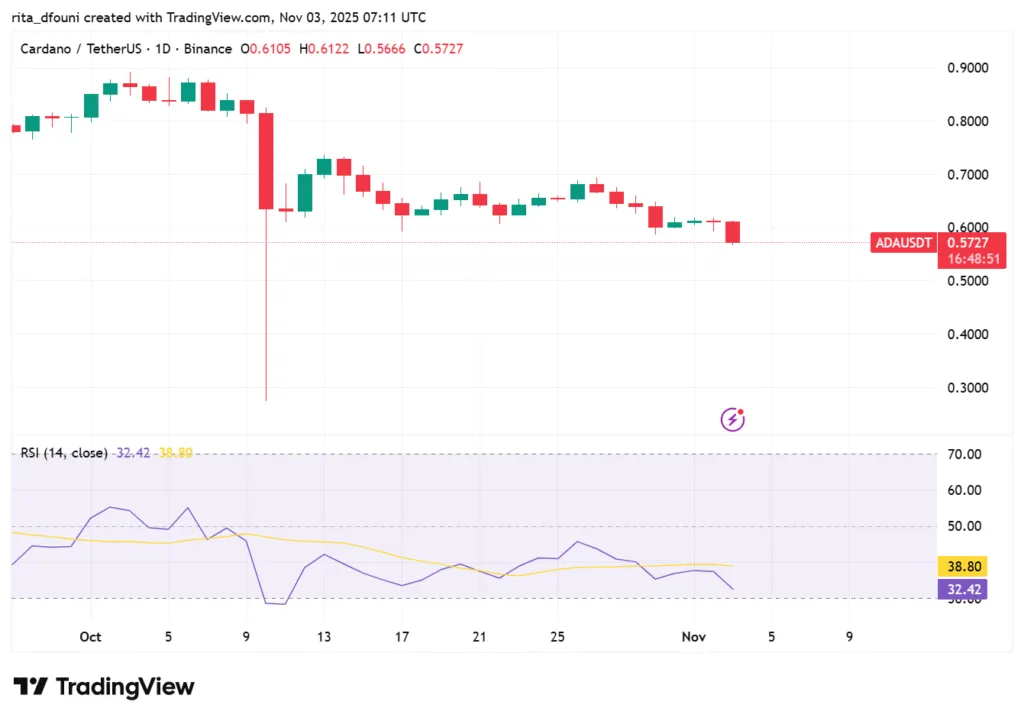
Market overview
Cardano continues a weeks-long phase of near-perfect equilibrium as it enters the November 3 session trading at USD 0.878. The asset does not exhibit signs of tiredness or speculative enthusiasm, being firmly anchored inside its long-standing corridor between USD 0.84 and USD 0.90. While rallies toward USD 0.90–USD 0.905 encounter steady supply absorption, any dip into USD 0.84–USD 0.85 draws responsive demand. The tape shows low spreads, volume that stays constant despite squeezed volatility, and significant liquidity on both sides of the book.
This calmness is a reflection of conviction rather than boredom. Long-term investors make up ADA’s investment base; they feel secure holding through consolidation because they know the framework supporting them is stable. While engagement on exchanges and staking platforms is still increasing, realized volatility has dropped to its lowest point of the year. It is clear that the market is in a resting, not a receding, position.
Technical structure
The technical canvas is symmetrical and clear. With a narrow band of support between USD 0.82 and USD 0.84, horizontal resistance is still there at USD 0.905. Around USD 0.86, where the greatest concentration of traded volume is located, the price has shifted toward a center of mass. The accumulation structure would be completed and a measured-move forecast toward USD 0.96 and USD 1.02, the August swing high, would be triggered by a confirmed daily close over USD 0.905.
The momentum readings continue to be constructive and neutral. While the MACD histogram floats at zero with shallow positive curvature, the RSI bounces around 52, reflecting stored potential rather than exhaustion. A platform of dynamic support has been formed by the tight compression of the 20-day and 50-day short-term moving averages beneath the location. Bollinger Bands have shrunk to multi-year lows, a statistical phenomenon that nearly invariably resolves by directional expansion and infrequently experiences volatility compression of this size. A breakout candle above USD 0.905 releases the stored energy, and a failure to regain that level merely prolongs the quiet. This is a simple but elegant setup.
Derivatives & positioning
The feeling of balance is strengthened by derivative markets. The existence of a slight long bias without leverage crowding is confirmed by perpetual funding, which is close to neutral and fluctuates between +0.01% and +0.02%. Although margin utilization is still low, open interest has increased somewhat since mid-October, suggesting that new money is positioning tactically rather than speculatively.
The picture painted by options data is comparable. Protective puts congregate at USD 0.80–USD 0.82, while call interest is around the USD 0.95–USD 1.00 strikes. For the first time in months, the 25-delta skew has shifted slightly in favor of calls, indicating a slight return to bullish sentiment. Because implied volatility is somewhat lower than realized volatility, pre-breakout exposure is preferred through defined-risk structures, and optionality is cheap. Market-maker hedging is likely to accelerate momentum rather than absorb it after direction appears because dealers retain minimal gamma near spot.
On-chain & ecosystem health
Cardano’s technical poise is still supported by its fundamentals. One of the greatest participation levels in the industry, with over 60% of ADA still in circulation, locks supply and suppresses short-term speculation. Through Q4, exchange reserves have been steadily declining, which indicates that long-term investors are accumulating.
The overall value locked within DeFi has increased by almost 8% so far this month, with the majority of inflows coming from lending methods and liquidity pools. Because to Hydra’s scaling improvements, which have increased throughput and decreased latency for high-frequency dApps, developer engagement is still strong. While whale addresses (>10 million ADA) have grown by almost 4% since mid-October, indicating a shift in capital from traders to holders, wallet creation and transaction data demonstrate organic growth. Beneath ADA’s serene exterior, the network is still developing the blockchain equivalent of breathing steadily before exerting yourself.
Macro alignment
Compared to its peers, Cardano has a different macro sensitivity; it reacts more slowly but lasts longer. A weakening dollar, lower equity-volatility indexes, and a relaxation of U.S. real yields have all improved the liquidity environment for digital assets. Capital tends to shift from high-beta ventures to fundamentally sound, yield-bearing investments in these kinds of settings. Layer-1s a profile that is specifically tailored to ADA.
Its fundamentals high staking lock-up, decentralized validator distribution, and limited leverage participation are the reason for its weak association with short-term risk shocks. Liquidity shift into secondary majors like Cardano is more likely if Bitcoin gains acceptability above USD 116 000 and Ethereum confirms a breakout above USD 4,500. On the other hand, ADA’s defensive stance would probably leave it range-bound rather than susceptible if macro sentiment soured because its investment base prefers continuity over speed.
Investor psychology
Cardano’s market attitude is characterized by composure and discipline. Although the asset’s speed is slower, traders nonetheless value its consistency. The lack of fanfare is intentional: institutions view ADA as a structured exposure and a place to park conviction rather than adrenaline, and retail traders no longer follow impulsive candles.
Unwaveringly confident, long-term stakers read the horizontal range as silent accumulation. Social media mood is still muted but bullish, and derivatives data confirms that optimism is measured rather than frantic. ADA’s inertia is transformed into latent strength by this behavioral maturity, which is uncommon in crypto. It guarantees that when expansion starts, participation will be sustained rather than speculative and avoids panic amid noise.
ADA’s psyche is essentially the same as its chart: calm, collected, and discreetly prepared. Emotional volatility is suppressed by the community’s collective mindset: the more stable the holders, the cleaner the breakout will be when it occurs.
Outlook
Cardano’s short-term trajectory is still straightforward and symmetric. An acceleration toward USD 0.96–USD 1.02, which correspond to August liquidity clusters, is encouraged by a daily closing above USD 0.905, which turns resistance into support. The eventual move will be more powerful the longer the price stays coiled between USD 0.82 and USD 0.90. The tone would momentarily flip to corrective if it broke below USD 0.82, with a target of USD 0.80–USD 0.78. However, on-chain accumulation and staking yield made prolonged decline unlikely.
In conclusion, ADA serves as a controlled compression case study. Technical balance, core strength, macro alignment, and mature psychology come together to provide a foundation that is uncommon in cryptocurrency.