


Bitcoin (BTC) liquidity tightens before expansion
Market overview
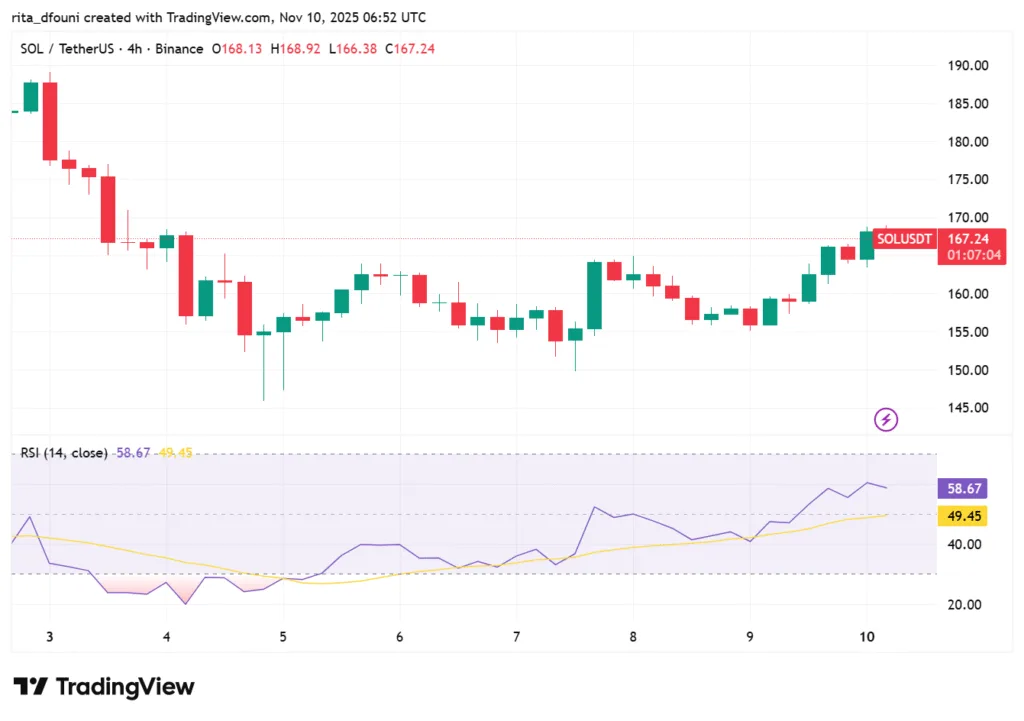
Bitcoin continues a week of stabilization that has characterized early November trading as it enters the November 10 session at USD 115,240. The coin’s intraday volatility has been progressively falling over the last five sessions, and it is still trapped in a narrow range between USD 113,600 and USD 116,200. Firm two-way depth bids are still concentrated around USD 113,800 to USD 114,000, according to the order book at major venues, while offers are still rebuilding just below USD 116,000. Because liquidity providers are busy, directional traders are cautious, and volatility sellers feel at ease until proven otherwise, this symmetry depicts a market in balance rather than one that is indecisive.
Though there is little movement, the mood below is nevertheless subtly positive. Without losing its structural underpinning, Bitcoin has withstood numerous macro shocks, ranging from mild yield movements to inconsistent U.S. employment data. Although open interest and exchange activity are still strong, realized volatility is currently close to quarterly lows, suggesting that participation is unaffected even if conviction is delayed. The emotional tone disciplined, patient, and alert for the next stage of expansion is reflected in the pricing rhythm.
Technical structure
The chart’s geometry is still clear. The immediate resistance level, which has been tested numerous times without confirmation, lies between USD 116,000 and USD 116,300. In addition to projecting a measured-move goal close to USD 118,800, a sustained daily close above USD 116,300 would validate breakout circumstances and, if momentum picks up speed, extend toward USD 120,000.

The initial defense is at USD 113,800, followed by USD 112,600, where previous demand reversed the structure in late October. Support is still piled. The 50-day moving average, a dynamic milestone that has subtly trailed the price since mid-September, and USD 110,500 represent a deeper cushion.
Instead of displaying weakness, momentum indicators display compression. The RSI remains constructively biased without going overboard, hovering around 55. Stored energy is indicated by the MACD histogram’s flattening near the zero line. Although volume has somewhat decreased, up-volume ratios are still positive, suggesting passive buildup. The candles of Bitcoin create a tightening wedge shape beneath resistance on the four-hour chart; once liquidity thins, this pattern usually resolves with directional aggression.The market has earned the right to pause, and the larger structure is one of coiled potential. This is controlled rest, not hesitancy, until shown differently.
Derivatives & positioning
At about +0.015 percent, perpetual funding is still somewhat positive, which is consistent with persistent long exposure without undue leverage. The open interest on all exchanges is close to USD 12.8 billion, which is somewhat less than the peak from last week and indicates little deleveraging but ongoing activity. While defensive puts cluster between USD 112 K and USD 113 K, options markets clearly reflect concentration in the USD 115 K–USD 120 K call corridor for mid-November expiries.
Realized volatility is close to 27%, one of the year’s tightest gaps, while implied volatility has shrunk to the low-30% level. A little preference for upside exposure is shown by the 25-delta risk reversal, which is still somewhat positive. Since dealers are still running light gamma exposure around spot, delta-hedging may intensify the move once Bitcoin departs this narrow area, especially if financing and options flows coincide.
Renewing basis trades are reported by institutional desks as futures premiums increased slightly to 7% annually. A hint of quiet confidence growing beneath the surface, the healthy spread emphasizes that money is shifting back to organized strategies instead of speculative pursuits.
On-chain & network health
Instead of depicting distribution, on-chain flows show accumulation. While wallets holding 10 BTC or more have climbed to their highest number since April, exchange balances have decreased by almost 18,000 BTC so far this month. The stability of miner reserves indicates that natural demand, not coerced sales, is meeting production. Even as short-term traders shift their wealth to altcoins, the percentage of long-term holders has increased to 70%, a post-halving high, demonstrating strong conviction.
Network activity is sustainable but not overheated, as evidenced by fee indicators that are still moderate and average transaction prices close to USD 2.80. With a total channel capacity of over 5,000 Bitcoin, the lightning network is still growing covertly, a record that shows continued use beyond price speculation. Even in the event of a pricing halt, these nuanced indications support the idea that structural confidence endures.
Macro alignment
The macro environment is still leaning cautiously toward risk-taking. The dollar index has stopped below 105 and U.S. real rates have dropped back below 2%, giving global risk assets more breathing room. Since equity volatility indicators are still low, there is room for digital assets to start moving in the right direction again. Historically, these liquidity-friendly windows when economic uncertainty is waning but complacency has not yet set in have seen some of Bitcoin’s most resilient breakouts.
At the same time, expectations for monetary policy are still balanced: long-end rates are anchored by the Federal Reserve’s “higher-for-longer” posture, but concerns about further tightening have been allayed by weakening inflation prints. The tranquil surface, latent torque price structure of Bitcoin is reflected in the subsequent macro equilibrium. Bitcoin might regain its position as the top high-beta liquidity proxy for global risk appetite if rates continue to decline or if stocks continue to rise into the middle of the month.
Investor psychology
The simplest way to characterize sentiment throughout Bitcoin markets is as disciplined anticipation. Traders are well aware that this type of volatility compression is rarely permanent; timing, not direction, is the key. The level of retail interest is still moderate. Participation is far from euphoric peaks, according to Google Trends and exchange signup statistics, although institutional flows are still steadily increasing through structured exposure as opposed to direct spot accumulation.
The bullish-leaning fear-and-greed indexes are positioned close to 55, indicating optimism without the use of leverage. The psychological environment is favorable: after several false starts this year, investors increasingly prefer confirmation to conjecture. In reality, stability is produced by such limitation. When expansion does occur, it will be fueled by new influxes rather than crowded outflows thanks to the lack of FOMO.
Outlook
Because of its psychological and technical constriction, Bitcoin’s next move could be pivotal. A verified daily close above USD 116 300 would indicate a breakout, with a first objective of USD 118 800 and a follow-through goal of USD 120 000. A move like that would probably encourage capital rotation from stablecoins back into majors and attract gamma-driven acceleration from options hedging.
The equilibrium is prolonged if resistance is not overcome, keeping Bitcoin range-bound between USD 113 800 and USD 116 000, where market makers can continue to profit from recycling liquidity. Although the fundamental support is still strong enough to withstand initial losses, a fall below USD 112 600 would soften the tone and test the 50-day base under USD 110 500.
In conclusion, Bitcoin is situated where possibility and serenity meet. Positioning is balanced but not complacent; volatility is sleeping but not gone. The subsequent impetus, whether macro or technical, is likely to cause a quick, wide-ranging, and defining reaction for the remainder of Q4.
Ethereum (ETH) the quiet engine of risk appetite
Market overview
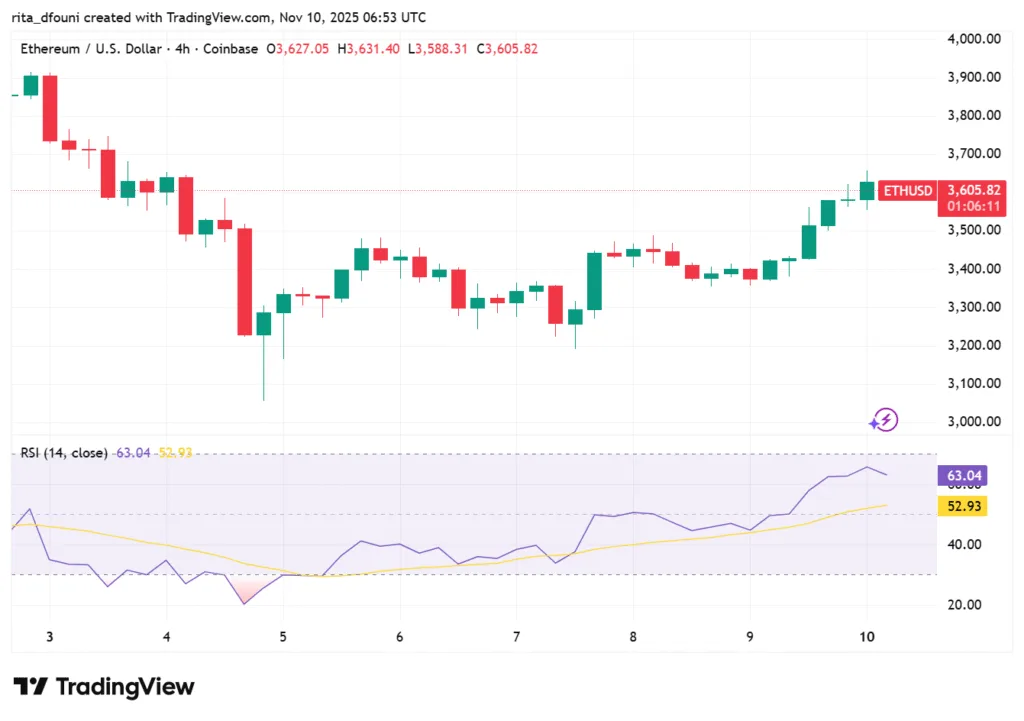
After a week of modest upward movement, Ethereum maintains its poise as it begins the November 10 session trading at USD 4,265. With no obvious breakout conviction, the pair has stayed inside a well-defined range of USD 4,220–USD 4,315 while honoring both support and resistance. ETH’s order books have a thinner, more responsive depth, which is characteristic of a market that reacts faster but runs out of energy sooner, in contrast to Bitcoin’s dense liquidity corridors.
The underlying qualitative structure is still positive despite the lack of movement. ETH’s dominance has increased to 18.2% of the total crypto market capitalization, its highest level since August, as a result of capital shifting from speculative altcoins into large-cap stocks. Layer-2 network transaction activity has maintained a high plateau, contributing to mainnet gas-fee stability and providing validators with consistent income despite low volatility.
The fact that ETH is still the standard for productive capital in the cryptocurrency space indicates that risk appetite is healthy rather than reckless. Deep-pocket spot buyers have swiftly absorbed every little decline over the last two weeks, especially during Asian trading hours when stablecoin inflows onto exchanges have been positive for eight straight sessions.
Technical Structure
Disciplined compression is still the medium-term trend. Price resistance caps are seen between USD 4,315 and USD 4,350, where algorithmic distribution is indicated by repeated intraday wicks. The wider symmetrical-triangle forecast aims for USD 4,650 on sustained follow-through, and a verified daily close over USD 4,380 would release USD 4,500.
The initial point of support is at USD 4,220, which is also the 20-day moving average. The structural shelf below it, between USD 4,100 and USD 4,125, corresponds to previous late-October breakout zones. Tests toward USD 4,000 would be encouraged by a clear break below that area, but unless the macro environment worsens, long-term holders and staking accumulators are likely to make aggressive bids on such retracements.
Controlled energy is reflected by momentum oscillators. The RSI is continuing exhibiting upside bias, hovering around 58. On daily frames, the MACD lines are close to a bullish cross, and the OBV is still positive evidence of calm accumulation. With a contracting Bollinger setup and a mid-band at USD 4,265, the four-hour chart indicates that volatility compression is getting close to resolution zone.ETH’s chart is essentially a more accurate, less spectacular version of Bitcoin’s. It does not hesitate; it waits.
Derivatives & positioning
The average perpetual funding premium is +0.02%, which is a slight bullish premium that is more in line with spot accumulation than leveraged chase. Week over week, open interest has remained relatively stable at USD 6.4 billion. For late-November expiries, options data shows a significant building of call exposure around USD 4,500. Dealers are also running small short-gamma exposure, which could highlight a rally if spot breaches resistance.
At 34%, implied volatility is lower than its 90-day average of 42%. With 25-delta risk-reversals at +1.8%, the skew is still marginally positive, indicating that traders continue to favor upside protection. At 1.2×, the perpetual-to-spot volume ratio is muted, suggesting that organic demand rather than synthetic leverage is driving the move.
According to institutional data, CME futures continue to accumulate: open interest is up 5% week over week, and spreads are holding an annualized premium of about 6%. This reflects macro investors’ increasing comfort with reestablishing ETH basis trades.
On-chain & network health
The on-chain foundations of Ethereum are still surprisingly strong. Gas prices average USD 2.15 and active addresses hover around 520 K per day, indicating high demand and promoting network utilization. More than 33.5 million ETH are currently being staked, locking in almost 27% of the overall supply and escalating the shortage.
With bridge inflows increasing by 9% every week, L2 ecosystems in particular, Arbitrum, Base, and optimism continue to direct user activity back to the mainnet. Over the previous month, net issuance has been marginally negative at -0.08% annually due to the steady inter-layer settlement volume and ETH’s deflationary burn mechanism. The reason ETH stays bid during times of general market prudence can be partially explained by these structural tailwinds.
Macro alignment
ETH has the same macro tailwinds that support BTC, albeit still relying on liquidity. As global stocks continue to rise and U.S. real rates continue to fall, more people are turning to staked Ethereum and other yield-bearing cryptocurrency assets. Investors’ attention is diverted from passive store-of-value positions to yield-accruing options if Treasury yields flatten, which supports the idea that ETH is a “productive digital asset.”
In addition, Ethereum’s role in the tokenization debate has become more prominent. Long-term credibility is strengthened as institutional pilots for tokenized T-Bills and physical assets continue to settle on Ethereum-compatible rails. Because of this macro-structural linkage, ETH is a less speculative and more integral proxy for infrastructure as a whole as well as risk.
Investor psychology
The sentiment around ETH is cautiously upbeat. As an asset that rewards discipline rather than chase, traders see it as a “patient trade.” Because speculative money continues to favor high-beta alternatives like Solana or meme sectors, retail involvement is still low to moderate. However, significant expansions frequently come before that noiselessness.
The conversation in the community has also changed, focusing more on ecosystem efficiency, modularity, and restaking narratives than on price. The tone is mature; long-term accumulation is once again acceptable to investors. The emotional balance is just right not too euphoric to peak, but enough conviction to last.
Outlook
The ability of Ethereum to close above USD 4,380 will determine its short-term course. A good breakout will affirm continuance and draw momentum inflows, targeting USD 4,500–USD 4,650. Otherwise, the axis of equilibrium, where rotation methods and mean-reversion predominate, is still the range between USD 4,220 and USD 4,350.
With network activity stable and volatility close to multi-month lows, ETH is currently experiencing a period of quiet accumulation before to the next liquidity wave. The path of least resistance continues to rise steadily through mid-November unless there are significant surprises.
Solana (SOL) — momentum meets maturity
Market overview
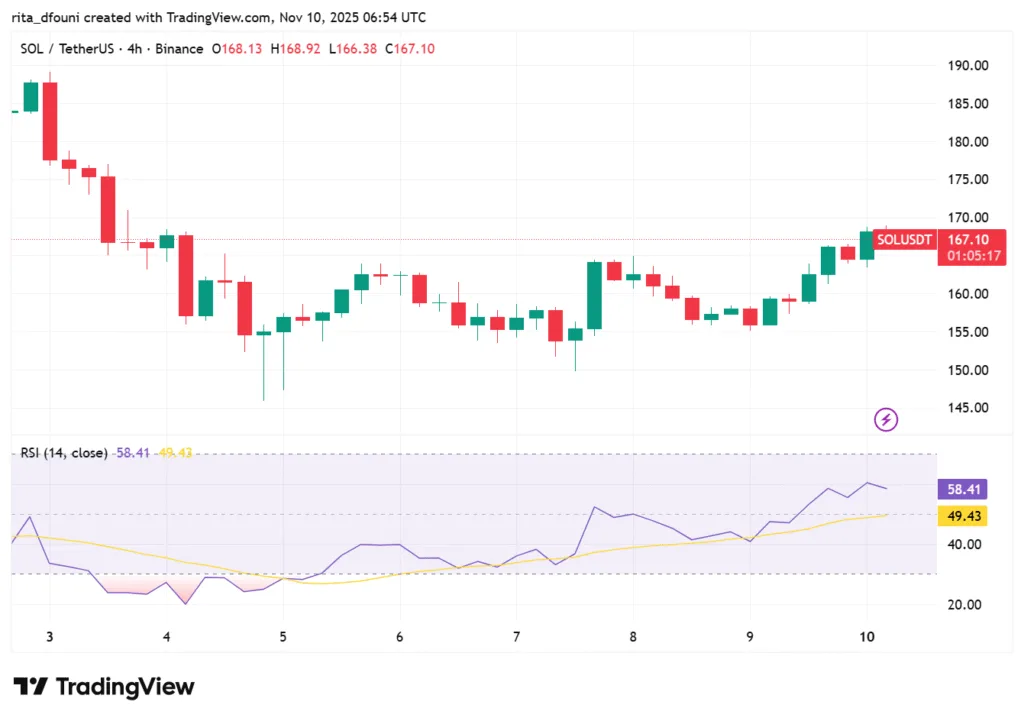
After recording a weekly top of USD 224.50 and a low of USD 215.40, Solana starts the November 10 session trading at about USD 221.80. Driven by renewed trust in its scalability narrative and ecosystem expansion, the coin continues to outperform the majority of its large-cap rivals on a relative basis. Second only to Ethereum in terms of perceived on-chain efficiency, SOL has transformed from a speculative high-beta asset to one of the most institutionally discussed layer-1s, notwithstanding sporadic volatility.
Conditions for liquidity have significantly improved. Even during off-peak trading hours, SOL’s perpetual futures market currently maintains a steady depth as the difference between the prices of the centralized exchange (CEX) and decentralized exchange (DEX) has decreased. This change illustrates how market players are redefining Solana as a fundamental productivity network rather than a “momentum coin.”
Solana’s market capitalization has risen by about 7% in the past ten days, and its TVL (Total Value Locked) has surpassed USD 16.8 billion, the highest level since early 2022. DEX volumes, NFT minting, and on-chain tokenized asset experimentation are among of the concrete activities driving this comeback, which goes beyond simple speculation. Usability, acceptance, and durability are more important aspects of Solana’s tale than speed alone.
Technical structure
Technically, the existing configuration is elegant. With a definite resistance at USD 224–USD 226 and dynamic support around USD 215–USD 216, where the 20-day and 50-day moving averages cross, SOL is still within a mildly rising channel. A daily close and breakout over USD 226 would pave the way to USD 235 and then USD 245, two significant supply zones that were identified from mid-summer congestion.
The RSI is close to 61, which indicates that momentum is stable but not overbought. With histogram bars stabilizing above zero, the MACD maintains a mildly bullish slope, suggesting persistent accumulation. The volume-weighted profile indicates that the majority of transactions take place between USD 215 and USD 222, indicating this as the area of value and accumulation, despite the fact that trading volume has somewhat fallen since early November.
The resulting pattern is one of methodical continuation rather than euphoria. As long as it stays above USD 209.5, the line that, if broken, would neutralize the setup and inject short-term corrective risk toward USD 205–USD 200, Solana is still structurally bullish.
Derivatives & positioning
The increasing sophistication of SOL’s traders is reflected in its derivatives positioning. The average for perpetual funding is +0.025 percent, which is healthy but not excessive. Leverage is still low, suggesting that capital inflow is spot-driven, but open interest is close to USD 1.4 billion, its highest level since September.
With most open interest centered around the USD 230–USD 250 strikes for late-November expiries, options flows have been rising gradually. The slightly right-skewed volatility smiles indicate that traders prefer upside protection to downside hedging. A month ago, the 30-day implied volatility was 62%; currently, it is 49%, indicating that the market has become more accustomed to SOL’s rhythm.
There are no significant arbitrage distortions, as seen by the SOL financing curve’s continued alignment among exchanges. Although OTC markets reflect an increase in structured note issuance connected to Solana’s price performance, CME data still indicates low involvement in institutional futures. This is another indication that professional exposure is expanding beyond Bitcoin and Ethereum.
On-chain & network health
Solana’s best defense is still on-chain data. At a level not seen since Q2 2022, daily active addresses have stabilized at 820 K. With an average of 57 million transactions per day and no latency spikes even during NFT mints, transaction throughput continues to surpass all major blockchains.
TVL on Solana’s DeFi protocols has already surpassed USD 16.8 billion, with Jito, Kamino, and MarginFi being the main contributors. Interestingly, staking participation is still strong, with 63% of the supply in circulation locked, suggesting that long-term holders are still firmly committed. Although still a small portion of Ethereum’s revenue, fee generation has increased by 18% month over month, demonstrating that use is both practical and speculative.
With collections like Mad Lads and Tensorians producing over USD 42 million in monthly trade volume, NFT activity on the Solana chain has also increased. When taken as a whole, these indicators show a positive feedback loop between asset value and user activity.
Macro alignment
Solana’s macro posture is slightly different from that of Bitcoin and Ethereum. Because of its high productivity, moderate risk, and strong narrative correlation to innovation cycles, Solana presently occupies the growth-equity corner of digital assets, whereas Ethereum represents infrastructure and Bitcoin is a macro-beta.
SOL gains from fresh speculative inflow as yields level off and cash shifts to riskier assets. Additionally, a number of ecosystem projects have announced Series A investment rounds in recent weeks, indicating that venture funders have started to re-engage with Solana-based protocols. This institutional support validates Solana as a high-performance, scalable substitute for developers that prioritize composability and speed of execution.
Solana may continue to thrive on a beta-adjusted basis and behave more like a growth company than a volatile token if global liquidity stays loose.
Investor psychology
Around Solana, investor sentiment is cautiously ebullient. The current fervor feels earned, in contrast to the frantic rallies of 2021. Instead than relying solely on hype, participants cite concrete milestones such as uptime improvements, validator dependability, and robust DEX operations.
Although they are less speculative, retail traders are nonetheless active. While social sentiment analytics show cautious optimism, Google search interest has increased by 12% month over week. Institutional traders refer to SOL as a “momentum hold” instead of a “trade,” a change in terminology that frequently denotes an asset’s maturing stage.
In moderation, the fear of missing out is making a comeback. One of the healthiest shifts in Solana’s brief history has been the move of investors from trading volatility to owning conviction.
Outlook
How Solana responds to the USD 224–USD 226 resistance will determine its short-term trajectory. Maintaining the consistency of the trend, a clean daily close above that zone forecasts an upward trajectory above USD 235 and then USD 245. If this is not done, the market may have more time to process gains while the current consolidation between USD 215 and USD 224 continues.
The overall structure continues to be optimistic as long as USD 209.5 holds firm. Going into mid-November, SOL is still among the most technically and fundamentally balanced assets due to its robust on-chain data and conservative derivatives leverage.
In a broader sense, Solana still represents the transformation of cryptocurrency from speculative speed to structural substance, a network that now trades more like a performer than a promise.
XRP consolidation before potential breakout
Market overview
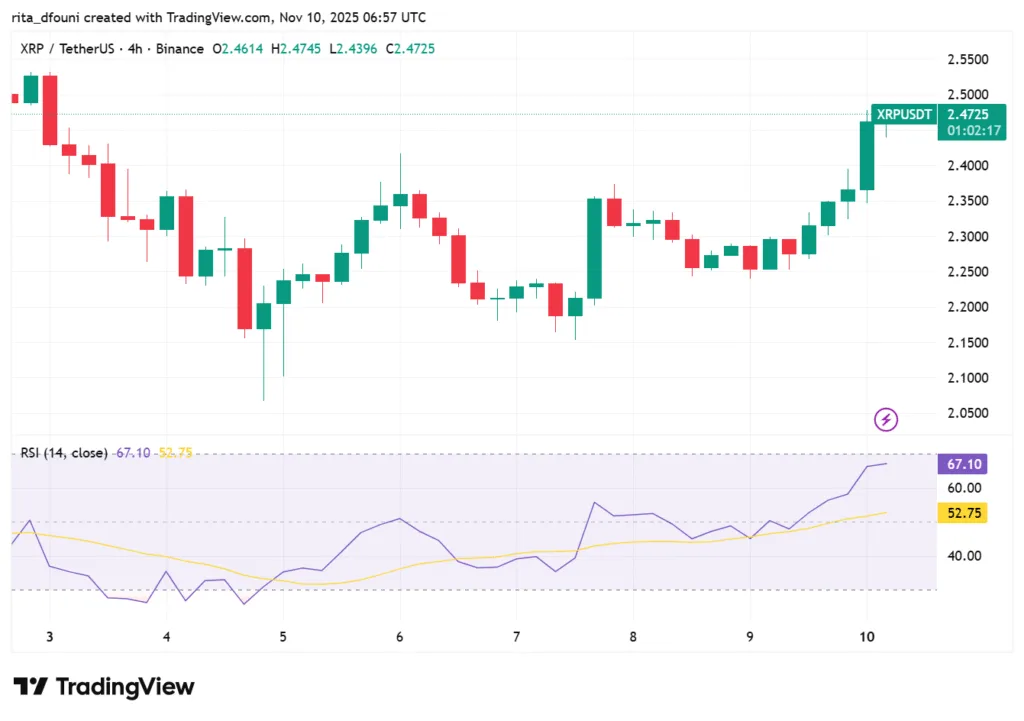
After many days of tight consolidation, XRP maintains a stable structure as it enters the November 10 session at USD 2.98. The axis of short-term equilibrium is currently defined by the token’s narrow oscillations between USD 2.94 and USD 3.03. The XRP community’s sentiment is remarkably stable despite the low price action, supported by consistent institutional headlines and fresh hope for international payment connections.
XRP has performed better over the last two weeks in terms of resilience as opposed to velocity. XRP has subtly drawn a fresh influx of capital from investors looking for stability with potential growth, even as high-beta assets like Solana or joke tokens continue to garner intraday attention. Market-maker activity has grown, liquidity depth across major venues is still solid, and a bid density of between USD 2.90 and USD 2.94 indicates strategic accumulation rather than retail churn.
The continuous transformation of XRP from a speculative token into an institutional settlement asset continues to be the key argument in favor of the cryptocurrency. Even while short-term traders are still focused on technical resistance at USD 3.03, trust in the network’s long-term viability has increased due to new cross-border partnerships and the fact that many central banks are still investigating pilot integrations built on top of RippleNet.
Technical structure
The construction of XRP is simple and symmetrical. The resistance level, which has blocked all upward attempts since late October, is still set at USD 3.03. Bullish breakout circumstances would be confirmed by a daily close above that threshold, with opening targets at USD 3.20 and USD 3.30 levels that correspond to the April swing high.
Between USD 2.91 and USD 2.95, support is piled; below that, USD 2.85 serves as the last line of structural defense. The constructive bias remains intact as long as buyers retain initiative above USD 2.90, even if losing this level would probably cause stop-loss cascades toward USD 2.78.
Momentum signs point to a slow comeback. With an RSI of 56, there is potential for upside growth without going overboard. After a brief bottom, MACD lines are curling upward, indicating that the negative pressure is abating. Volume analysis reveals a decline in sell-side participation; vigorous absorption has greeted each decline below USD 2.95.
To put it briefly, the technical configuration of XRP is similar to a coiling spring that is relaxed, compressed, and awaiting confirmation.
Derivatives & positioning
Data from derivatives supports the neutral-to-bullish technical perspective. A slight imbalance in leverage is implied by perpetual funding rates, which are close to +0.01%. At a moderate level of USD 520 million, open interest supports the notion of careful engagement as opposed to speculative enthusiasm.
Compared to majors, options activity is low, but it is clearly directional: calls at USD 3.10 to USD 3.20 continue to be the most traded strikes for mid-month expiries. With a 25-delta risk-reversal close to +1.2%, the implied volatility surface is slightly biased to the right, which is consistent with bullish protection flows.
Additionally, exchange statistics show that market-neutral strategies are becoming more active. Basis spreads in XRP futures have increased from 2.8% a week ago to over 4% annualized, a small but significant indication that institutional arbitrage desks are resuming carry bets following a period of inactivity.
When taken as a whole, the derivatives posture is still positive but balanced, providing the perfect starting point should spot prices validate technical breakout.
On-chain & network health
The XRP Ledger is still exhibiting outstanding consistency. On average, there are 1.4 million transactions each day; this steady amount is maintained by institutional remittance flows rather than speculative transfers. Unique active addresses are around 85 K, which has remained constant for three weeks in a row. There is no euphoria.
Even during increases in peak load, network throughput maintains sub-three-second settlement rates, making it one of the fastest in the market. In the meantime, the daily creation of new trust lines has increased by 7% month over week, indicating continued uptake in liquidity corridors connected to fintech apps.
A slight drop of 30 million XRP in total wallet balances across verified exchanges indicates slight outflows into custody or cold storage solutions, which is a historically positive on-chain signature that suggests investor confidence in long-term holding.
Macro alignment
The macro correlation profile of XRP has changed slightly. In contrast to previous cycles, when it closely followed the Bitcoin liquidity cycle, the structure of 2025 exhibits a smaller beta to BTC and a greater sensitivity to themes related to cross-border settlement. In addition to market momentum, the token’s value story now more closely links to international payment systems and regulations governing digital assets.
Institutions are reevaluating XRP’s settlement utility in corridors underserved by traditional SWIFT infrastructure as regulatory frameworks stabilize in both Asia and the United States. Therefore, the token’s anti-cyclical potential is what makes it so appealing to a large audience. While most cryptocurrency assets respond to sentiments of risk, XRP becomes significant when traditional systems exhibit friction.
The argument for alternative payment assets is further strengthened by a declining dollar and relaxing interest curves. Because digital infrastructure liquidity benefits from macronormalization rather than volatility, XRP may eventually behave less like a speculative asset.
Investor psychology
One of the most divided and steadfast investor bases in cryptocurrency is still that of XRP. Years of regulatory endurance have given long-term holders the confidence to act with quiet conviction. Instead of seeing every consolidation as stagnation, they perceive it as accumulation.
Compared to earlier cycles, the social tone has mellowed; cautious confidence has taken the place of excitement. Instead of focusing on speculative price objectives, traders are increasingly referring to fundamentals such as validator distribution, transaction speed, and corridor volume. Even though they are less powerful, retail traders are still active at important psychological levels like USD 3.00, which serves as a battleground and a magnet.The lack of extreme sentiment points to balanced optimism that is grounded in reality rather than hype.
Outlook
The USD 3.03 resistance line centers on XRP’s short-term trajectory. A daily close above that level ought to encourage follow-through in the direction of USD 3.20–USD 3.30, reviving momentum and possibly attracting capital rotation from traders who have been sidelined. If not, the coin might spend another week bouncing between USD 2.94 and USD 3.03, a range-bound pattern that encourages methodical accumulation tactics rather than breakout chasing.
At its core, XRP’s positioning is still admirable. Resilience is shown by macro alignment, network stability, and institutional involvement. Impulse, the spark that transforms credibility into price growth, is the sole component lacking. That spark might strike without much notice if mood is kept in check and derivatives are in line.
Cardano (ADA) patience over popularity
Market overview
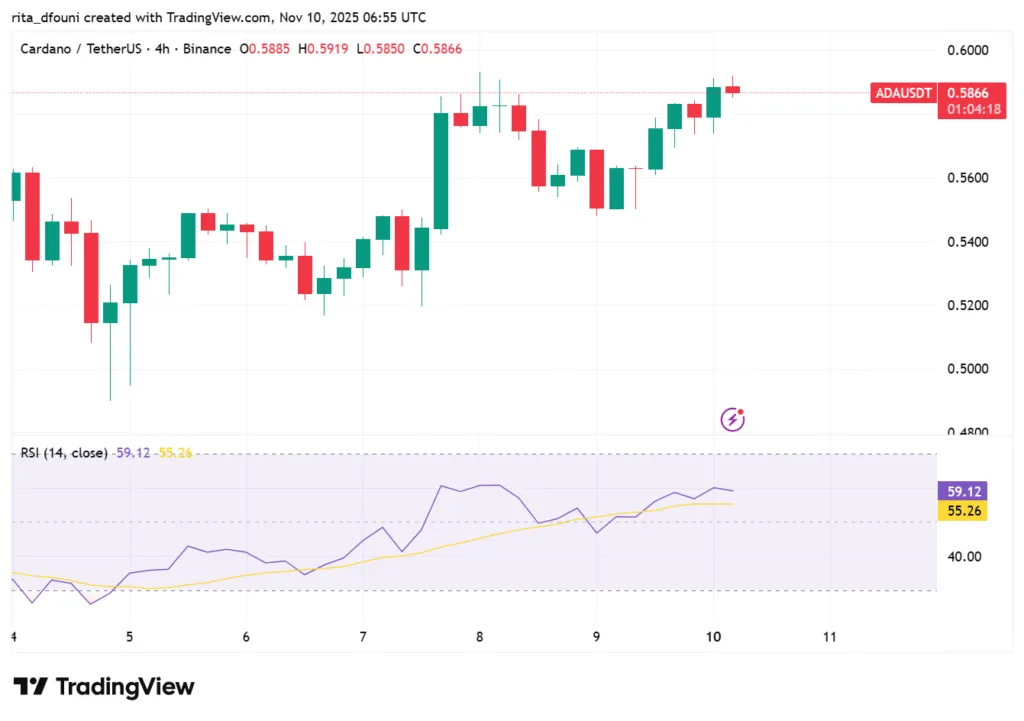
Cardano prints an intraday high of USD 0.893 and a low of USD 0.853 before starting the November 10 session trading close to USD 0.876. The network continues to attract consistent developer attention and gradual adoption, even though the price action is still muted. ADA’s transition from speculative exuberance to careful accumulation is highlighted by its muted volatility, which stands in stark contrast to the swift rotations of the larger altcoin complex.
On major exchanges, liquidity is steady: order-book slippage measurements have improved by over 10% since early October, and depth around USD 0.85 to USD 0.86 is still thick. Despite its modest size, institutional flow is nevertheless good, especially when it comes to staking products that provide yield without the need for leverage. Although there have not been any notable catalysts, ADA’s structural resilience has been maintained by this modest perseverance.
Technical structure
The chart for Cardano is still in line with its long-term equilibrium. The range between USD 0.90 and USD 0.905, where prior rallies stalled, continues to be resistance. Validating a breakthrough pattern and projecting targets toward USD 0.96 and USD 1.02 the highest goal since mid-summer would require a clear daily close above USD 0.905.
The USD 0.847–USD 0.85 range is support. The wider demand pocket, which has been a pivot for the past four months, is located below that at USD 0.82–USD 0.84. The MACD histogram is flattening at neutral, indicating equilibrium before push, while the RSI near 57 indicates possible energy for extension. These momentum indicators lean constructive.
The volume is still moderate, and there has been steady absorption with each dip into the low-0.85 range. The profile of ADA is structurally similar to a slow-burn basing process, in which accumulation occurs subtly until a single macro catalyst causes breakout awareness.
Derivatives & positioning
Perpetual-futures funding is almost neutral at +0.008%. Open interest is close to USD 410 million, up roughly 3% from the previous week, suggesting a modest influx of capital devoid of speculative leverage. For late-November expiries, there is little options activity, but open interest is directionally bullish and concentrated around the USD 0.95–USD 1.00 strikes.
At +0.9%, the 25-delta risk reversal is somewhat positive and leans slightly in favor of call protection. Realized volatility trails at 39%, while implied volatility has dropped to 42%, which is in line with the 60-day average. An early indication that ADA’s stillness may soon give way to movement is that such a close connection usually comes before expansion.
On-chain & ecosystem health
The on-chain environment of Cardano is still stable and systematic. The total delegated stake reaches 23 billion ADA, or about 64% of the circulating supply, while active addresses hover around 185 K per day, only slightly below September’s high. Even in times of stagnation, this deep staking ratio indicates investor conviction.
Deployments of smart contracts have increased by 4% every month to surpass 430 K. Among proof-of-stake networks, developer engagement across GitHub repositories continues to be at the top, demonstrating that the ecosystem’s advancement is not determined by cost. The Hydra scaling framework and sidechains are still expanding in silence; the number of Hydra heads has already reached 2,000, which is a major milestone in throughput scalability.
Despite the lackluster buzz, on-chain transaction costs are still very cheap, averaging USD 0.12, making it one of the top ten blockchains that consistently support retail use and NFT transactions.
Macro alignment
The conservative structure of ADA is favored by macro tailwinds. Capital is shifting toward yield-bearing, low-beta assets as global yields are cooling and cryptocurrency volatility is getting close to annual lows. Cardano can serve as a quasi-bond substitute in cryptocurrency portfolios because of its 3.4% yearly staking return, which compares favorably to risk-free rates adjusted for inflation forecasts.
Furthermore, the growing institutional emphasis on sustainability has an indirect positive impact on Cardano. When digital-asset investment products start to grow again in 2026, its energy-efficient consensus mechanism puts it in a good position for ESG-screened allocations. In summary, macro calm increases the allure of ADA as a defensive growth play.
Investor psychology
When it comes to ADA, quiet endurance has emerged as the adult approach. Unfazed, long-term investors view the current levels as opportunities for generational accumulation rather than as grounds for impatience. Retail discourse is notably more subdued, forums are quieter, and mood indicators are neutral. Because it prevents over-speculation and allows belief to spontaneously reassert itself, the absence of noise is advantageous.
Expert investors classify ADA as a low-beta, high-stability exposure that is a “slow compounder” that fits in with ETH’s productivity and XRP’s settlement tale. While patience has replaced euphoria, conviction has not diminished; it has only matured.
Outlook
ADA is at a turning point as of November 10. Rekindled interest from sidelined capital would be triggered by a daily closing over USD 0.905, which would confirm the breakout and expose USD 0.96 -> USD 1.02. The consolidation box between USD 0.85 and USD 0.90, where staking yield continues to reduce volatility, would be extended if that level could not be regained.
From a structural perspective, the idea that ADA is coiling silently is supported by every statistic, including investment, on-chain traffic, and sentiment. It is in a position to join the rise as liquidity widens, even though it might not lead it. Cardano has continued to create an asymmetry that is frequently only apparent in hindsight, even though the market may have momentarily forgotten about it.