



From permission less idealism to capital reality
The initial competitive advantage of crypto was its transparency. Anyone was free to create, release, trade, and grow their project without any restrictions. This transparency not only led to great innovations but also limited the types of investors who were willing to enter the market. The crypto world is entering the year 2026 and the market has already changed its criterion for selecting the projects to support. Now it is a matter of the ones that are the most comprehensible in practice.
Compliance has changed from being a growth limiter to the very requirement for expansion. The next round of protocols that will last will not be determined by their loudness or by their ideological purity, but by their capacity to take in institutional funds with no interference. In the given situation, compliance acts as a barrier not because it keeps the users out, but because it keeps the uncertainty out.
Why compliance became a competitive advantage
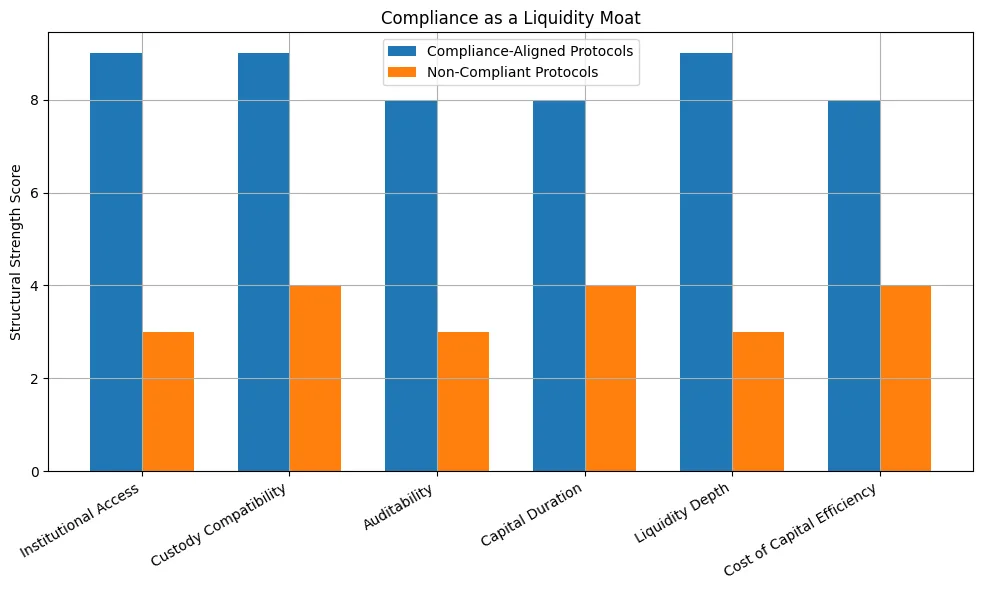
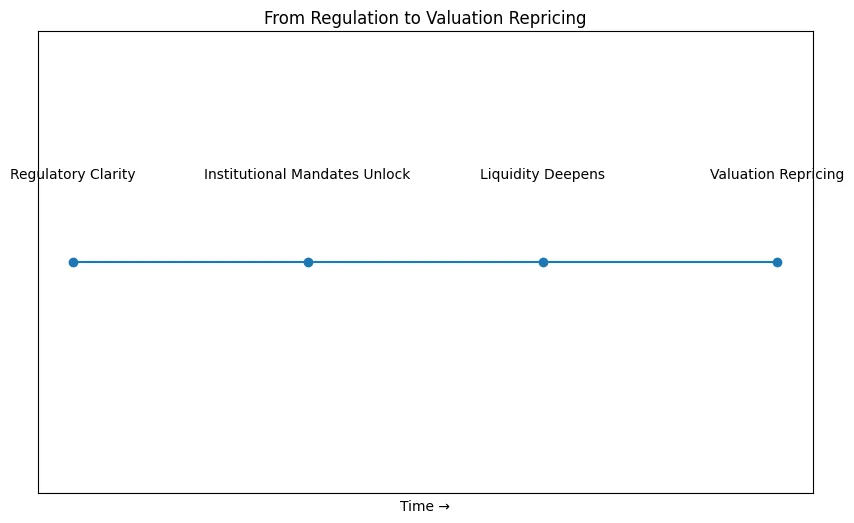
Market behavior already reflects the regulatory phase shift. Legal uncertainty, which was the reason why certain assets used to be traded at a discount, is being lifted and these assets are being repriced accordingly. On the other hand, projects that do not comply with institutional requirements are experiencing liquidity increasing only in certain areas instead of overall. Money does not just avoid risk but also avoids situations where it is not clear what is going on. Compliance leads to certainty in different areas such as custody, reporting, settlement, and governance.

The certainty in cost reduces the capital perceived cost, and this in turn makes it possible for protocols to draw in more considerable liquidity, longer holding periods, and more stable participation. Eventually, this leads to dominance. It is not about making the regulators happy; it is about being in sync with the large allocators’ operational reality, whose investments require clear tracing, accountability, and jurisdiction.
How compliance redistributes volatility
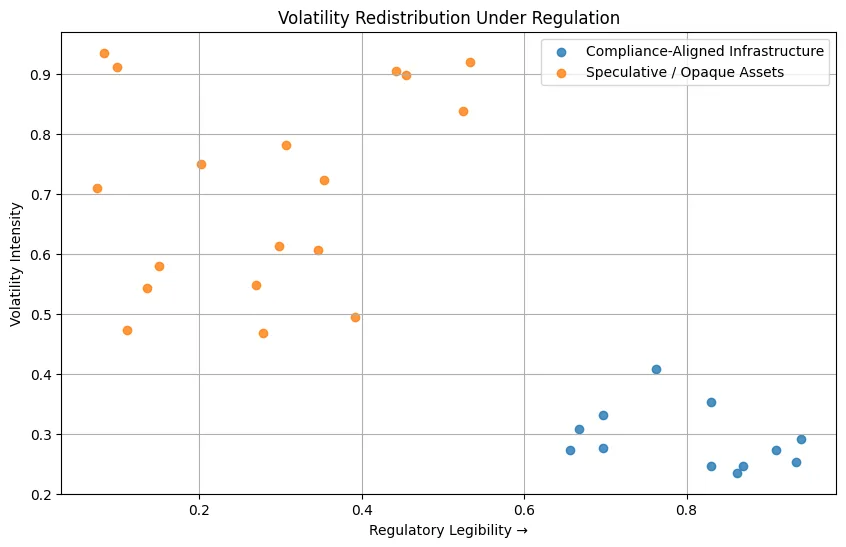
Regulation is one of the most misunderstood factors when it comes to its effect on volatility. The crypto market remains rife with volatility even after the introduction of regulations; rather, it changes the pattern of volatility distribution. There is a separation of the crypto market into two: one side of the market is represented by compliant venues and assets that absorb institutional flows and exhibit low volatility, while the other side experiences the migrating volatility which is absorbed by non-compliant or less regulated tokens and thinner liquidity pools.
Hence, a bifurcated market structure is created. On one side of the market are those assets that have the highest level of legal certainty, the best transparency in governance, and the most access to institutional investors, which start to act like macro instruments. On the other side, speculative assets suffer through price changes from retail investors’ reflexive behavior. This does not lead to a calmer market in general, but rather to a more divided market. Volatility is now determined through compliance where it exists.
Infrastructure wins before narratives
In the past, different stories around cryptocurrencies influenced the market prices. With infrastructure getting ready, however, the money is moving before any of the stories even get formed in the current cycle. Custody compatibility, auditability, reporting standards, and settlement finality are becoming the new kings in the market, while branding is only the queen. The protocols that incorporate these features from their very start are the ones that will be able to access the liquidity pools which are not very fast in rotation and do not follow the ups and downs in the market.
This will lead to a steady demand that is not based on temporary hype but rather on a fundamental consumer base. The winners of this cycle will not be the ones who sell the future, but the ones who come in unnoticed and become part of the existing financial workflows without making banks and other institutions change their operating models.
The new definition of ‘Decentralized Enough’
The decentralization debate is not just either-or anymore. It has become a matter of context. Systems are tolerated by the markets that maintain the decentralized execution and at the same time have the support of access layers that are compliant with the laws. The hybrid system permits the protocols to resist the censorship at the lowest level while providing regulated entry points for the capital that needs them.
In reality, it means that the argument has moved from “permissionless versus permissioned” to “where is permission applied, and for whom.” The protocols that give a precise rather than an ideological answer to this question are the ones that attract lasting adoption.
Compliance as a barrier to entry
Compliance once attached to infrastructure, it is very hard to unattach. Regulatory interactions, licensing routes, jurisdictional structures, and organizational trust are time-consuming processes and cannot be duplicated. This is the point where the compliance changes into a moat.
The newcomers might be able to replicate the code, but they cannot easily replicate the regulatory alignment or operational credibility. Gradually, this sets up a winner-take-most situation where only a few compliant protocols monopolize liquidity while others remain to be structurally peripheral.