




The crypto markets do not always divide themselves into separate narrative elements and thematic components and different sector rotation patterns. The market experiences a period when all market activities move toward one particular direction. The phase causes market participants to lose their ability to differentiate assets which results in increased market correlations and all diversification techniques becoming ineffective. The Correlation Singularity Monitor is designed to detect this particular environment. The premise is simple but powerful. The market enters a one-trade regime when cross-asset correlation reaches high levels while Bitcoin becomes the primary driver of major cryptocurrency price movements and liquidity conditions decrease.
The market operates under a system which reduces all assets to their basic common traits. Portfolio construction patterns experience deterioration as assets lose their unique properties. The diversifying risk evaluation systems which assess market exposure start to misestimate risk outcomes. The Correlation Singularity Monitor formalizes this transition. The system goes beyond basic volatility monitoring. The system categorizes different liquidity states while it shows the moments when the cryptocurrency market stops operating as separate assets and starts functioning as a unified synchronized market system.
Structural premise: When everything trades as beta
The cryptocurrency market operates as a disjointed system during periods of economic expansion. The two types of tokens which belong to AI technology show complete distinction from memecoins. The value of Layer-1 assets moves independently from their associated infrastructure investments. Investors shift their funds between different investment stories.

Alpha generation receives its boost from the market movement which creates price dispersion. Relative value strategies succeed because they use assets whose relationship between prices shows low connection. The market undergoes two cycles which create opposite effects. The market experiences a decrease in available funds. The market experiences a reduction in borrowed funds. Market makers decrease their potential losses through inventory management.
The market participants stop keeping their particular investments separate and decide to invest in general market trends. Bitcoin acts as the primary market driver which causes altcoins to stop trading based on their individual market structures. The financial markets show a pattern of increased cross-asset correlation during these periods. The left foot brings together two points which exist in different physical locations.
The market starts to follow beta movements. The market experiences a complete loss of independent asset returns. The market shows synchronized price changes for all assets. Even tokens which used to function as separate entities start to reflect the general market trends. The state of a Correlation Singularity exists. Correlation does not spike because of this phenomenon. The asset class shows complete loss of price movements across its entire range.
Rolling cross-asset correlation engine
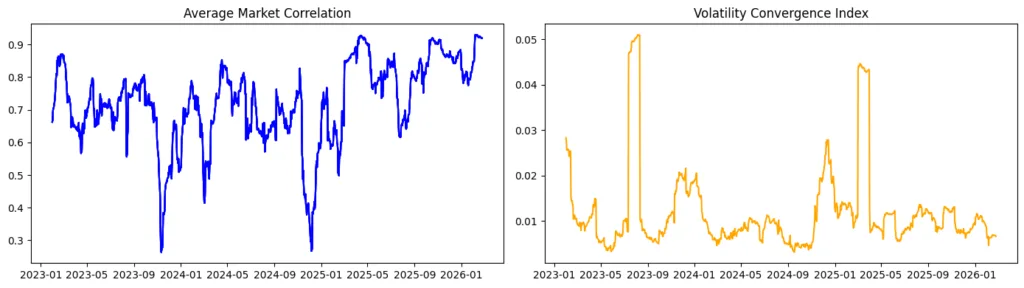
The first layer of the monitor measures rolling cross-asset correlation across major crypto assets. It investigates time-dependent network behavior by tracking short-term emergency situations and extended network development periods. The crucial aspect of this situation needs to be understood through two aspects which include persistent connections and broad network connections. The situation receives an alert when average correlation reaches above historical stability thresholds and stays above that point.
The signal strength increases when the correlation matchings show a simultaneous pattern of reduced dispersion. The dispersion collapse shows that all assets are moving together as one single group because they all move in unison. The transition leads to results which connect with the following outcomes. The market shows a decline in cross-sectional alpha.
The method of sector rotation does not produce successful results. Traders who look forward to experiencing different performance results will instead face drawdowns which happen at the same time as market rallies. The system monitors two aspects which include asset correlation status and their current independence state.
Beta dominance detection
The first layer of the monitor measures rolling cross-asset correlation across major crypto assets. It investigates time-dependent network behavior by tracking short-term emergency situations and extended network development periods. The crucial aspect of this situation needs to be understood through two aspects which include persistent connections and broad network connections. The situation receives an alert when average correlation reaches above historical stability thresholds and stays above that point.
The signal strength increases when the correlation matchings show a simultaneous pattern of reduced dispersion. The dispersion collapse shows that all assets are moving together as one single group because they all move in unison. The transition leads to results which connect with the following outcomes. The market shows a decline in cross-sectional alpha. The method of sector rotation does not produce successful results. Traders who look forward to experiencing different performance results will instead face drawdowns which happen at the same time as market rallies. The system monitors two aspects which include asset correlation status and their current independence state.
Liquidity compression index
Correlation spikes develop as separate events which should be understood as indicators showing liquidity contraction. The Liquidity Compression Index functions as a measurement tool which determines structural market tightening throughout different trading environments. The system measures market conditions through four parameters which include depth reduction and spread widening and derivatives positioning normalization and volatility convergence. Market makers decrease their cross-asset arbitrage operations when order book depth decreases while spreads increase across different trading platforms.
The reduction process leads to increased synchronization. The occurrence of liquidity compression will happen before the correlation singularity takes place. The system eliminates the structural buffer which enables assets to move apart from each other. The lack of liquidity makes it hard to create different assets. Capital creates a single concentration point which leads to markets operating in a specific trading pattern. The index functions as a stress measurement tool which goes beyond its basic purpose. The system detects hidden structural weaknesses which develop during the time period.
Diversification illusion score
The Diversification Illusion Score represents the most vital output produced by the system. The metric combines four different factors which include correlation levels and beta dominance strength and liquidity compression and volatility convergence to create a single indicator of market conditions. Healthy dispersion exists at low levels of dispersion. The assets maintain sufficient independent movement which enables portfolio construction to proceed without issues. The process of increasing score values results in gradual loss of diversification.
The critical point of single-factor investment starts at the established critical limits. Institutional mispricing occurs most frequently at this particular location. Risk parity strategies see their performance decline. Volatility targeting produces market instability. The current hedging process has lost its power to protect against risks. The approach to managing realized volatility leads to higher tail risk which develops over time. The Diversification Illusion Score uses risk to create a new perspective. The system measures market volatility through its assessment of market independence from other factors.
Regime classification framework
The monitor applies its system to analyze market behavior by combining four factors which include correlation and beta dominance and liquidity compression and dispersion metrics. In distributed regimes, dispersion supports alpha. The relationship between two variables stays at a moderate level while the story elements of the situation develop through different phases.
The increasing synchronization between participants in converging regimes leads to stable liquidity conditions. The synchronization between market activities increases while liquidity conditions become more restricted in compression market environments. In full Correlation Singularity regimes, beta dominance is overwhelming, liquidity stress is confirmed, and diversification collapses. This classification provides clarity for institutional committees. The system transforms complicated patterns of market interactions between different markets into clear operational status which shows different market conditions.
Institutional implications
The requirement for hedge funds to evaluate their gross exposure stems from correlation singularity which requires new assessment methods. The market experiences decreasing strength of relative value trades while its factor diversification benefits have become less valuable. The risk budgeting models need to change because organizations have started to achieve structural convergence together with their historical correlation requirements.
The inventory management process for market makers becomes more vulnerable to market fluctuations. The spread calibration process needs to modify its parameters according to the market’s synchronized volatility patterns. The risk of providing liquidity increases when the market experiences heavy order flow that moves in one direction.
The core risk that allocators need to manage arises from their belief that multiple investments will provide them with protection against market fluctuations. The practice of holding multiple tokens does not provide diversified exposure because extreme beta dominance requires different evaluation methods. Hedge overlays together with dynamic exposure reduction methods show better performance than organizations that use static allocation changes. The main point about the need for access to information about financial markets requires retail participants to understand it. The market experiences systemic exposure through leverage when altcoins start to behave as one asset instead of maintaining their individual identities.
Historical context
The history of cryptocurrency contains multiple instances of correlation singularity regimes. The market downturns resulted from three distinct phenomena which included liquidity-driven crashes and market structural interruptions. The pattern shows that dispersion collapses before volatility reaches its highest point.
The strength of synchronization increases between two events which result in drawdowns that become more pronounced. The periods become clear in hindsight. The periods become difficult to identify during actual time. The monitor exists to identify them before peak stress.Crisis situations develop through correlation but correlations function as crisis amplifiers.
Implementation framework
The prototype implementation tracks rolling correlations, calculates Bitcoin beta dominance using regression, and approximates liquidity stress using volatility convergence proxies. The expanded versions would use order book APIs together with funding rate dispersion metrics and stablecoin supply changes and cross-exchange liquidity synchronization. The goal is not a static chart but a dynamic institutional dashboard capable of real-time regime detection.