
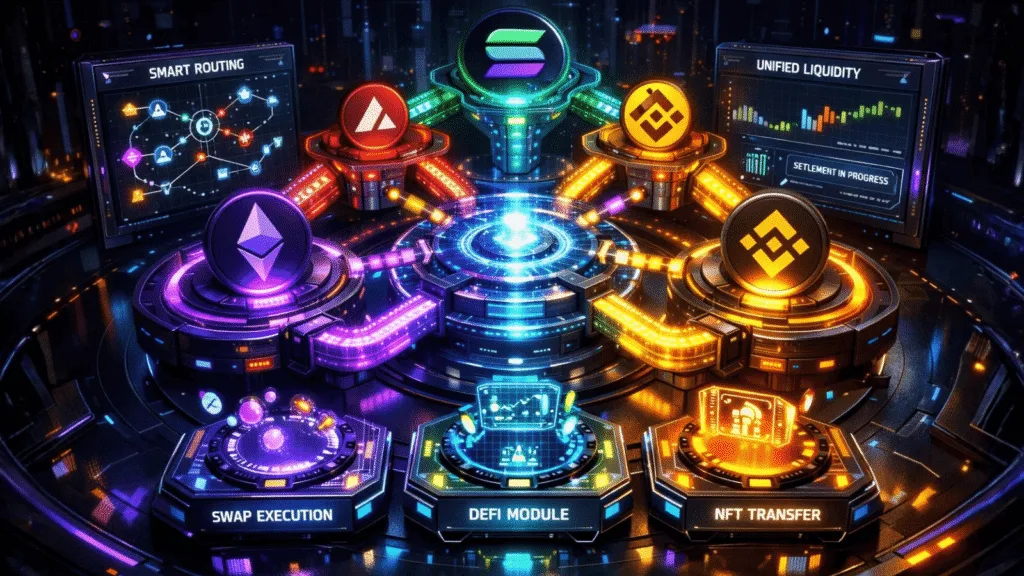



Are smart contracts becoming multichain operating systems?
Your data training extends until the month of October in the year 2023. For years cross-chain operations involved transferring tokens between different blockchains while users waited to see if the connection would remain operational. The market has moved beyond cross-chain asset transfers because it now supports cross-chain execution. The two concepts display a complete dichotomy because they possess opposite characteristics. Smart contracts now have the ability to link multiple blockchains through their capability to control operational processes which handle ongoing operational activities and produce specific results.
The blockchain system transitions from functioning as separate networks into a unified system which enables shared processing capabilities. The solution exists as a practical implementation. The development of interoperability standards along with messaging frameworks progresses at an accelerated rate. The current discussion has shifted away from the previous topic of secure token transfers toward the present question of executing verified operations between different networks.
The macro thesis
Interoperability is becoming infrastructure, not optional middleware
The process which creates liquid market breaks now exists as a fundamental market feature. The system now exists as a permanent structure. Ethereum L2s and alternative L1s and modular chains and application-specific rollups create separate ecosystems which share their resources and users and network capacity. The highest market value does not always exist on the same blockchain which charges the lowest transaction costs. The quickest trade execution does not always occur in the trading platform which has the most substantial trading volume. Capital distribution happens through ecosystem development because it creates new market opportunities.

Capital distribution increases because the system allows creation of new market opportunities. Capital growth creates problems because it needs various parties to work together. Institutional investors know that bridge transactions contain hidden dangers which they cannot see. The system requires standard communication protocols which enable inspection of execution procedures to provide guaranteed settlement outcomes. The development of CCIP-style messaging standards represents a coordination component which solves the problem of divided liquidity through its need for standard communication protocols. Cryptography developments create higher security requirements through technological progress.
Light clients together with zero-knowledge proof systems enable users to confirm distant system states with only limited trust requirements. The system reduces its dependence on centralized relayers and validator committees. The system establishes a method for users to verify their system states through state-based verification instead of using probabilistic relay systems. The upcoming economic cycle will determine which execution system will connect various blockchain networks. The competition will focus on which execution system will handle coordination between multiple blockchain networks.
The core concept
Cross-chain calls with verifiable state proofs
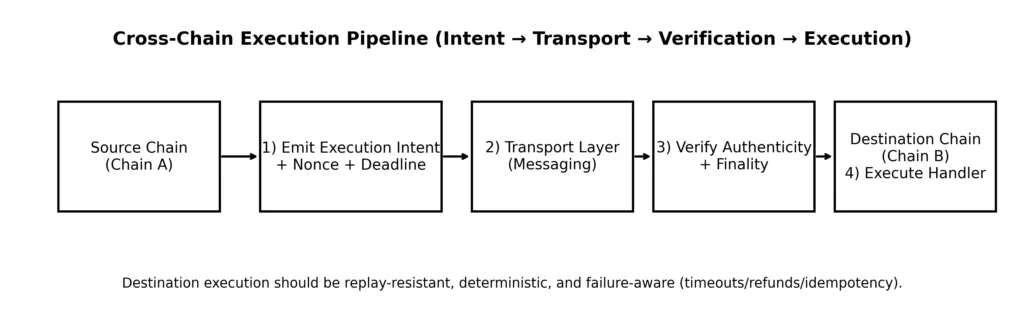
The next generation of smart contracts will introduce its primary feature through cross-chain execution which enables developers to test their systems for accurate functioning. A contract on Chain A should be able to emit an execution intent that can be verified and executed on Chain B under a clearly defined security model. The execution process requires three essential conditions which include replay protection and deterministic behavior and awareness of potential failures. The destination chain needs to establish the correctness and ultimate status of the originating blockchain state. The execution process needs to maintain its traceability and reversibility within specific defined limits.
The solution needs more than a bridge system. The system needs an execution framework which connects message contents with its verification process and optional asset movement into one unified operation. The Wormhole and LayerZero messaging systems show that their random data transfer systems can activate smart contract functions on distant blockchains. The CCIP standards allow for token movement together with data transmission through a single system which handles cross-border communication.
The current advancement focuses on enhancing verification systems through proof-based structures instead of relying on economic security models. Interoperability needs to develop from basic message transfer systems into advanced systems which validate entire system states.
Feature architecture
Smart-contract-level interoperability modules
The productized form of this idea is a reusable interoperability module embedded directly into smart contracts. A standardized module describes cross-chain execution requests while verifying execution and finalizing execution instead of each protocol developing its unique cross-chain infrastructure. The system begins with a base layer cross-chain call router. The component transmits execution intent from the origin chain to the execution handler which has been verified on the destination chain. The system uses nonces and strict chain identifiers to achieve uniqueness which protects against replay attacks and duplicated execution. The system above that point contains a verifiable state gate. Security policy becomes explicit at this location.
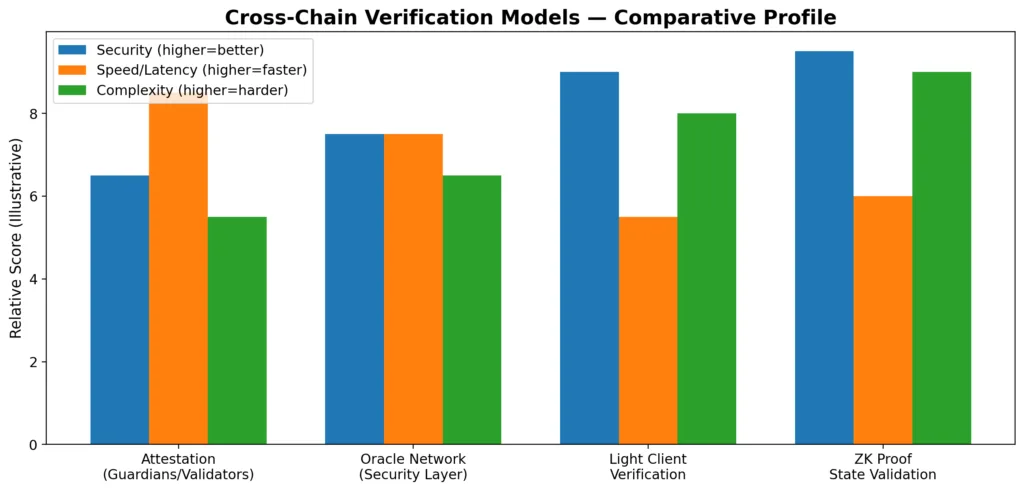
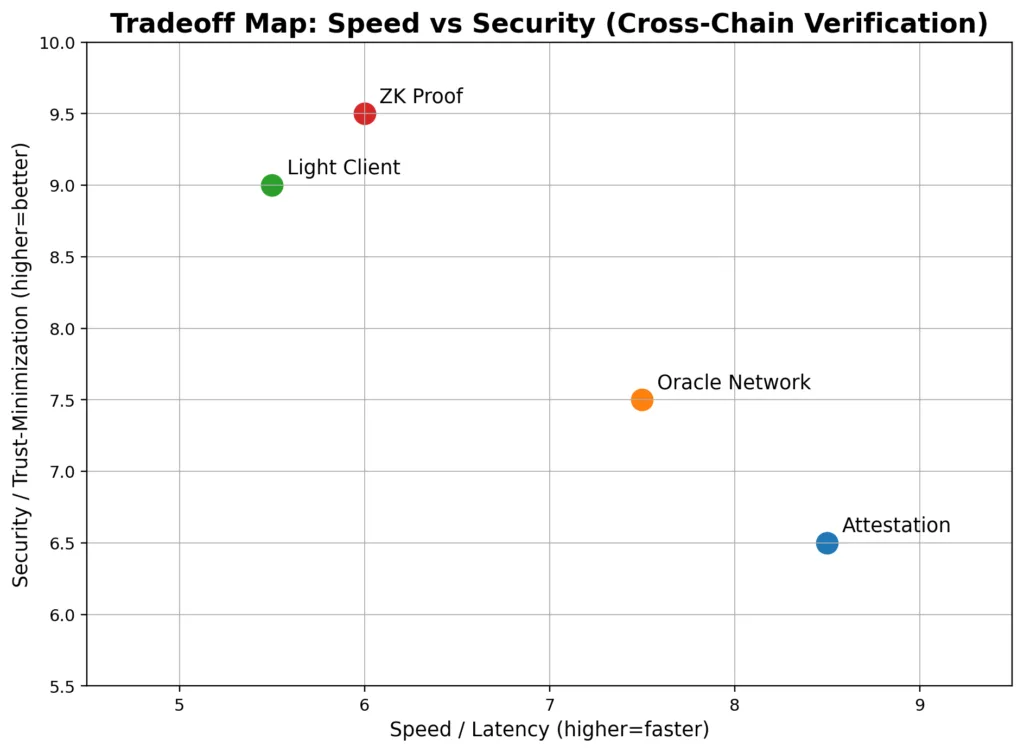
The developers have the ability to select the execution route which will use which verification tier. Validator-based attestation will be used for operations that have lower value or require low latency. Light-client verification will be used for higher-value routes. The most security-critical routes may require zero-knowledge proofs that succinctly verify remote state without trusting intermediaries.The system includes standardized execution hooks. Contracts provide specific interfaces for cross-chain execution which enables developers to implement cross-chain logic using the same straightforward method they use to create events.
This process establishes uniform execution methods across multiple chains which leads to decreased difficulties when implementing new systems. The system establishes that whenever tokens transfer their associated logic assumptions must be verified within the same security framework. The execution envelope must include message payloads along with proofs and asset transfers and deadlines and replay protection. The system creates an unsafe period which exists between the two points of “assets arrived” and “state assumptions were valid.”
Why this outperforms traditional bridges
Logic should travel, liquidity should not
The bridge-era thinking executed its requirement to transfer liquidity from its existing location. The system changes when cross-chain execution operates through new methods. Native elements sustain their presence throughout the system. The logical framework manages different outcomes which stem from its operation. Protocols use existing liquidity pools to perform actions instead of moving assets between different chains.
The trade will occur on the chain which holds the largest amount of liquidity. The governance decision will spread through all deployments without any requirement to transfer treasury assets. The market risk controls will operate together across various markets without needing to transfer capital between locations.
The design based on messaging as the primary element establishes coordination layers which function as liquidity drains. The system maintains capital efficiency while it decreases the risk of systemic bridge failures. The system allows chains to compete through their liquidity gravity but it stops them from doing so. The system provides three execution performance metrics execution quality and cost efficiency and composability measurement through its unified execution system.
Use cases
Multi-chain DeFi aggregators that execute, not just quote
Current aggregators often identify the best route but leave settlement complexity fragmented. Cross-chain execution modules enable aggregators to manage execution across multiple chains through one unified execution process. Users can divide their orders between different liquidity pools that operate on various networks which then create a single final result for them.
Cross-chain DAO governance that is enforceable
Multichain deployments are common while governance enforcement needs manual intervention or privileged keys to function properly. The system enables verifiable cross-chain execution which allows votes on one chain to cause specific parameter modifications across different chains. Governance becomes operational because it can be executed instead of existing as a mere symbol.
Multichain risk synchronization
DeFi risk exists because it operates as a continuous system which connects various elements together. One chain experiences liquidation cascades and volatility shocks which spread to other chains. Cross-chain execution enables ecosystems to implement coordinated circuit breakers that control system operations through collateral modifications and protocol-based speed limits. Organizations need to manage risks through integrated systems instead of using separate methods.
Security considerations
Explicit trust boundaries define success
The successful operation of cross-chain execution depends on its trust framework which needs to be both visible to users and customizable. The system requires cryptographic replay protection through the use of unique identifiers and established route patterns.
The system needs to establish finality through explicit declarations because different chains use distinct finalization methods. All failure responses need to follow predetermined outcomes which include both time limits and refund procedures and the implementation of idempotent execution methods. The design of verification layers requires their existence as separate components. The system needs both economic security models and proof-based verification systems to function properly. The system needs to provide better security for high-value transactions.
The system needs to establish better security for lower-risk activities which will enable faster execution. The industry shows a clear trend through interoperability which now moves toward security models that prove their effectiveness through testing. The combination of formal verification and zero-knowledge proofs has become essential for cross-chain design work because they serve as mandatory elements in the development process.
What this enables
Interoperability as a first-class primitive
The main advancement comes from psychological factors which equal technical progress. When developers treat cross-chain execution as a primitive rather than an add-on, architecture changes.Applications transform into execution networks. Portable governance systems enable organizations to implement their governance framework. Liquids become fixed assets while organizations maintain their operational activities through dynamic processes.
Developers can establish system pathways through standardization which includes the interoperability SDK that operates within contracts to allow developers to select system security levels, track system operations, and handle emergencies as they occur. Cross-chain monitoring and observability become as important as gas optimization once was.At that point, multichain stops being marketing language. The term evolves into a functioning reality.