


Throughout the majority of 2025, the cryptocurrency market appeared to have missed its opportunity. Bitcoin reached new peaks but then plateaued. Altcoins did not gain momentum. In contrast, equities continued to rise, and gold experienced one of its most significant rallies in decades. To the casual observer, the conclusion seemed evident: cryptocurrency had diminished in competitiveness.
That conclusion, as stated in Bitcoin Suisse’s Outlook 2026, could not be more deceptive. Underneath the frustrating price movements, the cryptocurrency sector dedicated 2025 to a task far more significant than merely rallying: it subtly reconstructed its foundations. If the previous year was when markets misinterpreted the resilience of crypto, then 2026 might be the year when those fundamental aspects finally come to the forefront.
This narrative does not pertain to yet another speculative increase. Instead, it focuses on a change in regime, one that is propelled by macroeconomic realities, the intricacies of institutional frameworks, and a market structure that progressively favors cash flow rather than mere storytelling.

The paradox of 2025
This narrative does not pertain to yet another speculative increase. Instead, it focuses on a change in regime, one that is propelled by macroeconomic realities, the intricacies of institutional frameworks, and a market structure that progressively favors cash flow rather than mere storytelling.
However, capital flows presented a contrasting narrative. Institutional investments emerged, albeit through limited avenues. Early in the year, ETFs and digital asset treasury (DAT) strategies were the primary sources of inflows, but these trends diminished as autumn approached. The capital that previously supported extensive altcoin rotations was redirected towards AI equities, a significant gold rally, and public vehicles related to cryptocurrency. As marginal buyers vanished, prices declined, revealing the extent to which this cycle relied on institutional flow dynamics instead of retail responses.
The outcome was a market that appeared fragile, yet in truth, it was consolidating. According to Bitcoin Suisse, the cryptocurrency sector managed to withstand volatility in 2025 with a level of resilience that would have seemed unimaginable just two years prior.
The macro shift that changes everything
The true driving force for 2026 is found beyond the realm of cryptocurrency. The macroeconomic landscape is becoming distinctly favorable, and this time the change is structural instead of cyclical.
The calculations surrounding U.S. debt have reached a point that cannot be overlooked. Annual net interest payments have soared beyond $1.2 trillion, surpassing defense expenditures. With federal debt approaching $38 trillion and the urgency for refinancing increasing, elevated real interest rates are no longer sustainable from a political or fiscal standpoint. Historical patterns indicate that when sovereign nations exceed this limit, the method of adjustment is not through austerity measures but rather through negative real interest rates.
Bitcoin Suisse anticipates that the Federal Reserve’s policy rate will approach 2.0% by the conclusion of 2026, significantly lower than existing forecasts.The process of quantitative tightening has concluded. Over the last two years, global central banks have implemented over 300 rate reductions, representing the most coordinated easing cycle in the past 25 years.Liquidity, which has been limited since early 2022, is set to increase once more.
This is of great significance for cryptocurrency. Bitcoin and Ethereum are currently traded as macro assets that are sensitive to liquidity, directly reacting to expectations regarding interest rates and balance-sheet policies. A policy rate of 2%, along with inflation in the mid-twos, replicates the historical conditions that have previously boosted hard assets, risk assets, and, more recently, digital assets.
Bitcoin grows up
Bitcoin begins 2026 in a distinctive situation: fundamentally optimistic, yet still priced below its estimated fair value. Following two significant corrections in 2025, with a decline of 30% in April and 35% in November, leverage was eliminated, sentiment was recalibrated, and long-term investors increased their holdings.
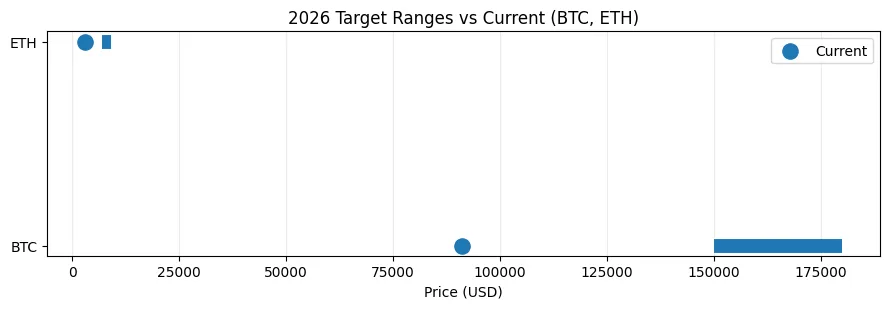
Bitcoin Suisse anticipates new all-time highs in 2026, with prices nearing $180,000. More significant than the target price is the nature of demand. ETF inflows are entering a new phase as major wirehouses commence distribution. Retirement accounts, recently unlocked by executive action, create a structural demand. Early sovereign investors are exploring their exposure.
By the conclusion of 2026, passive vehicles may possess approximately 10% of Bitcoin’s circulating supply. This does not represent speculative capital. Rather, it reflects benchmark-driven, price-insensitive demand that resembles passive equity flows more than any previous trends observed in the cryptocurrency market. Bitcoin is no longer in a position of waiting for recognition as digital gold; it is actively being assimilated as such.
Stablecoins eat finance
If Bitcoin represents the macro asset of cryptocurrency, then stablecoins serve as its utility engine, and the year 2026 could mark the point at which they completely emerge from the industry’s shadow.
Stablecoin supply has exceeded $300 billion, handling trillions of dollars in annual settlement volume, which competes with card networks and significantly outpaces traditional remittance systems.
What started as exchange plumbing is transforming into a neutral, continuously available settlement layer for trade, payroll, and savings, especially in emerging markets where banking is still slow, costly, or politically unstable.
For ten years, this expansion was primarily characterized by a straightforward duopoly: Tether and Circle. Collectively, they continue to represent approximately 85–90% of the total supply. Their model involves issuing tokenized dollars, investing reserves, and retaining the yield, which has proven to be exceptionally lucrative. This very profitability is the reason it faces potential threats.
Yield-generating stablecoins, which transmit a portion of the underlying returns, are experiencing rapid growth. Concurrently, conventional proprietors of distribution fintechs, neobanks, payment behemoths, and even retailers are introducing “in-house stablecoins” to regain the economic advantages they previously relinquished to issuers. Rather than hindering this trend, regulation is propelling it forward by formalizing payment stablecoins and establishing clear pathways for yield-generating frameworks.
The outcome signifies a transition from a duopoly to a three-way competition involving offshore issuers, regulated payment coins, and yield-sharing wrappers, all vying for dominance on the same public infrastructure.
The quantum question
Despite a sense of optimism, there exists a disconcerting issue: quantum computing. Bitcoin depends on elliptic curve cryptography for its digital signatures, and a quantum computer with adequate power could potentially compromise it.
Bitcoin Suisse contends that by the conclusion of 2026, a social consensus will emerge regarding the enhancement of Bitcoin to achieve post-quantum resistance, which will likely lead to the establishment of plans for a soft fork. Currently, approximately 6.7 million BTC, valued at hundreds of billions of dollars, are at risk due to address reuse or outdated formats.
The challenge extends beyond mere technicalities. It brings forth complex issues regarding lost coins, migration deadlines, and even the inactive holdings of Satoshi Nakamoto. However, the overarching conclusion is more comforting than concerning: Bitcoin is facing its inaugural genuine existential engineering challenge with awareness instead of avoidance. This, in itself, signifies a level of maturity.
From narratives to revenue
One of the most overlooked changes approaching 2026 is occurring within the market structure. The cryptocurrency landscape is increasingly consolidating at the upper echelons, even as the generation of value shifts to different areas.
Bitcoin and Ethereum lead in market capitalization, supported by passive ETF flows that function similarly to index demand.However, applications currently account for almost 90% of all fees within the ecosystem, despite representing less than 10% of the total market cap.For many years, regulatory uncertainty hindered the resolution of this discrepancy.
The barrier is diminishing. More defined frameworks are paving the way for revenue distribution, buybacks, and equity-like token mechanisms. Consequently, the application layer, which has long been regarded as speculative, may ultimately be reassessed as a group of high-margin, user-aggregating enterprises.
The implication is a structural tug of war. Passive flows anchor the top of the market, while fundamentals drive breadth below. It is a healthier dynamic than the reflexive rotations of past cycles and one rooted in earnings rather than hype.
A cross-asset moment
Zoom out, and crypto’s story becomes inseparable from the broader market. Bitcoin Suisse frames 2026 as a rare cross-asset alignment: liquidity improving, rate cuts underway, fiscal policy supportive, and risk appetite recovering.
Equities expand beyond large-cap technology stocks.Bonds gain from the relaxation of monetary policy.Commodities shift from a defensive posture to one of cyclical strength.Cryptocurrency, which is becoming more embedded in institutional investment portfolios, serves as a high-beta reflection of these same dynamics.This is not merely a crypto bull market in isolation. It represents a liquidity bull market, and crypto has ceased to be an outsider to it.
The end of the waiting game
Throughout a significant portion of its history, cryptocurrency has been in a state of anticipation for regulation, institutional acceptance, and macro validation. In 2026, this period of waiting concludes. The necessary infrastructure has been established. The regulatory framework is beginning to take shape. The macroeconomic environment is shifting. Whether or not prices respond immediately is nearly irrelevant. What is crucial is that cryptocurrency begins the year with the most robust fundamental foundation of any previous cycle.
In a landscape characterized by inflated equity valuations, substantial debt obligations, and tenuous monetary trust, digital assets have transcended the need for validation. They are becoming progressively harder to overlook.