



Markets don’t mature quietly
The development of cryptocurrency began without any restrictions. People had complete access to create and use financial systems which enabled them to conduct large-scale trading operations without any obstacles. The unrestricted access to resources enabled people to develop new solutions, but it led to the creation of unstable systems. The financial collapse that occurred during the previous economic cycle stemmed from a single fundamental problem which involved businesses taking on too much debt while relying on their limited financial resources.
The failures of FTX, Terra, Three Arrows, Celsius, and recent perpetual funding cascades were not independent events. They represented the internal market problem which had not yet developed a method for accurate risk assessment. Now the community needs to learn this lesson through their emotional response and their mechanical learning process. The cryptocurrency market is moving away from its current state of disorderly trading because it is adopting a new system based on algorithmic control which traders fail to recognize as their primary operational framework.
The end of permissionless leverage
The first cryptocurrency systems treated traders leverage as something they should own instead of something they must repay. Traders wanted to use extreme leverage which exchanges supported while trading platforms made deep risk exposure their standard operating procedure. Traders had the choice to practice risk management because they treated liquidation events as entertainment.

The market needs strong systems which can handle all operational activities. The system had to adapt its capabilities through every successive failure. The system began to use cross-margining methods which required stricter control measures. The system implemented funding rate controls which now operate with more restrictive parameters. The system developed better auto-deleveraging procedures.
The risk engines began to use correlated exposure modeling instead of single position assessment. The current derivatives market shows two fundamental changes since the year 2021. The market experiences smaller liquidations while funding expenses reach their peak for shorter periods and market participants now handle most forced liquidations before they start affecting the spot market. The market showed increased price movements. The market currently determines risk through its pricing system.
Algorithmic discipline is replacing emotional trading
Your training includes data until the month of October in the year 2023. The most significant change requires people to alter their conduct. The retail market now operates through permanent detection methods which enable traders to establish their market presence. Capital now waits for structural alignment instead of chasing candles. The execution process now requires volume confirmation and VWAP positioning and funding normalization and open interest compression. Market participants have stopped using their market sense to understand market conditions. They create market models to understand market behavior.
The current market trends lead to price movements that create stable trading ranges instead of sudden market crashes. The price movement shows a temporary stop which prevents complete market collapse. The market experiences drawdowns which maintain their orderly movement instead of developing into unpredictable patterns. Cryptocurrencies are beginning to implement probabilistic methods which have existed in traditional financial markets for many years. Traders did not become more intelligent because their need to stay alive forced them to improve.
Market structure is forcing maturity
The fragmentation of liquidity together with the implementation of stricter margin regulations and the requirement for improved counterparty standards has created new challenges for the internal operational systems of cryptocurrency markets. The capital market now operates through a smaller number of trading platforms. The risk management systems now function together to protect multiple financial instruments. Market makers operate with stricter inventory limits.
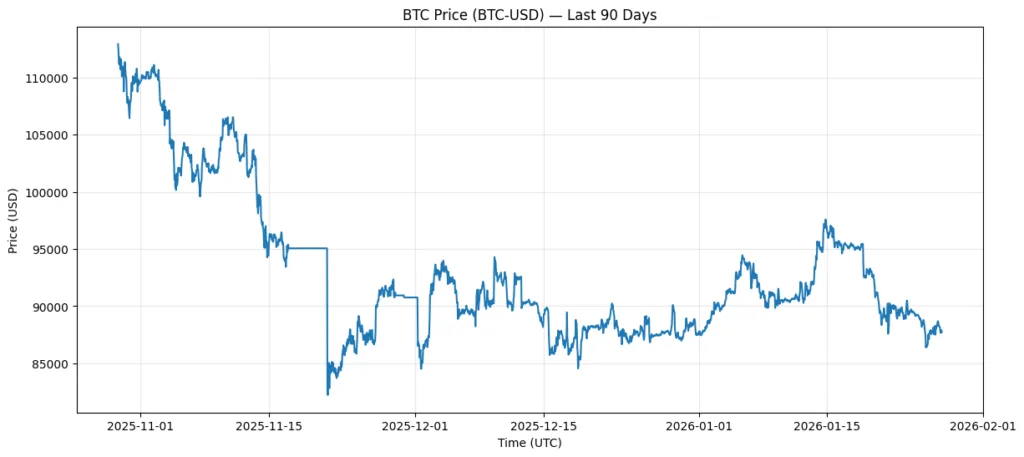
The result is structural containment. Market instruments which previously experienced uncontrolled volatility across multiple trading platforms now display reduced shock propagation to specific areas. The market is currently developing its capacity to handle external impacts. The situation does not provide better security than before. The system has become more orderly since its previous state. Place your macro visual here showing Bitcoin price alongside open interest and funding rates which shows declining volatility despite increasing market activity.\
Trading in a disciplined market
The transition brings about a fundamental transformation of available opportunities. The permissionless era permitted all software to operate without restrictions which attracted aggressive users who sought to gain advantages. The algorithmic era requires users to wait to achieve their desired advantages. The current system needs users to complete multiple steps before reaching system access.
The system requires users to produce additional energy before they can complete their work. The system develops its energy through a gradual process which prevents sudden movements from occurring. The system maintains its forward movement until the established structure confirms its authenticity. The world of cryptocurrency maintains its excitement for people who work in the field. The industry has developed into a formalized business sector.
What comes next
The upcoming stage of the transformation process will provide further advancements. The use of options-based hedging will increase. The market for basis trading will experience growth. The volatility bands will experience a tightening phase. The separation between Bitcoin and Ethereum from speculative assets will become more pronounced. Bitcoin has developed into a macroeconomic collateral asset.
Ethereum has transformed into a financial infrastructure system. High-performance blockchains show increasing tendencies to function as growth-oriented equity assets. All other assets compete to obtain remaining liquidity. The market has developed into two separate trading systems. The market has developed into two separate trading systems.