




When payroll becomes infrastructure
Labor compensation has been a major aspect of the financial system that has remained inflexible for decades. Domestic banks are the ones to pay salaries, and their operation is limited to certain geographical areas, currency regimes, and time needed for settlement.Fortunately, capital markets went through a significant evolution process and became global, digitized and even more programmable. The gap is now being closed by crypto. What was once just a payment method for freelancers in Bitcoin has now turned into a full-scale transformation: the payroll system is going to be entirely based on blockchain.
Not only are startups paying their remote teams with stablecoins, but also are DAOs rewarding their contributors with tokens. This simply means that labor income can be taken outside of fiat banking systems. The change is not driven by ideologies but rather by the forces of the economy.
Why traditional payroll is failing a global workforce
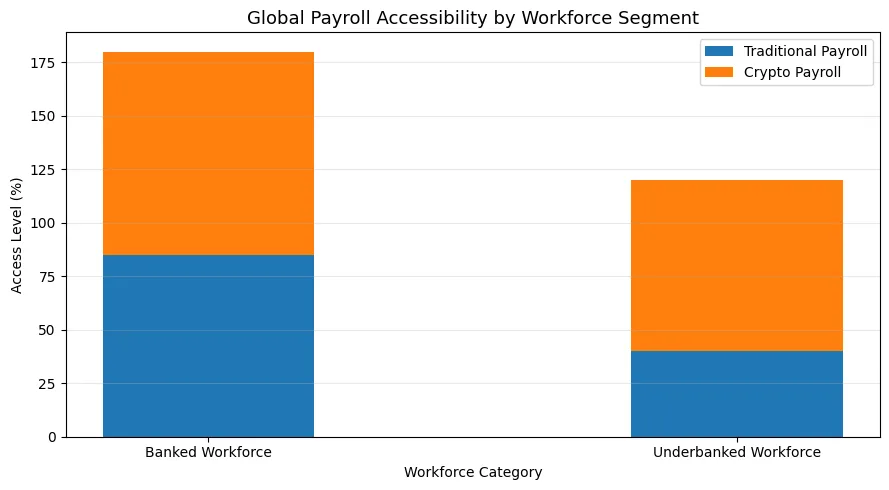
Contemporary job markets are worldwide but not payroll systems. The payment of salaries between countries is still slow, costly, and at times even impossible to process. International money transfers may take several days, charge high fees, and can put employees at risk due to currency conversion. In developing countries, the situation can even be worse because access to reliable banking infrastructure is not always guaranteed. The nature of remote work has greatly contributed to this problem Since they can hire talent from anywhere, companies are still held back in their payment processes, which is the most efficient way of motivating talent.

Cryptocurrency-based payroll addresses properly the issue of coordination: the question is how to transfer money between countries quickly, reliably, and without the help of middlemen. This is clearly not a side effect; it is an answer to a problem of systematic inefficiency.
Stablecoins as the new salary currency
Stablecoins, although not loudly, changed cryptocurrency payroll from being a gamble to a practical solution. Digital assets tied to the dollar permit employers to provide price stability, instant settlement, and worldwide accessibility all without the risk of volatility. For the employees, salaries paid with stablecoins are like digital cash that is programmable. They can be held, converted, saved, or rolled into DeFi yields without waiting for the banks or business hours to come. For companies, using stablecoins means no correspondent banking risk and easier payroll in foreign countries.
To put it another way, stablecoins are starting to take the place of regular salaries, especially in places where inflation, capital controls, or banking friction render income value skewed.
Token compensation and the financialization of labor
In addition to stablecoins, the crypto-native companies have started to reward their employees with governance tokens, equity-like instruments with vesting, or digital assets linked to performance. This practice makes it harder to differentiate between employees and investors. Compensation through tokens brings about a different alignment of incentives. The contributors do not just receive salaries but also gain exposure to the success of the network they are developing.
This, on the one hand, introduces risk, but on the other, it guarantees upside participation through contracts with labor. This is quite similar to the early startup equity compensation but for one major point: liquidity. Tokens, in many cases, can be traded, staked, or borrowed against which changes labor income from being a non-liquid asset (locked equity) to being a financial asset with liquidity (flexible).
DAOs, freelancers, and the on-chain labor market
Decentralized organizations went so far with crypto payroll that they practically made it their ultimate application. Contributions in the form of tasks, proposals, or results are getting payment most of the time without any employment contracts, payroll departments, or geographical limitations. This payment model is quite favorable to modular work, quick co-operation, and worldwide participation.
On the other hand, it can be considered as a negative that such payments are also transparent, auditable, and programmable. To the contrary, it comes with new risks like income instability, lack of legal protection, and regulatory ambiguity. The situation is not chaotic but rather a new labor economy in which speed, flexibility, and composability are the desired features instead of permanence.
Taxation, regulation, and the inevitable normalization
Governments are taking notice. Crypto payroll is raising basic issues:
What is the classification of income?
When does the token compensation become taxable?
Which jurisdiction applies to non-local workers? The reactions of the regulators will not get rid of the crypto payroll; they will make it official.
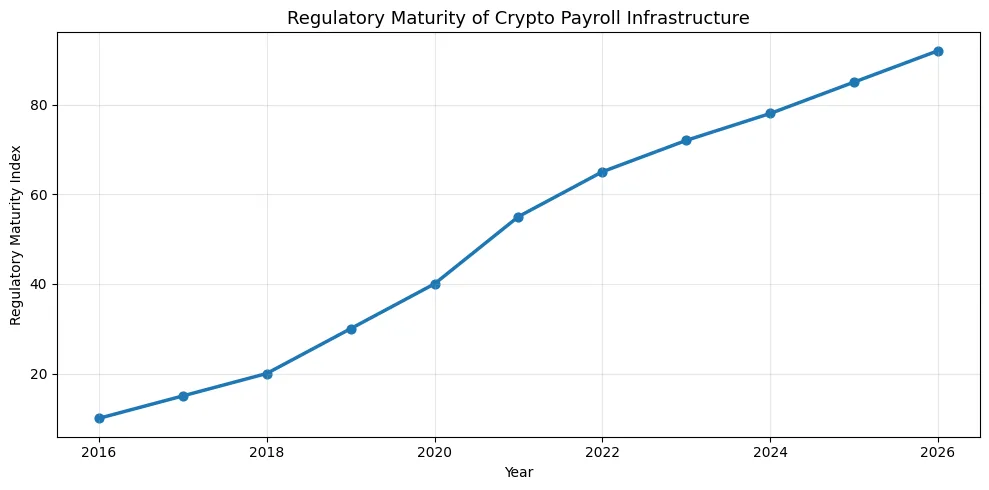
Similar to how online banking was ultimately accepted as regulated infrastructure, the digital-asset payment will transition from gray areas into compliant zones. The early adopters are already setting the standards for best practices. Before regulation feels “clear,” the infrastructure will be rooted already.