



The basic contradiction of cryptocurrency authentication operates through its requirement of trust for market operations while it eliminates user identification. The credibility signals which determine capital flows and code deployments and validator behavior and governance participation and liquidity provisioning exist as current fragmented signals. The present situation includes signals which exist outside the blockchain network and they create unreliable reputational signals which people are able to control through social engineering methods.
The Decentralized Reputation Engine introduces a fundamental change through its development of on-chain reputation systems which enable developers and validators and liquidity providers and AI systems to build verifiable programmable reputation systems. The system does not function as a social scoring mechanism. The system functions as a record which tracks all user activities. The organization needs to achieve two goals. First, it must decrease the need for trust verification through pseudonymous methods, while maintaining, its purpose, to, control, user access, through, centralized identity, verification.
Why reputation infrastructure is now critical
The DeFi system creates a fundamental problem for capital allocators who now need to obtain transparent operator history and verified performance consistency and risk-adjusted behavioral scoring and cross-protocol accountability to assess investment opportunities. The AI agents that manage wallets and execute trading strategies create a greater requirement for secure trust channels because machine-driven systems need to undergo evaluation according to the same standards that apply to human systems.

Markets rely on social signaling and Discord influence and paid marketing credibility and centralized vetting because they lack formal reputation systems which create better measurement methods. The decentralized reputation engine replaces narrative trust through its ability to measure trust through on-chain tracking of user-developed programmable trust frameworks which operate through smart contracts and give users their full digital rights.
The engine produces a comprehensive reputation assessment system through its three main evaluation areas which include social media activity and system usage patterns and market performance to establish a decentralized infrastructure that functions as an identity system which links different protocols while reducing trust issues related to pseudonymous users.
Core architecture
The Decentralized Reputation Engine operates through its four architectural layers which enable the conversion of unprocessed behavioral data into trust-based systems. The Behavioral Data Layer collects authentic on-chain data which includes both transaction records and validator operational times and slashing incidents and governance voting records and code contributions through oracle data and liquidity depth and liquidation activity and execution performance to establish the basic behavioral record.
The Scoring Layer operates above the Behavioral Data Layer because its algorithms use transparent methods to convert user activity into reputation scores which adapt based to risk factors and time passage and situational context while maintaining trustworthiness through consistent performance assessment. The Attestation Layer enables DAOs protocols and counterparties to create cryptographic verifiable endorsements without needing to obtain centralized identity information which allows users to maintain pseudonymity but increases their responsibility.
The Composable Interface Layer enables external protocols to implement reputation systems through their economic frameworks which control collateral requirements and validator delegation decisions and developer grant distributions and liquidity incentive systems and AI-agent access rights. The system transforms reputation from a social construct into programmable capital which exists in smart contract systems.
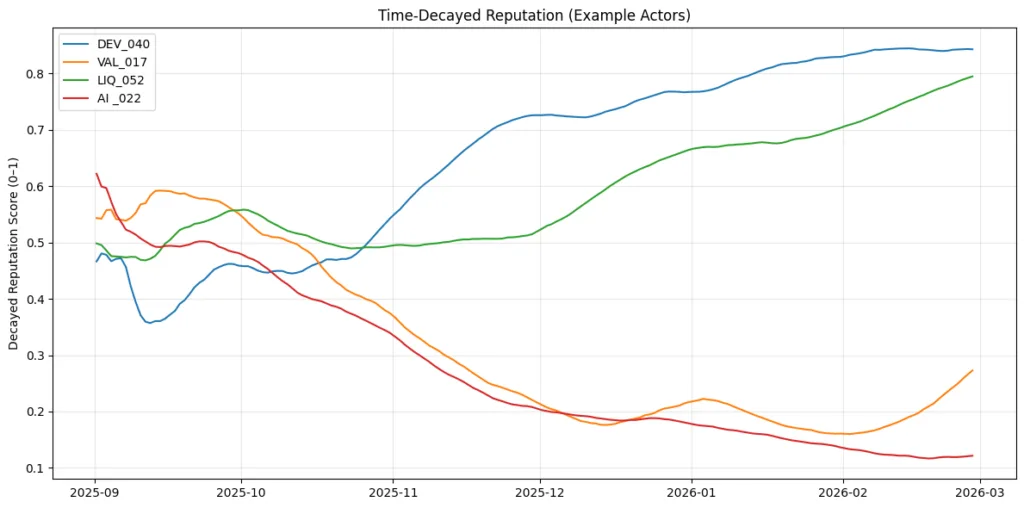
Use case 1 developers
The principle that developers should use pseudonyms to build their projects needs to stay unchanged but the protocols require actual proof systems which should assess credibility through multiple factors. A decentralized reputation engine addresses this by creating a persistent and portable builder track record that follows the developer across chains and deployments, transforming fragmented contributions into a measurable performance history.
A developer who implements audited contracts across different platforms without security breaches and maintains regular system updates should receive continuous trust advancement instead of starting with a new credibility evaluation at each system introduction. The system uses reputation as a permanent digital asset which people can use across different systems to build their value through better performance while creating new business opportunities in upcoming projects.
Use case 2 validators
Validator trust today is largely derived from uptime dashboards and informal community recognition which provide limited and fragmented signals of reliability. The on-chain reputation engine evaluates validator performance through five specific uptime metrics and slashing incidents and block proposal success rates and governance activity and geographical distribution of their network operations.
The delegation process enables validators to receive automated stake distribution based on their performance which meets established operational standards. The system achieves optimal capital efficiency because validators who demonstrate actual performance receive stake from investors instead of those who rely on anecdotal evidence.
Use case 3 liquidity providers
Different types of liquidity provide different levels of support for market stability because some liquidity providers create permanent market depth which helps reduce price fluctuations and enables accurate price determination but other liquidity providers use short-term profit-seeking methods which make markets more unstable during times of high demand.
A decentralized reputation engine can differentiate between these behaviors by evaluating liquidity stickiness, depth contribution during periods of market stress, impermanent loss absorption patterns, and response time to volatility shocks, which enables the conversion of idle capital into observable human activity patterns.
By embedding these metrics into programmable scoring frameworks, protocols can reward long-term stabilizing liquidity with enhanced incentives and preferential treatment, which ensures that capital allocation follows structural resilience patterns instead of short-term profit extraction. The economic reputation system functions as an incentive alignment mechanism, which creates an incentive system that connects liquidity providers with the health of the protocol.
Use case 4 AI agents
As AI-controlled wallets continue to expand, autonomous systems will increasingly execute trades, participate in governance, manage lending strategies, and perform arbitrage, making it essential for markets to distinguish between proven AI agents with consistent risk controls, exploit-prone bots, and entities engaging in flash-loan attack patterns.
A decentralized reputation engine enables this differentiation by allowing AI agents to accumulate measurable credibility over time based on Sharpe stability, disciplined drawdown management, governance accuracy, and oracle response reliability, transforming raw performance data into verifiable behavioral signals. In this framework, reputation evolves into machine-readable trust, enabling protocols and counterparties to interact with autonomous systems based on demonstrated reliability rather than opaque code or anonymous presence.
Institutional implications
The decentralized reputation layer establishes kYF counterparty trustworthiness because it transforms past conduct into visible authentic indicators which automated systems can evaluate. Institutions need reliable risk assessment methods which create definite results about their digital financial activities according to their requirements.
The reputation engine establishes a controlled solution which balances between complete identity concealment and mandatory personal identification through centralized identity verification systems. Decentralized reputation systems use pseudonymity to maintain user privacy while enabling smart contract systems to establish user responsibility which permits organizations to build trust at scale without compromising public network security.
Key design challenges
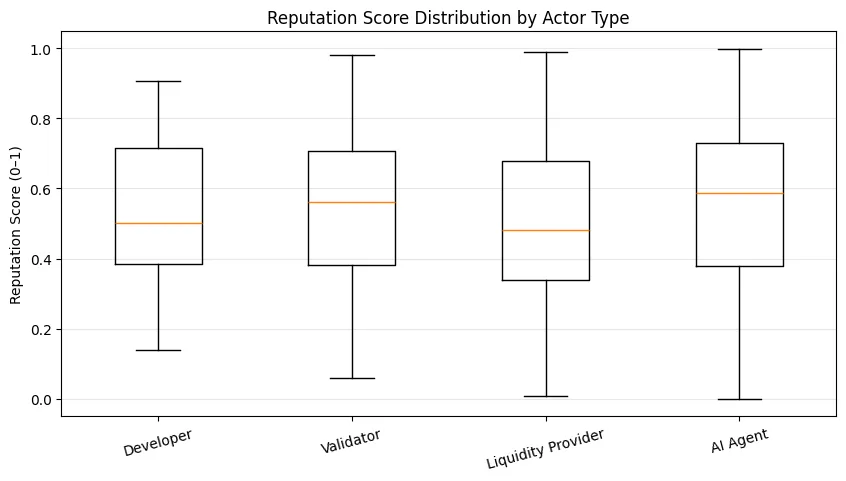
The decentralized reputation system needs to solve multiple important design problems which will allow it to function as real infrastructure instead of just providing surface level scoring. The system needs to implement strong Sybil defense measures which will stop users from creating multiple identities through wallet recycling and identity fragmentation.
The system requires algorithms which should not be susceptible to manipulation through wash activity and artificial behavioral inflation because they need to control gaming risks. The reputation system needs to allow users to move their credibility between different networks because it should not be limited to one specific network. The system becomes a meaningless metric which uses false economic indicators when it gets implemented poorly but when it gets implemented correctly, it builds essential economic foundations which improve business operations and capital distribution and public confidence in the system.
Comparative model Web2 reputation systems
The element of trust between unknown people is diminished through the use of reputation systems which Web2 platforms implement for their ride-sharing services and rental marketplaces and developer communities.Web3 introduces a new capability known as composability which distinguishes it from existing systems.A decentralized reputation engine enables multiple protocols to access and evaluate reputation information which they can use to determine reputation values in real time.The system transforms into a fundamental building block instead of remaining as a specific software solution.
Potential early builders in this space
Several ecosystems are implementing adjacent primitives which establish basic decentralized reputation systems. Gitcoin explores quadratic funding while conducting identity-linked contribution tests. Optimism develops RetroPGF systems to monitor contributor performance and provide recognition for their work. EigenLayer creates accountability systems for operators who use restaking. Worldcoin builds Sybil-resistant identity infrastructure to solve authentication and unique identity verification problems. The existing initiatives do not provide complete solutions for transferring on-chain reputation across different protocols but they establish essential components which will create a unified trust system for decentralized economies.