



The new frontier of economics
For a long time, the tale of unemployment has been linked to privilege, politics, and geography. But the equation is being rewritten by blockchain. Millions of people in developing nations who were shut out of formal labor markets and financial systems are now obtaining new sources of income through decentralized procedures rather than from businesses or governments.
The crypto economy has produced an unprecedented experiment in cross-border employment, from Latin American artists minting NFTs to African freelancers earning in stablecoins. Blockchain has created a worldwide digital labor market that operates around-the-clock and does not require a passport, while established institutions continue to quarrel over job-creation strategies.
From jobless to tokenized
Crypto is now used for work in the same way that it does for money. In Web3, people contribute rather than being hired. Decentralized autonomous organizations, or DAOs, provide governance, design, community management, and microtasks that are paid in tokens as opposed to cash.

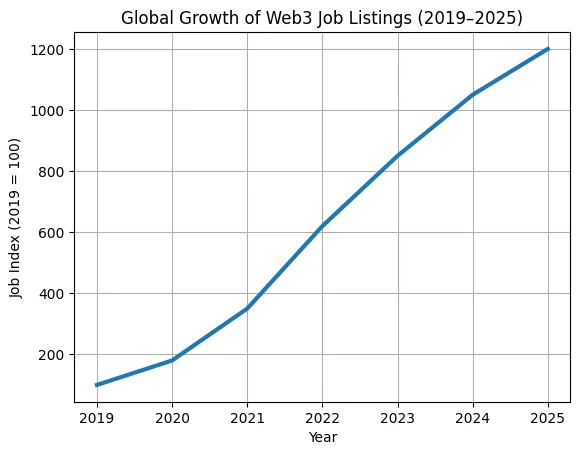
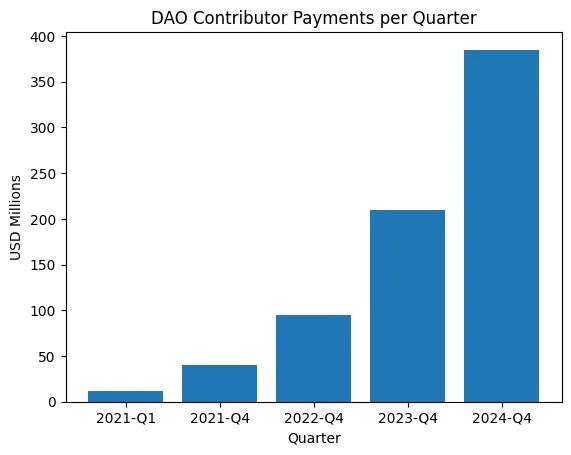
With this new paradigm, a coder in Manila or a youngster in Cairo can work for a DeFi protocol with no headquarters. Employment is driven by the same global reasoning that drives Bitcoin. And the growth is quantifiable: since 2021, Web3 bounties, on-chain contributor payouts, and DAO payrolls have increased dramatically, creating a new “crypto middle class.”
However, the change is philosophical in nature rather than merely economic. Blockchain substitutes proof of contribution for resume hierarchies. Smart contracts are used to verify skills, and earnings are made in a transparent manner.
Financial inclusion as a policy for employment
In many places, access issues, not a lack of ability, are the primary reason of unemployment. In countries with weak currencies or hyperinflation, freelancers often cannot receive international payments. Blockchain solves this by providing rapid, cheap, and censorship-resistant transfers.
Artists, writers, and programmers can now get direct payments from customers all across the world using cryptocurrency wallets. Farmers tokenize their produce for microloans. Rural women can build wealth with stablecoins. In a nutshell, blockchain acts as a shadow employment policy, eliminating middlemen and facilitating the global need for local knowledge.
Every wallet opened, transaction executed, every DAO work finished symbolizes innovation-based survival rather than speculation.

Reskilling the next billion
The silent framework behind this change is education. People can learn how to create smart contracts, maintain DeFi portfolios, and engage in ethical trading through Web3 academies, YouTube tutorials, and open-source coding communities. The transition from unemployment to empowerment begins with a wallet and Wi-Fi, not a job.
These abilities convert into direct employment in developing economies. Within weeks, a single Solidity developer can join international projects. NGOs are investigating cryptocurrency stipends for training programs, and universities are incorporating blockchain courses. A speculative bubble is giving way to a digital employment economy.

The limits and the leap
Blockchain won’t eliminate unemployment immediately, of course. Scams, volatility, and a lack of regulations continue to be obstacles. Not everyone is capable of designing or coding NFTs. However, there is no denying the opportunity: where traditional institutions failed, crypto is establishing parallel economies.

The workplace of the future might not be corporate; rather, it might be linked, collaborative, and encrypted. Decentralized finance and tokenized labor marketplaces may offer what governments were unable to: a new means of allocating income, purpose, and participation when automation supplants traditional jobs.Blockchain is more than simply a way to make money. One block at a time, construction is being done.