



The passport becomes a token
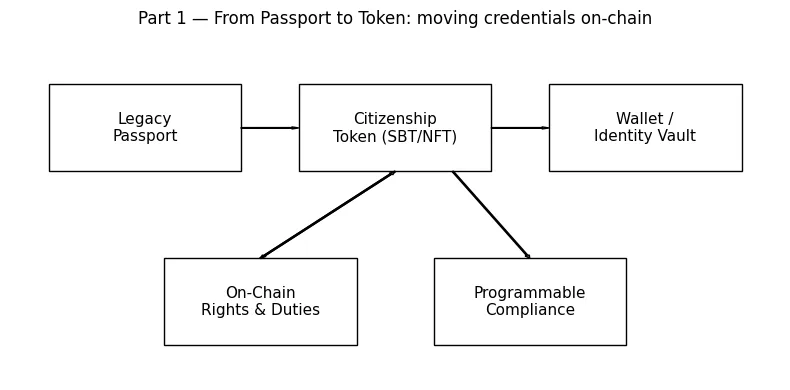
The passport began as a printed consent document; it has evolved into a data package: identity, rights, and rules for cancellation. Within a digital-nation context, the “passport” serves as a unique citizenship token linked to a wallet and a privacy-protecting identity vault. It signifies your identity (verified by various issuers), what you are permitted to do (residency, employment rights, access to services), and the circumstances under which those rights may be enhanced, reduced, or paused. Rather than a single dominant state validating your position, a network of verifiers including established states, universities, employers, and DAOs authenticate your assertions. Border control transforms into an API request: venues, employers, or various authorities validate your citizenship token and its programmable guidelines, rather than relying on a physical booklet and a human stamp. Sovereignty, in reality, transitions from geographical boundaries to procedural boundaries.
The DAO-state operating stack
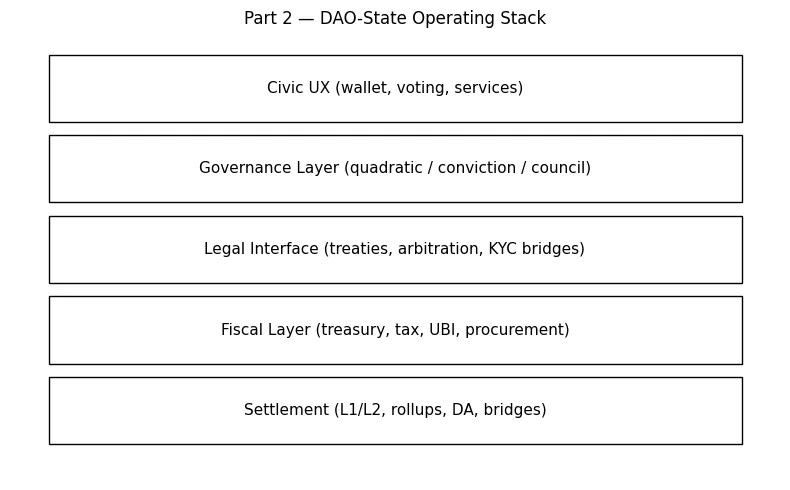
A DAO-state encompasses more than a treasury with voting; it represents a comprehensive operational framework: (1) a settlement layer ensuring property rights and execution; (2) a fiscal layer that taxes resources and allocates funds for communal goods via transparent procurement; (3) a legal interface accommodating external courts, arbitration, and treaties; (4) a governance layer employing a mix of mechanisms (quadratic, conviction, council-based vetoes) tailored to domain risk; and (5) a civic user experience resembling a national super-app covering voting, permits, education, health, mobility, all accessible from a single wallet. “Sovereign” in this context refers to reliable governance of rule modifications and public welfare expenditures, rather than ownership of territory. The market will evaluate DAO-states based on service quality, execution assurances, and default risk similar to assessing jurisdictions on uptime, rather than military strength.
Citizenship markets free from human trafficking
Selling passports is nightmarish; selling rights within boundaries is acceptable. A citizenship token doesn’t have to be tradable; it can be non-transferable, time-restricted, and “upgradable” through achievements such as days of residency, tax payments, community service, military service, language skills, and standing. Entry pathways expand: contribution-driven mints, expedited refugee processes, student visas issued as provisional tokens, and corporate “sponsorship verifiers” facing severe penalties for inaccuracies. As reputation builds on-chain, managing multiple citizenships becomes feasible: you can possess various tokens, yet conflicting responsibilities are addressed through treaty logic, ensuring automatic nullification of double-voting or double-benefits. This eliminates the most detrimental arbitrage of the present (rent-seeking gatekeepers) while maintaining the essence mutual responsibilities between citizen and government.

Security and diplomacy without territory
If DAO-states aren’t defined by borders, how do they defend citizens? By credible commitments in code and contract. Treasuries pre-fund insurance consortia, whitehat retainers, and incident response SLAs. Dispute resolution is pre-agreed via arbitration forums; sanctions are programmable: rate limits, asset freezes under strict, auditable criteria, and time-boxed emergency powers with automatic sunset. Diplomacy becomes treaty standards inter-DAO defense pacts for cyber incidents, shared blacklist/whitelist registries, and cross-recognition of citizenship tokens. Deterrence is not tanks at the border; it’s (a) rapid restore of services after an attack, (b) provable evidence chains that withstand any court, and (c) the threat of composable counter-measures access revocation across dozens of aligned DAOs.
The path from 2025 to 2035
The next decade will look less like a revolution and more like accretion. First, “city-as-a-service” programs issue residency tokens layered on national IDs: tax filing, permits, and benefits move to wallets. Second, corporate and university networks mint contributor credentials that earn you fast-track status with partner jurisdictions. Third, a handful of crypto-native polities network states, special economic zones, and treaty towns standardize interop: arbitration schemas, emergency-power templates, and sanctions APIs. By the mid-2030s, many people will hold multiple citizenship tokens: a birthplace nation for travel, a services nation for healthcare and education, and a digital nation for work and capital. Sovereignty won’t vanish; it will unbundle. Land powers keep borders; protocol powers keep users. The winner will be whichever can deliver safety, services, and opportunity with the least friction and prove it, on-chain, every epoch.