



The Ethereum “Strawmap” draft which lacks binding power functions as a marketing document because it does not include any specific release schedule. The document serves as an architectural guide which describes Ethereum’s anticipated development path for its fundamental blockchain network until the year 2029.
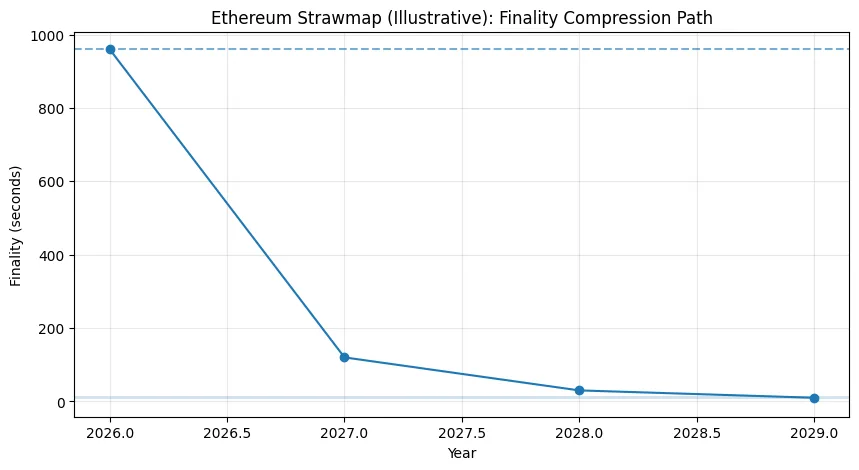
The draft centers on five structural goals: reducing finality from roughly sixteen minutes to a range between six and sixteen seconds, expanding throughput across data and execution layers, introducing native privacy at the base layer, integrating post-quantum cryptography, and tightening the integration between Layer 1 and rollups.Taken together, these objectives describe a transformation in Ethereum’s role. The chain is not simply iterating. The system establishes itself as a worldwide platform for programmable settlement through its current evolution process.
Ethereum is compressing time, expanding capacity, and hardening security
The Strawmap presents a framework for a multi-year re-architecture which will affect the Consensus Layer, Data Layer and Execution Layer. Ethereum intends to achieve economic finality through direct methods which will deliver results within near real-time periods while enhancing data capacity for rollups and improving cryptographic strength.

Base-layer privacy control now exists through native shielded transfers which operate at base layer while post-quantum preparation measures demonstrate security strategies for future developments. Tighter L2 integration suggests Ethereum is doubling down on its modular thesis rather than competing with high-throughput monolithic chains on raw transaction counts.The roadmap is not about chasing headlines. Ethereum will maintain its status as a secure settlement backbone through this process while expanding its economic reach.
Finality compression: From sixteen minutes to seconds
After multiple epochs of operation under the Casper FFG design Ethereum achieved its economic finality today. The system establishes block proposals at twelve-second intervals which results in reliable irreversible settlement through extended time periods. The Strawmap proposes compressing this window to between six and sixteen seconds.The network operational structure undergoes total transformation because of this economic system change.
DeFi operations experience lower capital lock-up duration because of faster finality which enhances market efficiency for high-frequency liquidity strategies and reduces counterparty risk in on-chain derivatives and lending markets and cross-chain bridging systems.The user experience receives benefits from these changes which extend their impact to other areas.
Organizations experience reduced risk because of shorter finality times which help them determine liquidation thresholds and institutional participation standards.Ethereum will improve its competitive edge against fast blockchain systems that concentrate validator power when it achieves rapid finality without losing its decentralized structure. Ethereum maintains its commitment to security as its core principle. The company improves its existing system by working to reduce settlement times while ensuring that all validations occur in a decentralized manner.
Throughput expansion: Scaling the data layer and execution layer
The StrawmapThe Data Layer and Execution Layerboth show different throughput rates. The separation of these two components supports the modular scaling approach of Ethereum. The data side shows that blob scaling together with bandwidth increases will double the capacity of rollups.
The roadmap establishes permanent goals which reach teragas-level L2 throughput because Ethereum expects rollups to process high volumes of transactions without burdening the base chain. The execution side of Ethereum development includes proposals for canonical zkVM integration proof aggregation and multidimensional gas pricing and expanded execution capacity.
Ethereum prepares for advanced computational demands through these execution proposals while maintaining its cost efficiency. The main point of comparison shows that Ethereum uses its scaling system to increase Layer 1 transaction volume. The base layer establishes consensus and data availability which enables rollups to perform large-scale execution. Proof systems use compression to simplify their system. The L1 system becomes a secure settlement base that handles high-volume transactions. The approach establishes Ethereum as an infrastructure system that operates independently from its application software.
Native privacy: Shielded transfers at the base layer
The Strawmap establishes its most important element through its specific aim to implement shielded transfers on Layer 1. Ethereum has maintained its privacy protection through the development of external protocols and application-layer solutions since its inception. Base layer privacy integration represents a complete philosophical transformation for the system. The system recognizes that economic sovereignty needs optional confidentiality which must become a fundamental system element.
Base layer shielded transfers will protect against address clustering threats while enabling better transaction privacy for institutional users and supporting privacy-based financial systems that do not require complete external systems. Ethereum base architecture implementation of privacy protection transforms the network from an open settlement system into a finance system that permits controlled access to information. The design philosophy which governs this system has undergone a fundamental transformation because both regulatory systems and institutional involvement have expanded.
Post-quantum cryptography: Future-proofing the network
The Strawmap includes preparation for post-quantum cryptographic schemes as part of Ethereum’s long-term objectives.Quantum computing does not pose an immediate threat to existing elliptic curve cryptography, but long-lived public blockchains must plan for generational security risks. Migrating cryptographic primitives in a live, decentralized network is a complex multi-year process that cannot be executed reactively.
By embedding post-quantum readiness into its forward vision, Ethereum signals that it is building not only for the next market cycle but for the next technological era.For sovereign capital, institutional allocators, and nation-state-level use cases, cryptographic durability becomes a strategic factor. Ethereum is positioning itself as resilient infrastructure rather than speculative software.
Tighter layer two integration: Strengthening the modular stack
The Strawmap shows that Ethereum has dedicated its future development plans to rollup technology. Ethereum plans to achieve its scaling goals through more complete Layer 2 solutions and common infrastructure elements and proof aggregation and standardized zk proof pathways.
The main objective of the project exists to establish rollups as fundamental security components which extend the base layer protection systems. Ethereum now operates as a unified settlement system which connects multiple execution environments because proof systems have progressed and interoperability capabilities have grown. The system successfully reduces composability friction while creating a stronger economic power for the network.
Market implications: From smart contract platform to global settlement backbone
Ethereum will transform its entire system by 2029 if it successfully achieves six-to-sixteen-second finality together with its large-scale data availability expansion base-layer privacy features post-quantum readiness and seamless L2 integration. The chain would no longer be described primarily as a smart contract platform.
The system would operate as programmable infrastructure which protects user privacy while enabling quantum secure settlement processes across multiple financial systems. Investors in infrastructure projects tend to assess systems based on their capacity to withstand time yet vital components remain protected through institutional-grade security. Ethereum’s Strawmap system establishes its functions to meet requirements of that particular target demographic.
Risks and execution realities
The Strawmap serves as a nonbinding document that provides directional guidance. The engineering trade-offs and governance discussions together with unexpected technical problems will determine changes to both project timelines and its execution plan. The Ethereum network requires multiple stakeholders to work together which includes client developers and validator operators and all ecosystem members.
The evolution of decentralized protocols requires organizations to develop complex systems while reaching agreement among their members. The architectural path forward has become obvious. Ethereum will achieve multiple goals by reducing settlement times and increasing bandwidth capacity and adding privacy features and strengthening its cryptographic systems. Incremental change does not define this occurrence. The process achieves complete optimization of all system components.