



Why you should look beyond Bitcoin
Bitcoin is no longer the main indicator of strength in the market. Over the past quarter, capital rotation has favored tokens with distinct catalysts, quantifiable utility, and robust community-driven demand, even though Bitcoin continues to underpin liquidity. This is a selective structural rerouting of liquidity towards assets that provide something Bitcoin does not, such as protocol revenue, supply constriction, creator-economy monetization, or extraordinary trading volume, rather than a speculative ‘altseason hype.’
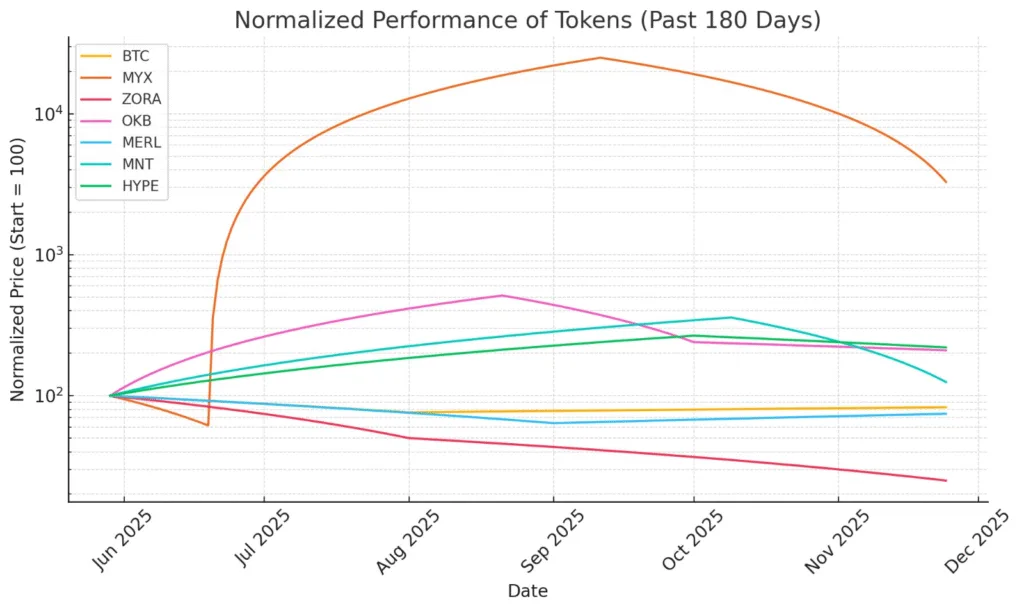
Only a few cryptocurrencies have dominated returns, according to the statistics, and each increase was linked to a particular economic shock, technological advancements, supply burns, L2 consolidation, or creator-token monetization.
The market is rewarding coins with actual cash-flow mechanics or narrative leverage, not widespread speculative hysteria, therefore identifying this pattern adds value. Understanding that Bitcoin is no longer the only narrative anchor of the cycle value is moving to domains where functionality directly drives token demand offers analysts a significant opportunity.
The infrastructural shockwave in decentralized perps
The kind of rise that MYX produced is no longer typical for large-cap cryptocurrency assets. A fundamental change in the perps DEX meta caused traders to switch from centralized exchanges to multichain, high-liquidity platforms that could allow cross-ecosystem leverage with almost no slippage. MYX became the key node for one of the most lucrative leveraged speculation markets in cryptocurrency by capturing this migration at the same moment it delivered its V2 upgrade.

It wasn’t random volatility that caused the increase. It was fueled by a significant wave of liquidations, network growth that drew in experienced traders, and protocol advancements. Understanding that MYX surged because it captured a crucial market function leveraged trading revenue rather than because of hype is the additional analytical value here. A token becomes the growth engine of the entire speculative economy when it serves as the settlement layer for risk-taking behavior.
ZORA: The creator- economy economic engine
ZORA increased as a result of a social-economic shift the rise in creator tokens and on-chain collectibles rather than typical DeFi activities. Millions of posts were created, exchanged, and speculated upon in this ecosystem, transforming ZORA from a specialized initiative into the structural foundation of Base’s creator economy. The token was able to monetize attention and culture, which Bitcoin is unable to achieve.
The key takeaway from this is not just that ZORA pushed, but also that it did so because user-generated material was immediately made profitable. The most deeply integrated token becomes the liquidity layer of cultural speculation in creator economies. The start of tokenized social capital, when postings, memes, and creator identities become tradable goods, is reflected in ZORA’s ascent.
OKB: The scarcity experiment that worked
Because the token did something incredibly uncommon in centralized exchange economics a supply compression event so aggressive that it redefined the asset’s value OKB became one of the top performers. The token changed from being a utility coin to a quasi-scarcity asset that mirrored Bitcoin’s deflationary philosophy after OKX burned more than half of its supply and centered its L2 gas model around OKB.
This change is significant. OKB’s scarcity was produced by corporate action a top-down monetary shock while Bitcoin’s scarcity is predetermined. If such events are not supported by true utility, they typically fail. Because the burn occurred concurrently with L2 consolidation, ecosystem expansion, and liquidity growth, OKB was successful. The more profound realization is that OKB has evolved into a hybrid paradigm, combining the monetary psychology of a store-of-value asset with the functionality of a utility token.
MERL: Bitcoin L2s enter the yield era
The next stage of Bitcoin’s development is represented by Merlin Chain, which turns the cryptocurrency from a static store of value into useful collateral. MERL established itself as the focal point of a new narrative BTCfi by facilitating staking, lending, and yield-based techniques that are directly dependent on Bitcoin security.
The growth of MERL reflects a basic market desire: investors want the security of Bitcoin but the benefits of DeFi. By drawing liquidity from both yield-driven DeFi traders and BTC maximalists, MERL fills that gap. Realizing that Bitcoin L2s will probably take center stage in the upcoming institutional wave adds value. The first indication of Bitcoin’s financialization phase, MERL’s surge is not a unique incident.
MNT: The modular L2 that outperformed on real throughput
Mantle’s ascent was fueled by a real technological advancement rather than conjecture. MNT became one of the few L2 tokens supported by actual execution improvements after switching to a ZK-based architecture with quicker finality. Developers had access to a more efficient environment for high-throughput applications, particularly RWAs and DeFi protocols that require quick settlement, which is why liquidity moved into Mantle rather than traders following the buzz.
The deeper market value comes from realizing that L2s are now competing on execution layers designed for certain economic verticals rather than on broad scalability. Mantle’s update matched it with the industries that are most likely to provide institutional liquidity: low-latency settlement railroads, high-frequency DeFi, and tokenized assets.
HYPE: The perps DEX token becoming an institutional asset
Hyperliquid’s HYPE token had the best structural performance, making it one of the few decentralized exchanges generating real, consistent cash flows. The coin’s buyback mechanism, fee structure, and staking payouts make it an on-chain revenue share instrument. The ETF application was the sole thing that accelerated HYPE’s story, turning it from a trader-driven coin into a potential institutional index component.
Realising that HYPE signifies a new era of DEX tokens assets whose value is directly correlated with trading marketplaces that have managed to evade exchange regulation is what adds value. The token’s performance is showing that Hyperliquid is evolving into the first “institutional-grade perps DEX.”