



Market overview: Two hard assets, one global function
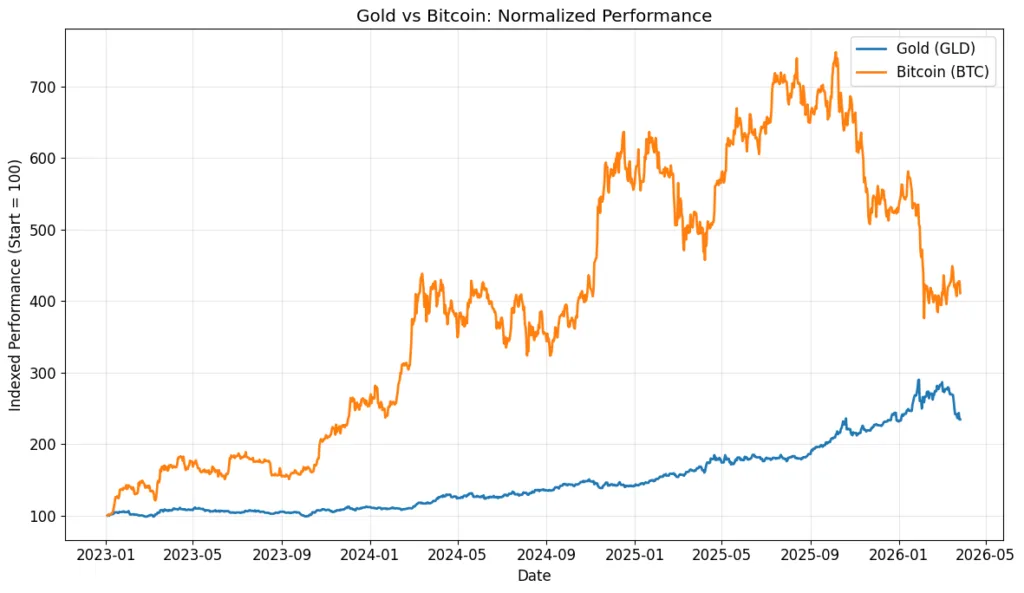
Gold and cryptocurrency exist together as two different forms of the same fundamental human tendency which seeks non-governmental methods to preserve wealth. Gold maintained its dominant position for many years because it provided protection against inflation and currency devaluation and geopolitical conflicts.
Companies which operate Bitcoin and other cryptocurrencies have entered that market because they provide customers with digital solutions which satisfy their fundamental needs. The relationship between these two entities operates through rotational movements instead of competitive dynamics.
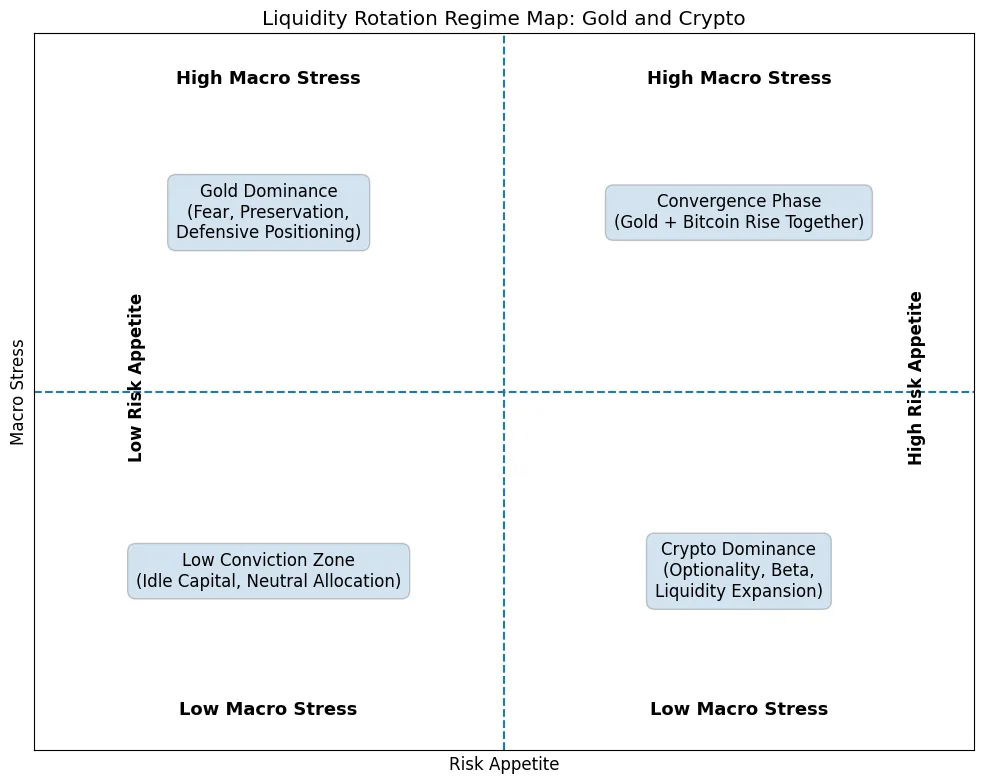
Investors use both gold and cryptocurrency as their main investment options which they switch between according to present market conditions. Investors gravitate towards gold during times of extreme market instability because it maintains its value throughout history.

The market environment for cryptocurrencies attracts funding during times when investors are more willing to accept risk because it operates at higher volatility while offering potential future growth opportunities. The system establishes an ongoing connection which enables investors to trade between physical gold and digital currency networks.
Structural framework: Liquidity as a moving system
The function of liquidity extends beyond static capital because it operates through dynamic systems which use dynamic systems to achieve efficient market macroeconomic predictions. Gold functions as a reserve which allows investors to access their liquidity. The asset maintains a passive and stable status because institutional investors back it.
The asset exhibits low volatility while maintaining a comprehensive market system which has developed over time. The investment process requires capital absorption by the system when investors choose to protect their assets instead of pursuing investment returns. Active market conditions create liquid conditions for crypto assets. The asset exhibits two main characteristics which create market fluctuations while maintaining its built-in leverage capacity.
Investors who want to achieve high returns with low risk can benefit from the investment opportunities which the market creates. The transition between the two is governed by three key variables:Monetary conditions determine the availability of liquidity. The expansion of central bank balance sheets results in additional liquidity which investors will use to secure better returns by transferring their assets from gold to crypto. The markets establish different risk levels through their different volatility patterns which determine the investor’s risk capacity.
When the markets experience a volatility spike, investors move their assets from crypto to gold. The capital markets shift back to crypto assets when the markets experience low volatility. Investor behavior gets influenced by the main story which exists in the market. Gold thrives on fear narratives. Crypto thrives on innovation narratives. The dominant story dictates where liquidity flows.
Macro alignment: Inflation, rates, and currency confidence
The different ways that economic conditions affect gold and cryptocurrency markets stem from their shared fundamental connection. Gold shows its first response to inflationary periods. The immediate protection provided by this asset against currency devaluation has received institutional backing throughout many years. Central banks use gold as an asset which strengthens its value during these economic times.
The first reaction occurs through crypto which develops into a stronger response. Once governments start to print money through monetary easing and liquidity injections Bitcoin becomes the main method for handling that increased money supply. Investors now prefer digital assets over physical bullion because digital assets have become their main investment choice. The determination of interest rates creates the main decision point.
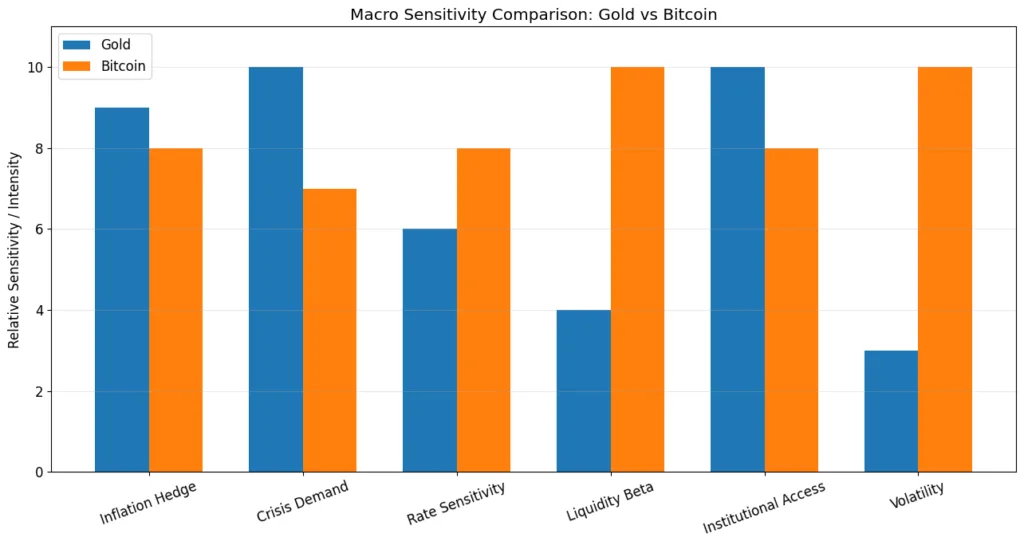
Higher interest rates strengthen the value of fiat currencies while reducing the value of gold and cryptocurrency assets yet cryptocurrency experiences greater losses because of its higher risk. The decreasing interest rates create conditions that reduce fiat value while increasing liquidity which helps both assets yet it benefits crypto Currency confidence is the underlying driver.
Capital moves to neutral positions when trust in fiat systems decreases. Gold provides users with physical assets that maintain neutral status. Digital assets maintained by crypto networks provide users with digital assets that maintain neutral status. Their decision process requires them to compare three factors which include accessibility and speed and expected return.
Market microstructure: How the rotation actually happens
The market shows actual evidence of liquidity transfer between gold and cryptocurrency assets. The way institutional portfolios operate shows that gold and Bitcoin now function together as the same investment category. The process of reallocating assets usually requires investors to switch their holdings between these two assets instead of exiting the complete investment system.
The complete process which runs through this market gets amplified through derivatives trading. Investors can move their asset positions quickly using gold futures and Bitcoin perpetuals because they do not need to settle physical assets. The system enables market participants to shift their trading activities when larger economic indicators become available.
Stablecoins play a critical role in this bridge. The digital currency functions as the liquidity component which allows investors to move their assets out of risky positions while remaining within the digital currency market. Investors who transfer their assets from cryptocurrency markets to gold markets first move their capital through stablecoins because this process takes place in multiple steps instead of happening at once.
ETFs and institutional products further compress the distance between the two markets. The appearance of spot Bitcoin ETFs established a new trading structure for cryptocurrencies which now operates through the same system used for gold ETFs to permit capital movement between traditional financial systems.
Investor psychology: Fear vs optionality
The psychological aspects of human behavior drive the gold-crypto relationship. Gold serves as a security asset which investors use to protect their money during uncertain times. Its appeal is rooted in history and trust.Crypto serves as an asset which provides investors with multiple future possibilities.
It performs when investors prioritize growth, innovation, and asymmetric upside. Its appeal is rooted in future potential.Liquidity shifts towards gold during market conditions which people see as dangerous. The market shifts towards crypto when investors see business possibilities.
The current cycle shows both narratives existing together because of its special characteristics. Investors have two opposing attitudes because they want to protect themselves from systemic risk while they want to benefit from technological advancements. The two markets create shared market movements which allow both gold and crypto to increase in value although they do so at different rates and for distinct reasons.
The convergence phase: When both assets rise
The specific regimes create circumstances which establish competitive boundaries between gold and crypto because they keep their existing relationship. The situation occurs when monetary expansion happens together with structural uncertainty. The environment provides abundant liquidity while people lose trust in conventional systems.
The conservative liquidity allocation goes to gold storage. The speculative funds directly enter the crypto market. The dual inflow process establishes a period where both assets increase in value which supports the larger trend of non-sovereign value storage. The established balance between the two assets will not last.
The crypto market begins its upward trend after investors increase their risk appetite which results in their gold liquidity withdrawal. Gold maintains its value while crypto decreases in value when market risk conditions become worse.
Forward outlook: The liquidity cycle ahead
Gold and cryptocurrency markets display increasing interconnection which produces greater market integration between these two assets. As institutions start to embrace cryptocurrencies, they create an environment that enables both markets to develop greater interconnectedness.
Portfolio managers no longer view them as separate asset classes but as different expressions of the same macro thesis. Future liquidity cycles will likely accelerate this rotation dynamic. The enhanced information flow together with expanded derivatives markets and greater institutional involvement will enable faster capital transfers between bullion and blockchain assets.
The key implication is that gold and crypto should be studied together because their value exists in their connection to each other. The market operates as a single liquidity system where investors continuously search for optimal investment strategies that protect their assets while generating returns.