



The end of Bitcoin’s rebel phase
The creation of Bitcoin originated as a form of protest against bank bailouts and it served as a method to reject monetary authority while providing a decentralized system that existed as an alternative to the centralized financial system which failed during the Global Financial Crisis. The public understood Bitcoin as a conflict between Bitcoin and established financial systems but this understanding persisted until the present time. Bitcoin functions today as a regular asset which markets all macro assets.
The system operates through two main factors which include central bank policy and geopolitical events and liquidity conditions with global risk appetite. The current situation shows that there is a permanent link between two things which used to operate independently. A fundamental change has occurred.
Bitcoin develops from a speculative technology into a tool for international relations. The price changes which occurred after this transition show a new pattern because institutional investors now have a greater influence than retail investors while sovereign nations create the strongest demand for Bitcoin.

Bitcoin’s correlation reset: From tech proxy to macro asset
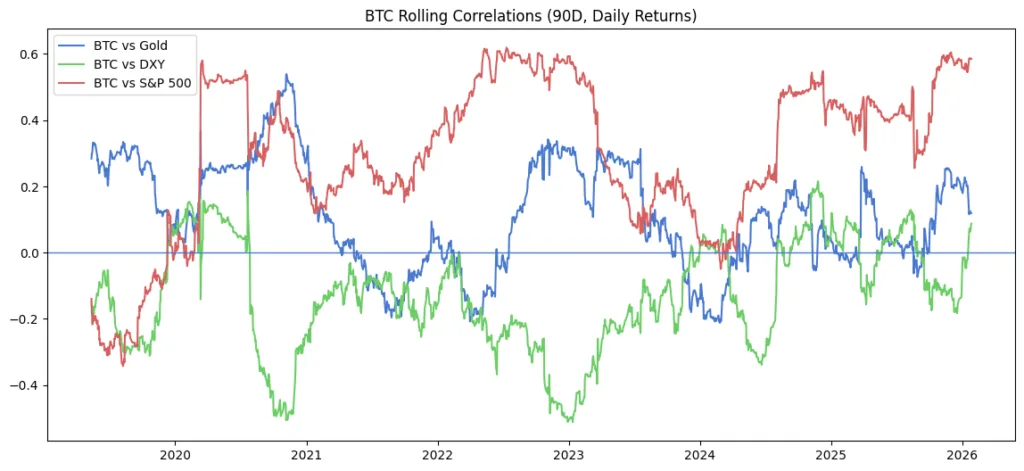
Bitcoin performed after COVID-19 as a Nasdaq proxy which traders used through their leveraged positions. The market reacts to liquidity entering the market because it results in higher prices. The market experience price declines when market tightening occurs. The relationship proved through equity correlations which reached above 0.6 because BTC functioned as a high-beta technology investment. The connection between the two parties has started to decrease. Bitcoin now acts as a dual-purpose asset which combines defensive and risk-on characteristics.
The correlation between gold and another asset has risen during times of geopolitical conflicts. The DXY currency index has become more significant for market analysis. Equity markets continue to influence Bitcoin prices but they no longer represent the primary driver. Bitcoin now responds most intensely to three main factors which include The global liquidity situation The financial decline of The currency system The governmental financial instability.
This development shows that the system has entered a new operational phase. Institutional investors use macro variable-based assets as permanent components of their investment portfolios. The assets transform from conceptual ideas into official financial instruments used for balance sheet purposes. Bitcoin has entered a new development stage.
Institutional positioning: Quiet accumulation, not loud speculation
Retail businesses still discuss economic patterns because their industry requires them to do so. Financial institutions measure their risks through exposure metrics. The introduction of spot exchange-traded funds has enabled Bitcoin to become part of standard investment portfolios. Pension funds and asset managers and family offices and sovereign-adjacent entities now access BTC through regulated vehicles that fit existing mandates.But the more important shift is behavioral.The institutions that operate financial markets make their investments through strategic asset allocation instead of pursuing sudden market price increases.
The market data shows that investors accumulate assets during market declines instead of buying assets during peak market periods. The way traders calculate their position sizes corresponds to their intentions to protect their assets for the long haul instead of participating in short-term price movements.
Bitcoin is being treated less like a growth asset and more like an asymmetric insurance instrument.In macro terms, BTC is increasingly viewed as:a hedge against monetary disorder ,a diversification tool during geopolitical fragmentation ,a non-sovereign reserve assetETF inflows show no signs of stopping because investors use this trading instrument to buy assets when prices remain stable. The buyers are not speculators.They are reallocators.
Sovereign risk: The hidden driver behind Bitcoin demand
The most misunderstood force in Bitcoin markets today is sovereign risk.Not default risk in isolation but systemic confidence erosion.Rising debt-to-GDP ratios across developed economies. The existence of ongoing fiscal deficits. The practice of using payment systems as weapons. The expansion of sanctions regimes. The process of trade routes breaking into separate parts. The emergence of new currencies that compete with established ones.
The following events are permanent changes to the financial system. The current situation enables neutral assets to become essential for strategic purposes. Gold has always filled this role. Bitcoin is now entering the same conversation with a crucial difference: digital portability, settlement speed, and censorship resistance.Country capital controls force their citizens and businesses to use Bitcoin as their main financial tool.
Corporate entities who work with sanctioned regions and people from unstable countries recognize Bitcoin as their primary means of financial movement. The accumulation process occurs in a silent manner because of this reason. The situation has no connection to exaggerated public interest. The situation exists because we require this solution.
Macro collateral: Bitcoin’s new identity
The three properties of collateral assets are scarcity and global recognition and neutrality. Bitcoin now satisfies all three. Its supply exists through mathematical restrictions. The network operates as a worldwide system. The settlement process operates independent of any one specific state. The characteristics of Bitcoin push it into a new classification which functions as macro collateral.
The statement does not imply that Bitcoin functions as a substitute for bonds or gold. The statement indicates that Bitcoin now stands alongside them. The volume of BTC-backed loans shows growth within funding markets. BTC operates as a parallel savings system in emerging economies.
In developed markets, BTC has transitioned into a portfolio stabilizer from its previous role as a speculative lottery ticket. The situation represents a major change. Bitcoin has developed beyond its original function as an asset. The asset has evolved into an item which you must post.
From rebel to reserve: A structural reclassification
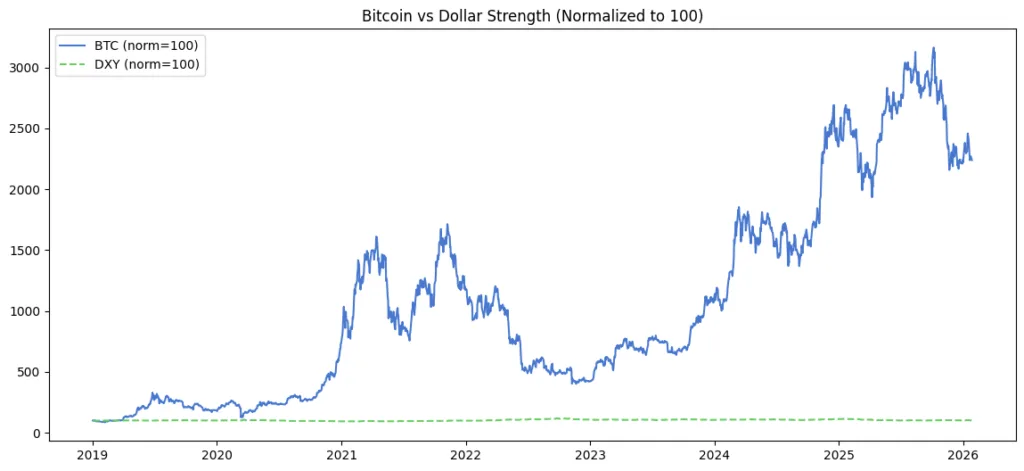
Bitcoin started as a revolutionary digital currency system which now operates under a planned business strategy. The system started through anti-establishment testing but now operates as a core system which protects itself against its own limitations. The present market situation now requires investors to determine their proper Bitcoin holdings after the market has confirmed that Bitcoin will continue to exist.
Bitcoin has transformed from its previous existence as a minor technological innovation to its current role as a tool used in global political affairs. The price of Bitcoin continues to change. The market trends will change over time. The public will experience multiple buying patterns throughout time. The system now undergoes a major change which remains hidden from public view. The definition of Bitcoin has changed.