


Market overview
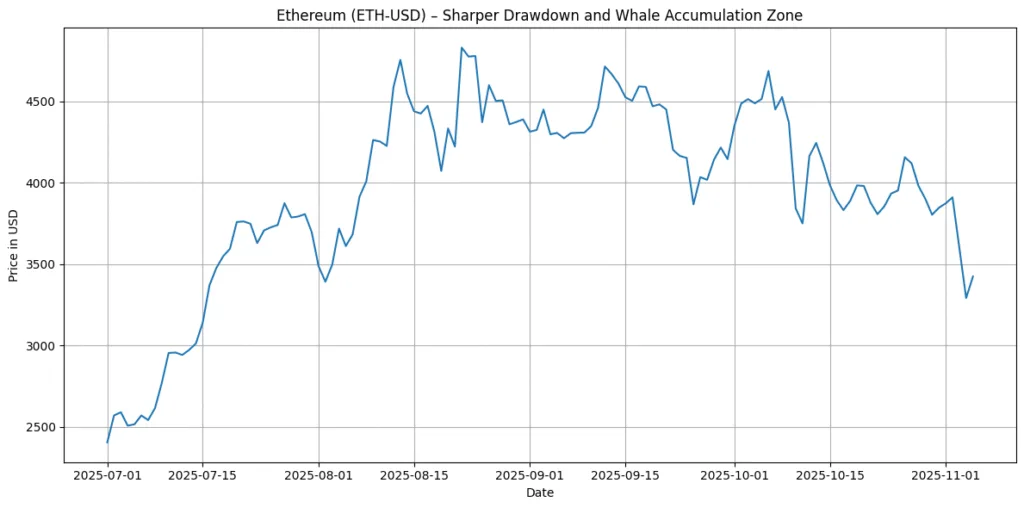
After stratospheric gains for months, global markets are now more reflective than ebullient. A mix of profit-taking, macrouncertainty, and shifting liquidity dynamics are currently plaguing the cryptocurrency market, which earlier this year had a valuation of over $3.5 trillion. A psychological turning point was reached when Bitcoin fell below $105,000, and the vulnerability of the speculative leverage that had accumulated over the summer was exposed by Ethereum’s drop to the $3,000 range. The overall tone, however, is one of transition rather than collapse in spite of the correction. Ethereum’s recovery toward $3,400 and Bitcoin’s continued consolidation above $100,000 indicate that institutional participation is still present. Investors are now relearning the value of patience, and the market’s rapid impetus has moderated.
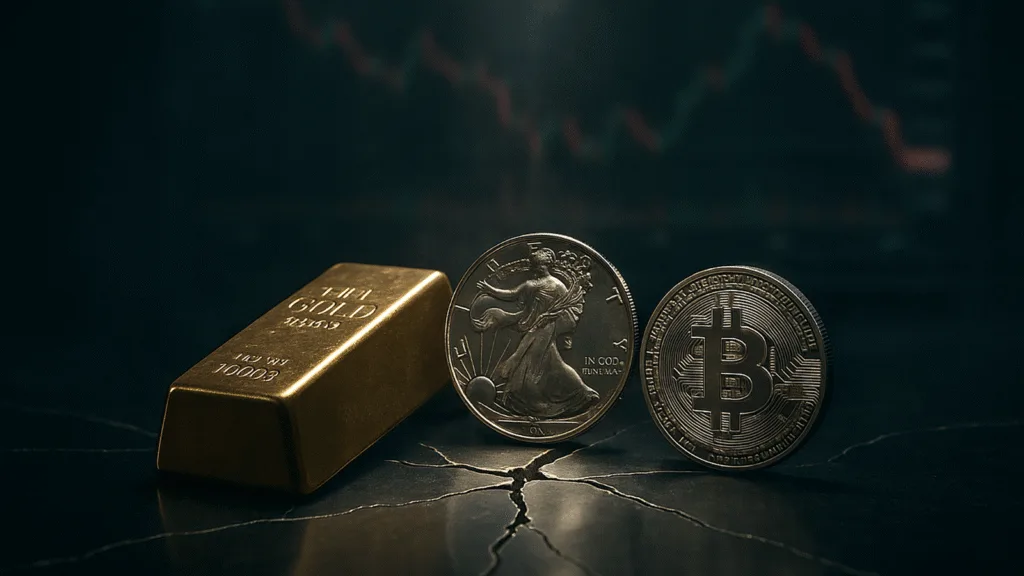
Gold and silver continue to be the most obvious indicators of confidence and fear in traditional markets. Gold, which is currently selling close to $4,000 an ounce, continues to draw consistent inflows as demand is sustained by uncertainties surrounding interest rates, the dollar, and world politics. The conflict between silver’s monetary attractiveness and industrial demand is reflected in its price, which is just under $50 per ounce. At a time when digital assets are still trying to find balance, these assets collectively provide the hard, tangible, and comforting emotional spine of global finance.
Crypto under pressure but structurally intact
Although Bitcoin’s October decline was the biggest in almost ten years, the course of its recovery is just as instructive. The sell-off was caused by long-term holders realizing profits and deleveraging across key exchanges, not by a collapse in network activity or regulatory fear. Even while retail optimism is waning, spot ETF inflows are still strong, suggesting that big players are continuing to accumulate. The current battleground for both long-term investors and short-term traders is the price movement between $98,000 and $115,000. The longer Bitcoin stays over $100,000, the more probable it is that this region will serve as the basis for the subsequent significant surge.


Ethereum’s story is similar, but more unpredictable. Its percentage movements were more noticeable due to its lower liquidity and greater sensitivity to futures markets. On-chain data indicates that whales are building up around $3,100, and they view this decline as a chance to strengthen long holdings ahead of the next cycle of network upgrades and new institutional staking flows. The altcoin market is still quite calm overall, though. With nearly 60% of the market, it is evident that Bitcoin is still driving this cycle. Unless Bitcoin stabilizes for a few weeks in a row, altcoins are unlikely to fare better. Even while volatility is expected to remain high in the foreseeable future, strong institutional demand, increasing liquidity, and the continuous expansion of tokenized real-world assets continue to underpin the structural bull case for cryptocurrencies.
Gold: The reluctant winner
Instead of being a sign of worry, the fact that gold is currently selling around $4,000 an ounce is a statement of faith in its lasting value. After reaching a record high of $4,380 in October, the metal witnessed a nearly 9% drop, but it quickly drew buyers who were prepared to steadily grind their portfolios. Numerous variables, such as the US dollar’s recent decline, ongoing political unrest, and the potential for a lengthy government shutdown, have allowed gold to maintain its appeal. The absence of monetary tightening is another element that adds to its allure. With global yields peaking and inflation stabilizing, the prospective cost of owning non-yielding assets like gold is declining. Because of this, gold is once again a safe haven and a competitive store of value, particularly for conservative investors and sovereign funds trying to shield themselves from market volatility.
The advent of tokenized gold on blockchain networks gives this age-old asset a contemporary spin. By bridging the gap between traditional bullion and digital liquidity, stablecoin-type products like PAXG and XAUT have amassed billions in market value. This on-chain accessibility keeps overall liquidity in the digital ecosystem by ensuring that capital may move smoothly from Bitcoin or stablecoins into tokenized gold, even during crypto downturns. One of the most important changes in contemporary portfolio creation is the transformation of gold into a hybrid on-chain and off-chain store of value.

Silver: The high-beta metal
Silver has traditionally been the more daring brother of gold, a metal that trembles when fear takes hold but flourishes when optimism prevails. After a sharp increase earlier in the year, it has recently stabilized around $49 per ounce, and analysts now see its behavior as a test of conviction. Its monetary attraction rides the coattails of gold’s popularity, while industrial demand from industries like solar technology and electric vehicles continues to cement its long-term importance. When gold rallies 10 percent, silver can rally 20 or 30 percent; when gold retraces, silver bleeds twice as quickly. In macro terms, silver frequently acts similarly to a leveraged version of gold. Because of its flexibility, it can be used as an economic indicator as well as a speculative instrument. Its current trajectory is contingent upon the stabilization of global manufacturing. Silver may retest the $50 range and eventually go higher if growth picks up speed. It may revert to $45, reiterating its erratic nature, if recession fears materialize.

The interplay of hard assets
Today, the function rather than the form is what ties gold, silver, and cryptocurrency together. Each provides protection against ambiguity, yet each represents a distinct period of believing. Gold represents centuries of trust, silver bridges the gap between technology and tradition, and Bitcoin represents the digital frontier of scarcity. Investors are discovering in 2025 that these assets coexist rather than compete. Gold and Bitcoin are increasingly viewed by fund managers as parts of the same “hard-asset basket,” striking a balance between innovation and dependability. Portfolio rotation is now possible within the blockchain itself thanks to tokenized metals, which have made that theoretical connection a reality. As a result, a new multi-asset ecosystem is being created in which money can flow from virtual danger to real safety without ever leaving the chain.
Something about sentiment is also revealed by this interaction. The flight to gold and the pause in crypto exuberance are not contradictions; they’re symptoms of the same caution. A period of rising rates, geopolitical upheaval, and reevaluated risk tolerance is upon the planet. Investors are not giving up on growth; rather, they are redefining security in a time when everything seems fleeting, including data and fiat currency.
Outlook
Both cryptocurrency traders and metal investors’ faith will probably be put to the test during the next months. The most crucial indication is still Bitcoin’s stability around $100,000; a persistent increase above $110,000 may boost trust in the entire digital asset complex. Longer-term players still have a chance for accumulation due to Ethereum’s consolidation below $4,000. As markets seek clarity on global growth, gold is anticipated to remain stable in the $3,850 to $4,300 area, while silver will continue to fluctuate around $50. Liquidity and real yields will continue to be the unseen forces influencing the path of all assets.
Essentially, 2025 is turning out to be a year of recalibration rather than catastrophe. Silver is waiting for its turn, gold is regaining its hegemony, and cryptocurrency is learning endurance. When taken as a whole, they tell a singular story about how resilient value is in an uncertain age. Introspection has replaced the exhilaration of the previous cycle, but the next action is rooted in that calm.