


When crypto warned you about itself
During the ICO frenzy of 2017, investors invested millions into ventures that lacked a product, a roadmap, and at times, even a team. From this turmoil emerged two intentionally ludicrous experiments: PonziCoin, which unabashedly identified itself as a Ponzi scheme, and Useless Ethereum Token (UET), which boldly advertised itself as “the world’s first 100% honest ICO” due to the creator’s promise to undertake absolutely no actions. Both were humorous attempts to underscore the irrationality of the situation, yet the irony was that they successfully garnered substantial real funds. These tokens served as a reflection of the psychological fervor surrounding early Ethereum fundraising: if a project candidly acknowledges its worthlessness yet still attracts investment, what implications does that have for the market?
PonziCoin a ponzi scheme that said it was a ponzi scheme
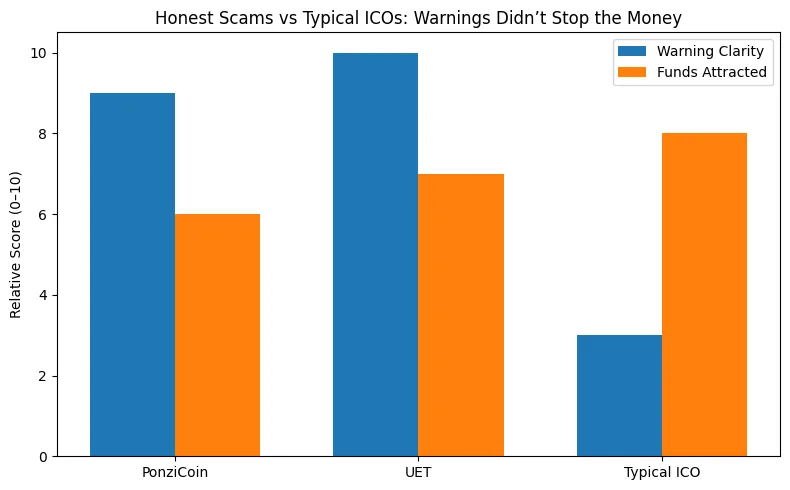
PonziCoin debuted with a website that essentially proclaimed, “This is a scam.” It clearly outlined its framework: initial investors are compensated by subsequent investors, there is no actual product, and ultimately it will fail. Rather than deterring individuals, the stark transparency drew interest in cryptocurrency discussions. Investors proceeded to buy in, hoping to withdraw their funds before the inevitable collapse. It turned into an experiment that showcased how greed can eclipse rational thought. Individuals were not deceived; they consciously chose to participate in a system that was transparently unsustainable. PonziCoin illustrated that during periods of excitement, the allure of rapid profit can overshadow any cautionary advice, even when that caution is the very essence of the project.
Useless ethereum token the ICO that promised nothing and kept its promise
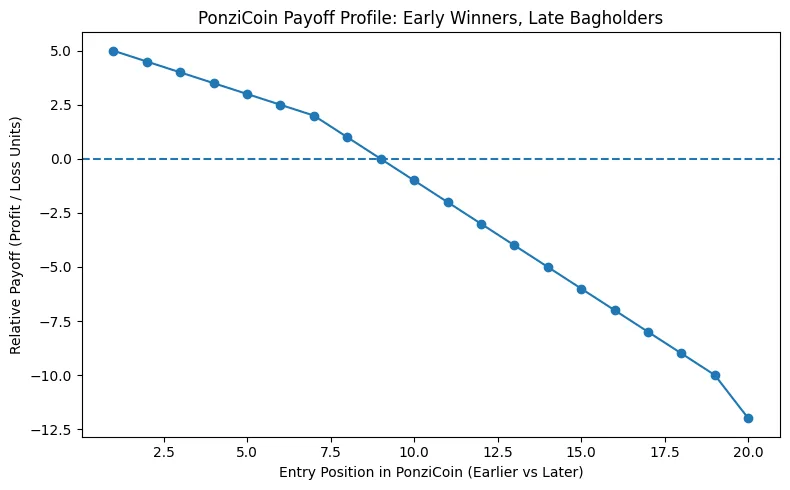
The useless Ethereum Token took satire to an even greater extent. Its whitepaper was a remarkable piece of mockery, declaring: “You are going to provide some random individual on the internet with money, and they will take it to purchase electronics, most likely.” In contrast to PonziCoin, it did not feign the promise of any returns. Its website clearly informed investors that they would receive no product, no roadmap, and no value. Nevertheless, UET managed to raise more funds than many legitimate ICOs from 2017. The creator’s candidness about doing nothing served as the primary selling point. Individuals invested because their participation became a form of cultural expression, a collective recognition that ICOs had evolved into a form of performance art.

What these tokens revealed about investor psychology
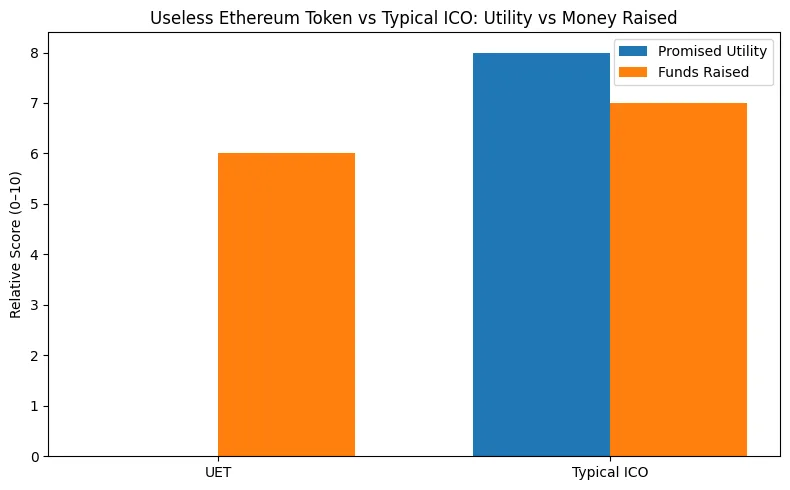
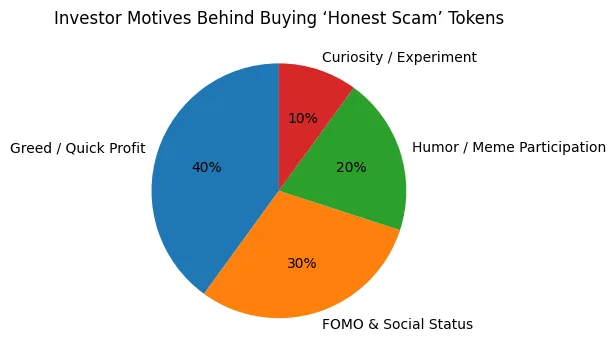
Together, PonziCoin and UET revealed the emotional essence of ICO bubbles. Investors engage not solely for financial returns but also for a sense of belonging, humor, novelty, and occasionally the thrill of gambling. During periods of market mania, valuations become detached from fundamental values and evolve into a social game. Both projects served as experiments in human behavior rather than mere financial endeavors. They demonstrated that transparency does not mitigate irrationality; individuals invest not based on information but driven by emotion. Genuine scams thrived because the majority of investors were not in search of truth; they sought a narrative, excitement, or an opportunity to be early, even in ventures that openly acknowledged their lack of purpose.
The legacy they weren’t just jokes. They were warnings.
Despite their ridiculous nature, these satirical ICOs significantly contributed to the history of cryptocurrency. They underscored the absence of due diligence in a market where excitement frequently overshadowed reason. PonziCoin and UET evolved into cultural symbols: reminders that mere transparency is insufficient to safeguard investors in an environment dominated by greed. Their influence resonates in meme coins, hype cycles, and the speculative culture of contemporary crypto. They foreshadowed the emergence of communities that perceive tokens as a form of entertainment rather than as financial assets. In an unusual manner, the joke tokens were more truthful than many of the ‘serious’ projects they mocked.