



The idea that Bitcoin might achieve a value of $1 million per coin has appeared to most Bitcoin supporters as an unrealistic target throughout multiple years. The number appears to defy reality when you compare it to Bitcoin’s initial trading period which saw the asset value at only a few dollars and to the current trading range which extends from $20,000 to $70,000. The discussion about Bitcoin’s long-term value exists in a frame which people use to view the situation. Most people who participate in Bitcoin discussions believe that Bitcoin must contend with a market whose size remains unchanged.
Bitwise’s Chief Investment Officer, Matt Hougan, in a recent post discusses the probability of Bitcoin reaching this eye-watering valuation. In his memo, Matt says the mistake most analysts make when calculating Bitcoin’s value is ignoring its growth.
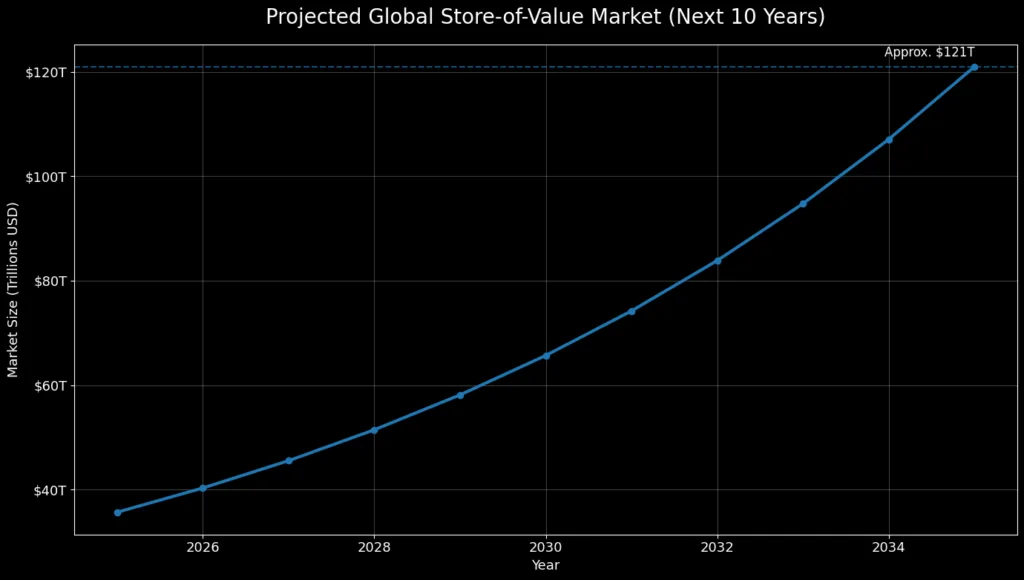
“The mistake people make when evaluating bitcoin’s potential is ignoring this growth. If this growth rate continues, the global “store of value” market will be ~$121 trillion in 10 years. At that level, bitcoin only needs to take 17% of the market to be worth $1 million a coin.

That’s still a lot of growth—from ~4% to ~17%—but it feels well within reach when you reflect on all the progress bitcoin has made recently.”
The global store-of-value market functions as an evolving marketplace which experiences growth because of factors such as monetary policies and geopolitical tensions and rising debt levels and changes to wealth preservation methods. The evaluation of Bitcoin as both a speculative asset and a digital store of value which competes with gold and other reserve assets shows us a new perspective.
The $1 million Bitcoin value becomes mathematically possible through market growth and adoption which create a reasonable path to that target. The evaluation of this possibility needs three main elements which include measuring the total store-of-value market and determining Bitcoin’s market share and assessing the economic conditions that impact demand for different types of monetary assets.
Bitcoin as a store-of-value asset
The essential value of Bitcoin exists because it operates as a store of value that non-government entities can use. Bitcoin has a total supply limit of 21 million coins while fiat currencies permit central banks to create unlimited currency through their monetary powers. The limited availability of Bitcoin creates a value pattern that resembles the value pattern of commodities such as gold.Throughout history, gold has functioned as the main worldwide asset that people use for value storage. People and businesses use it as protection against inflation and currency devaluation and political unrest.
Bitcoin introduces a similar concept but in digital form which enables global value transfer without needing traditional banking systems. Bitcoin operates as a contemporary store-of-value asset because it possesses multiple attributes that establish its value. Bitcoin provides users with cross-border transfer capabilities which enable them to send billions of dollars instantly.
The system allows anyone to verify the currency supply because it uses public blockchain information for audit purposes. The system provides transaction security because it prevents governments and organizations from blocking transactions. The system establishes three essential monetary rules which remain fixed and public for all users to see while fiat systems change according to economic requirements. Bitcoin has become a digital equivalent to gold because its attributes have attracted various investors from institutions and hedge funds and sovereign wealth funds and corporations. As more people use Bitcoin the main question which needs answering is: what size of market does Bitcoin need to compete against.
The size of the global store-of-value market
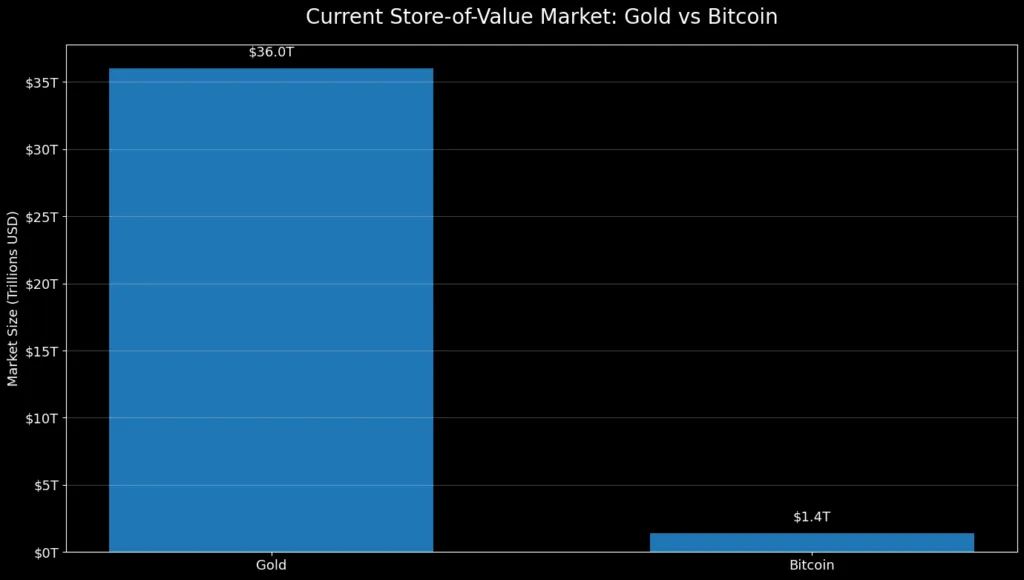
The global market for store-of-value assets which mainly consists of gold and Bitcoin is currently valued at approximately 38 trillion dollars.Today the combined store-of-value market which includes gold and Bitcoin has an estimated value of 38 trillion dollars.Gold alone accounts for approximately $36 trillion, while Bitcoin’s market capitalization fluctuates around $1–2 trillion depending on price levels.The current Bitcoin market value demonstrates that Bitcoin holds approximately 4 percent of the entire store-of-value market. The small Bitcoin market share which exists now appears to restrict Bitcoin price growth potential.
To achieve a value of 1 million dollars Bitcoin needs to acquire more than 50 percent of the entire store-of-value market. The current situation appears unworkable when we consider that market conditions will not change. The critical assumption here about the situation contains incorrect information. The store-of-value market has expanded dramatically over the past two decades because of worldwide economic uncertainty and rising government debt levels.
The expansion of the store-of-value market
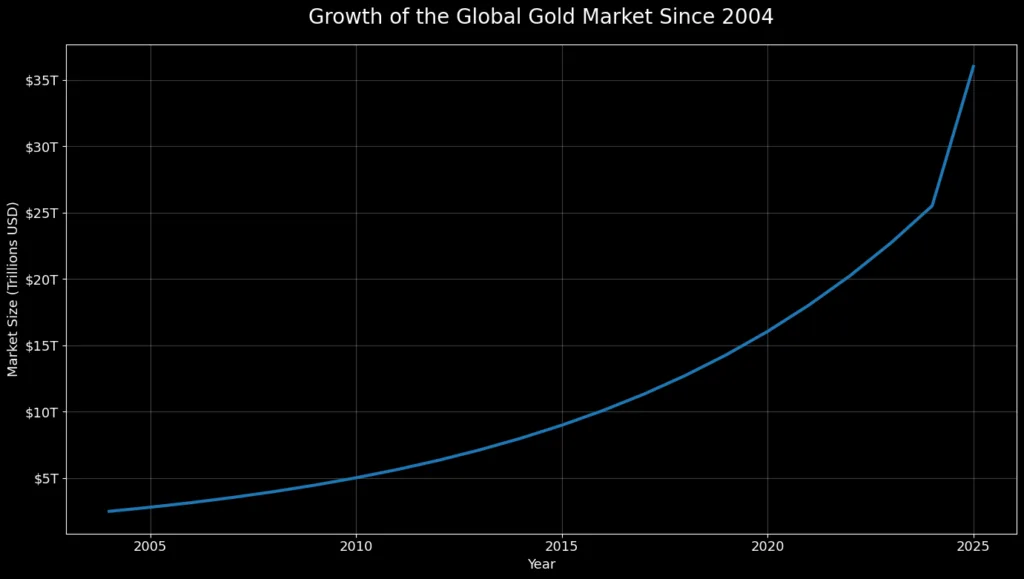
The global gold market had a valuation of approximately 2.5 trillion dollars at the start of the 2000s. The market underwent substantial growth during the following twenty years which has resulted in a present market value of approximately 40 trillion dollars. The growth rate of this market during that period reached a compound annual growth rate of approximately 13 percent.
The macroeconomic forces of the time period created specific conditions which helped the market to grow. First, the 2008 global financial crisis fundamentally changed investor behavior. The major financial institutions experienced collapse which, together with the implementation of large monetary stimulus programs, caused people to worry about currency stability.
The widespread use of quantitative easing by central banks throughout the world created a substantial increase in global money supply. The policy produced economic growth benefits while it created worries about ongoing currency devaluation. The international situation, which includes trade wars and regional conflicts and rising global tensions, has caused people to seek assets that function as neutral stores of wealth. Investors show a growing tendency to invest in assets that operate beyond conventional monetary frameworks. The current shift in investor behavior has created opportunities for Bitcoin to grow as a result.
A growing market changes the math
The store-of-value market will reach a value of approximately $120 trillion within ten years if it continues to grow at its current rate which started two decades ago. Bitcoin needs to control only 17% of the total store-of-value market in order to reach a valuation of $1 million. Bitcoin needs to take 17% of the entire store-of-value market to reach its current valuation.
The current Bitcoin market share of 4% requires the market share to increase four times within ten years to reach Bitcoin’s target market share. The level of growth achieved here stands as a significant accomplishment which should be recognized as an exceptional achievement.
The past ten years have shown Bitcoin market share growth because institutions started using Bitcoin and financial systems became more advanced. The introduction of spot Bitcoin ETFs together with institutional custody solutions and regulated derivatives markets has created better investment opportunities for institutional investors. The current development of institutional adoption in Bitcoin resembles the process which transformed gold into a mainstream investment after gold ETFs launched in 2004.
Institutional adoption and market maturity
The institutional adoption of Bitcoin functions as the primary factor which drives its long-term development. Professional investors in the past avoided investing in Bitcoin because they worried about custodial problems and regulatory issues and price fluctuations. The barriers which prevented people from using these systems now begin to vanish. Major markets now allow pension funds and asset managers and sovereign wealth funds to invest in Bitcoin through approved spot Bitcoin ETFs. Institucional investors now treat Bitcoin as a valid investment option because they will allocate 1% to 5% of their diversified portfolios to Bitcoin.
The capital markets will experience a major increase when institutional investors worldwide change their portfolio allocation by even a small amount. Bitcoin market capitalization will experience a significant increase when institutional investors around the world who control more than $100 trillion in assets make even minor reallocations to Bitcoin. The market infrastructure improvements together with increased liquidity have reduced Bitcoin price fluctuations. At this point, institutional investors view the asset as a suitable option for their long-term investment plans.
Macroeconomic forces supporting Bitcoin
Bitcoin’s expansion depends on wider economic patterns which include macroeconomic developments. The world experiences an ongoing increase in total debt which shows no signs of stopping. Global governments face their highest budget deficits in history while several nations depend on ongoing increases in money supply to support their economic expansion. The current economic climate creates a greater need for assets which central banks cannot easily create from nothing.
Bitcoin establishes a permanent supply limit and its issuance process operates through a transparent system which creates clear differences with fiat currencies whose central banks adjust money supply according to economic needs. The world economy currently experiences greater digitization than ever before which results in higher demand for digital assets which exist exclusively within virtual environments. Digital-native younger generations who received modern digital education see Bitcoin as easier to understand than traditional assets like gold.
The transfer of wealth from older to younger generations throughout the next decades will create a Bitcoin adoption trend that will grow stronger because of this demographic transition.
Risks and challenges
Bitcoin will not achieve a $1 million valuation because its strong growth prospects face multiple obstacles. The process of adoption will experience delays because various factors will disrupt its progress. The issue of regulatory uncertainty presents significant obstacles that affect multiple regional markets. The government will establish rules that limit cryptocurrency markets while implementing substantial tax burdens which will decrease investor activity.
The store-of-value market could face expansion limitations because historical growth patterns may not sustain their current pace. Investors will decrease their interest in hedge assets which include gold and Bitcoin because rising interest rates and economic stabilization will create less need for these assets.
Investors will decide how to distribute their financial resources between various monetary systems based on the competition that digital assets and central bank digital currencies create. The current risks face opposition because the strong macroeconomic trends drive people to seek alternative stores of value.
The long-term Bitcoin valuation framework
The increasing value of Bitcoin as a store-of-value asset market transformation enables better comprehension of its future worth assessment. The question now centers on the complete replacement of gold by Bitcoin as a monetary standard.
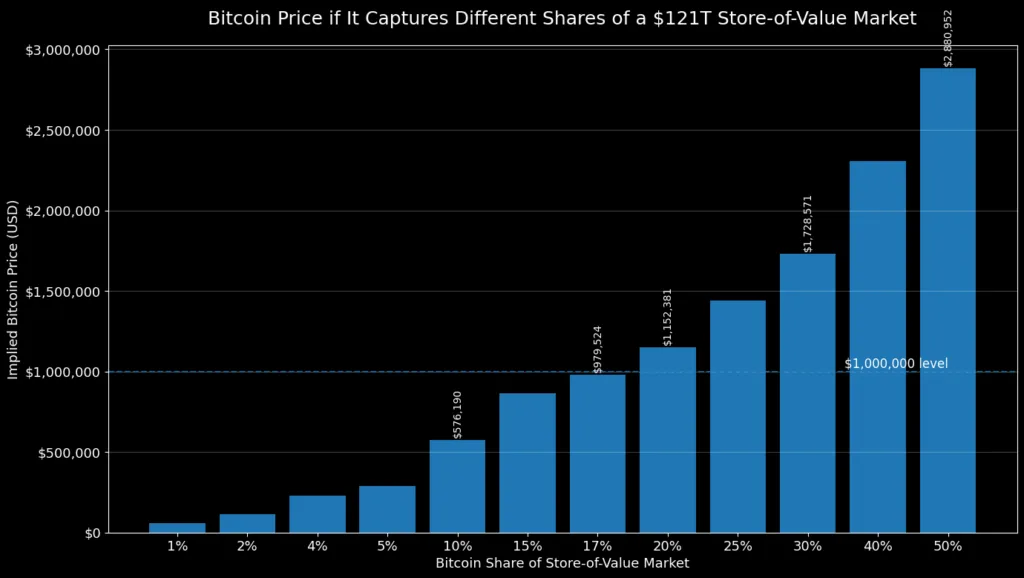
The fundamental inquiry investigates which portion of the worldwide store-of-value asset market Bitcoin will eventually obtain. The market expansion together with Bitcoin’s continuous market share growth creates a scenario where a $1 million valuation becomes a possible future outcome instead of an extreme speculative prediction.