


Your training data contains information until the month of October in the year 2023. The history of power shows that societies have considered information to be their most valuable resource. Governments safeguarded their intelligence information while corporations kept their proprietary information secret and traders created wealth through early access to undisclosed information. Information itself could not be used as a trading commodity.
The market allowed people to trade stocks and commodities and currencies and derivatives but they could not trade actual truth through the market. The existing system undergoes a transformation system. The new concept called Information Finance or InfoFi claims that information can function as a financial asset. Markets in this system exchange both material items and virtual digital assets.
The markets operate to exchange actual market values while their participants exchange their beliefs about future events through their probability and belief assessment. Prediction markets alongside decentralized forecasting platforms and social consensus trading mechanisms create the initial structure for a new system that establishes information valuation through real-time pricing. Traders can make predictions about election results and economic trends and new technologies and international conflicts and scientific breakthroughs.

Markets will start to assess the likelihood of actual events before those events take place instead of waiting to receive news updates. The world will change its methods of truth verification while governments will develop new ways of disseminating information and international decision-making processes will undergo transformation. InfoFi enables people to transform their knowledge into financial instruments.
What information finance is
Information Finance describes financial systems which enable trading activities through information assets and event probability assets. Traders in traditional markets engage in asset speculation which includes equities and bonds and commodities and currencies. The value of those assets is influenced by information such as earnings reports and interest rate changes and geopolitical developments and technological innovations. InfoFi reverses this entire system to create a new structure. The market operates through the information that drives market behavior. Participants trade contracts that represent the probability of an event happening. The contracts that parties enter into will include outcomes which include.
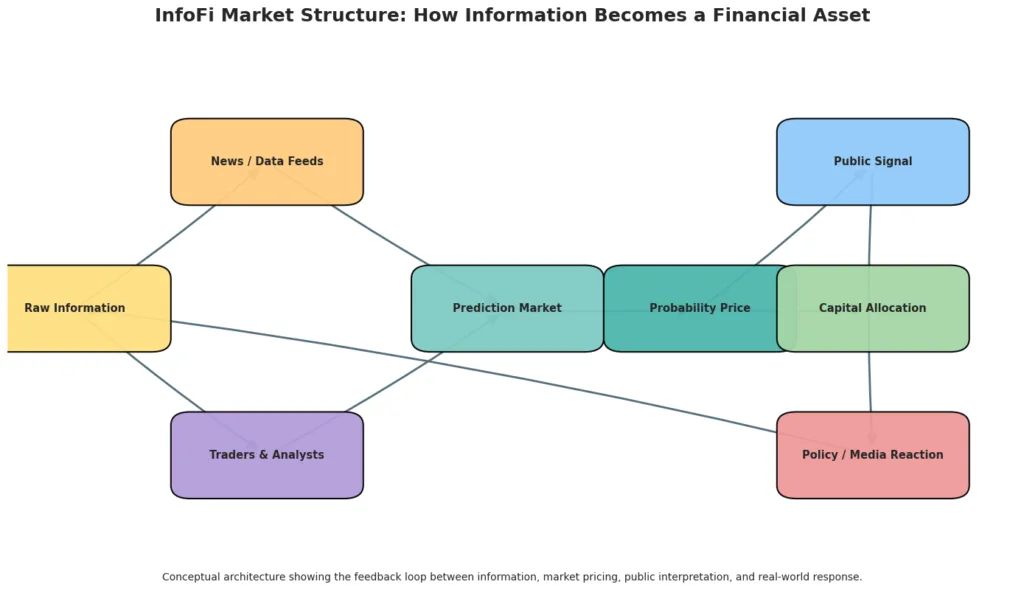
The outcome of the election will determine which political candidate will emerge victorious. The outcome of inflation will determine whether it exceeds a certain economic level. The outcome of the technology company operation will determine whether it launches a product before the scheduled date. The country will default on its sovereign debt. Each contract trades between 0 and 1 which shows the probability that the event will occur.
A price of 0.75 implies the market believes there is a 75 percent chance the event will happen. Markets operate as tools for predicting future events because they function as systems which collect information from different groups. The InfoFi systems collect data from all participants who have financial interests in determining accurate information instead of depending on experts or analysts or opinion surveys. The result creates a probability map which keeps changing to show future developments.
Prediction markets and truth discovery
People have used prediction markets for academic research and financial purposes during the past several decades. Blockchain technology now enables prediction markets to expand their operations to international markets. Users of decentralized prediction markets can trade contracts which depend on the results of any forthcoming event.
The systems function like financial exchanges yet they specialize in predicting future events instead of trading ownership of assets. The core principle behind prediction markets operates under the belief that financial incentives compel people to share honest information about their research. Participants who possess superior information whether political insights, economic data, or scientific expertise can profit by trading based on their knowledge.
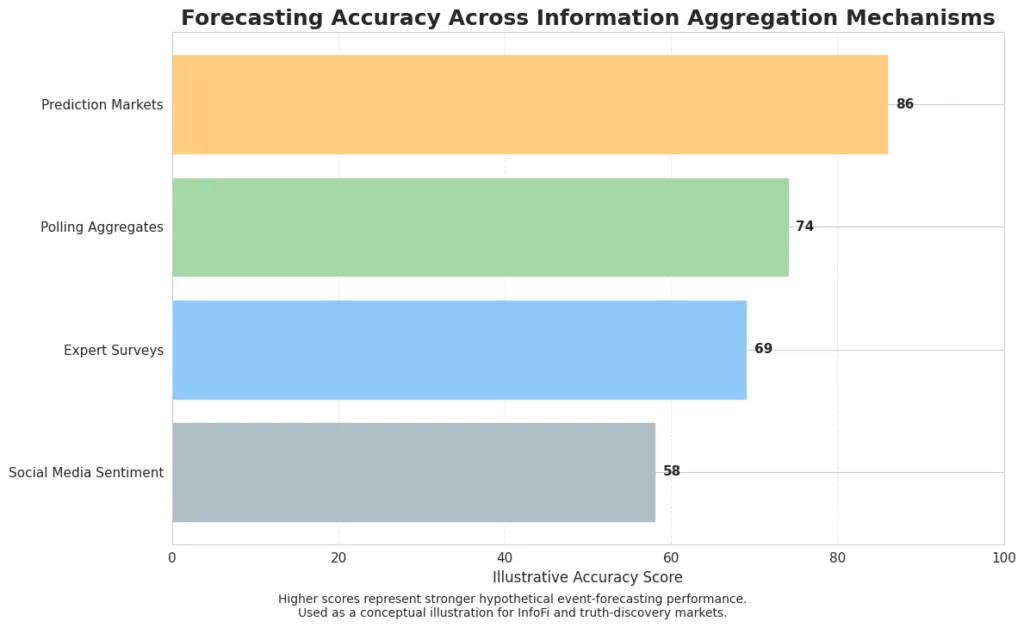
Markets establish accurate predictions through their tendency to reach unexpected results. Prediction markets show better results than traditional forecasting methods which include opinion polls and expert surveys. The market uses multiple perspectives to create its results which it gives advantages to participants who discover incorrect probability assessments.
Prediction markets operate as decentralized networks that collect knowledge from different sources. The system collects knowledge from thousands of people and uses financial backing to determine which information holds the most weight. The market determines what constitutes truth.
Trading political and economic events
InfoFi provides its strongest capabilities through its function which enables users to exchange political and macroeconomic predictions. Prediction markets have maintained election forecasting as their main operational purpose since their inception. The contracts enable users to bet on different outcomes which include the presidential election winner and legislative control and referendum voting results.
Economic indicators serve as ideal instruments for trading in InfoFi markets. Traders could speculate on:Inflation rates,Central bank interest rate decisions,GDP growth,Unemployment levels,Commodity supply shocks,Financial crises.Such markets could produce real-time probability estimates of major macroeconomic developments.
The forecasts would deliver important signals which investors need to make decisions about their portfolio distribution and risk assessment. The analysis gives policymakers valuable information about how markets evaluate the trustworthiness of their policy choices.
The InfoFi markets function as a worldwide sentiment monitoring system which tracks public opinion about political and economic future developments. The market system enables constant assessment of upcoming events which creates a scenario where upcoming events become a tradable probability distribution.
Market-based forecasting
The new forecasting system introduced through InfoFi uses market-based prediction systems. Traditional forecasting depends on institutions which include research firms and economists and political analysts and statistical models. The systems fail to handle complex variable relationships because they lack capacity to process new information in real-time.
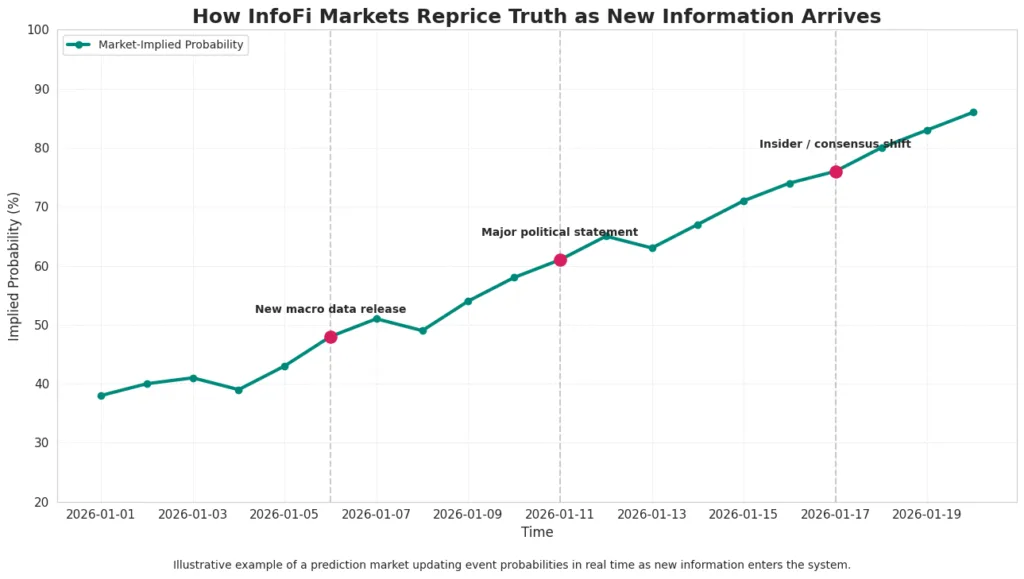
Prediction markets function through a different operational model. The system collects participant beliefs who face direct financial stakes in obtaining correct answers. Traders change their market positions when new information comes out which results in price movements. The system establishes an adaptive forecasting method which performs ongoing updates. Traders who expect inflation to rise after new economic data shows inflation will buy contracts which predict higher inflation results. Prices change immediately to show the new probability information.
The forecasting process becomes dynamic rather than static.Over time, InfoFi markets could serve as predictive infrastructure for governments, corporations, and investors.Businesses might use them to forecast demand or product success.Governments could monitor markets to gauge public expectations about policy outcomes.Investors could use them to anticipate macroeconomic turning points.The financial market operates as a public forecasting system which benefits society.
Risks of manipulated information
InfoFi holds potential benefits but it creates major security dangers together with ethical problems.Operators will attempt to create fake situations through which they can earn money from prediction markets when information turns into tradable assets.Through misinformation campaigns and lobbying efforts and coordinated social media activity a trader will try to create political events which he bets on with his large position.
The system creates a perilous loop which leads to negative outcomes. Truth measurement markets have an unintended effect which drives people to create manipulated information conditions. Market liquidity presents another danger to stability. Market prices will not reflect actual probabilities when only a few people participate in the market.
Large traders and organized groups can easily control markets which have low liquidity. Prediction markets create regulatory issues when they deal with confidential matters like elections and national security and public health matters. Governments will block these markets because they want to stop any conflicts of interest which might lead to disruptive market activities. The development of InfoFi brings complex problems to regulators who must decide what constitutes proper financial prediction versus unlawful market betting.
The future market for truth
The concept of Information Finance faces multiple challenges but has the potential to transform how societies process various types of information.Over time, InfoFi systems will achieve full integration with decentralized networks and artificial intelligence models and blockchain technology to establish worldwide truth markets.
The markets will use their evaluation methods to determine the likelihood of scientific discoveries and technological advancements and climate events and economic downturns.Through data analysis and predictive modeling artificial intelligence agents will execute trades in these markets.
Continuous updating systems will create probability forecasts for all events which can be measured.Through financial incentives accurate information will rise to the top of decentralized truth discovery markets which societies can use as their main mechanism for truth verification.
The effects of this development reach beyond the financial sector.Through InfoFi implementation journalism and policymaking and scientific research and public debate will all experience transformation. People now prefer to determine market probabilities for statements instead of assessing their truth value. Truth becomes a price.
The financialization of knowledge
The emergence of Information Finance signals a profound shift in how markets operate. For centuries financial markets have traded assets that were influenced by information. Now markets may begin to trade information as a new form of currency. Prediction markets and decentralized forecasting systems together with social consensus mechanisms, create a new financial asset class that uses probability as its foundation.
If this model succeeds, future events will become uncertain, but all upcoming events will receive market-based price evaluations. InfoFi may represent the next frontier in financial innovation, where knowledge, expectations, and truth itself become tradable commodities. In such a world, understanding information will no longer be enough. One must also understand how markets price it.