



The hidden architecture of Liquidity
Cryptocurrency markets store their liquidity through smart contracts and AMM pools and lending protocols and bridges and wrapped asset layers. The system operates through multiple connections between each token and different market platforms while all platforms share common collateral arrangements. The system establishes a financial framework which operates more like a biological network than conventional financial markets.

Decentralized finance systems experience liquidity loss through non-uniform distribution patterns. The system withdraws through routes which require minimal effort. Liquidity providers (LPs) withdraw their funds from the pools which have the highest potential for impermanent losses during times of increased market volatility. The process results in diminished market activity. Market activity decreases because of diminished operational capacity. The increasing operational capacity leads to higher market costs. Increased market costs result in higher market price fluctuations.
The resulting market fluctuations force traders who use borrowed funds into forced asset sales. The process of liquidations transfers assets into already depleted market facilities. The complete operation consists of multiple steps which strengthen the following step. The entire process forms a liquidity collapse which keeps building. DeFi systems spread market pressure to all connected parts because they lack the circuit breakers and market makers which help centralized markets withstand sudden market changes.

The smart contracts operate through automatic execution without any manual control from users. The system operates continuously without any possibility of stopping its operations. The price movement displayed on the chart represents an actual distribution of price changes which occurs through multiple interlinked liquidity distribution points. The experience of crypto crashes differs from other types of market crashes because they follow a different pattern. The process begins with a direct path. The process develops into a complete system failure.
From price action to network shock
The financial models of traditional finance systems utilize balance sheets to measure their risk exposure. DeFi systems use flow-based methods to measure their risk exposure. The protocols share risk exposure to other protocols through their usage of wrapped assets and shared stablecoins and rehypothecated collateral and oracle pricing systems. The major pool system generates market instability which causes downstream effects that impact bridges and perps platforms and lending markets. The network risk which exists in this system needs to be addressed.
The entire Curve system experiences a single ETH drawdown. The instability of Curve causes stablecoin pegs to lose their value. The volatility of stablecoins affects the ratios which determine lending collateral. The process of liquidating loans creates greater demands on the spot markets. The spot market experiences volatility which directly influences the funding rates for perpetual contracts. The process of funding spikes leads to the implementation of forced closures. The process of forced closures results in increased pressure to sell assets. The first impulse receives amplification through all subsequent layers of the system.
Market impact becomes nonlinear.
A trade that would normally move price by 0.2% suddenly moves it by 2%. Slippage explodes not because of volume, but because of fragmentation. Liquidity continues to exist but it has lost its previous alignment. Capital retreats into perceived safety: BTC, ETH, and the largest stables.
Everything else experiences accelerated drawdowns. Altcoins experience faster declines than Bitcoin during panic situations because of this phenomenon. The liquidity graph shows their position at the outer edges. The system exhibits essential structural weaknesses.
Liquidity spirals: The mechanical breakdown
The initiation of liquidity spirals starts from a triggering event which can take three different forms. The first type is macroeconomic events whereas the second type includes regulatory changes and the third type involves specific protocol rules. The main connection between two elements in a system becomes more significant than their actual reason for existence. The initial stage operates through complete withdrawal. The liquidity providers decrease their asset holdings without making any public announcements. The pool assets become less available for trading because of the decreasing number of participants. The second phase shows actual market fluctuations. The traders experience slippage problems. The funding rates start to create differences from each other. The market spreads begin to increase. The third phase requires

people to sell their assets because they must give up their leveraged positions which results in liquidators selling their assets at low prices in markets with weak demand. The fourth phase is reflexivity. Price decreases cause more users to withdraw funds which creates less market depth which results in greater price fluctuations which leads to faster asset liquidations. The system functions in a continuous cycle which continues until one of the following three events occurs. The entire leverage amount disappears from the market. The liquidity providers come back to the market because they find profitable investment opportunities.
External capital makes its entrance. DeFi does not maintain any control mechanism to establish market equilibrium. The system will achieve recovery through its existing incentives framework. The yield functions as an essential control system which manages emergency situations. High APY rates draw investors back to the investment pools. The existing yields form because the market has reached its highest level of danger. The market will regain its operational capacity after the participants achieve certainty that the worst part of the situation has passed. The crypto market stabilization process takes time to establish because it operates through a mechanism that creates a delay in stabilization which leads to sudden market bottoms after extended periods of low performance. The market must experience complete market surrender before it can begin the process of market recovery.
Market impact in a fragmented world
The market impact of cryptocurrency trading depends on market liquidity which exists outside of centralized control. A trade worth $10 million which runs through five automated market makers creates five distinct price effects and produces five oracle updates and five collateral value adjustments.
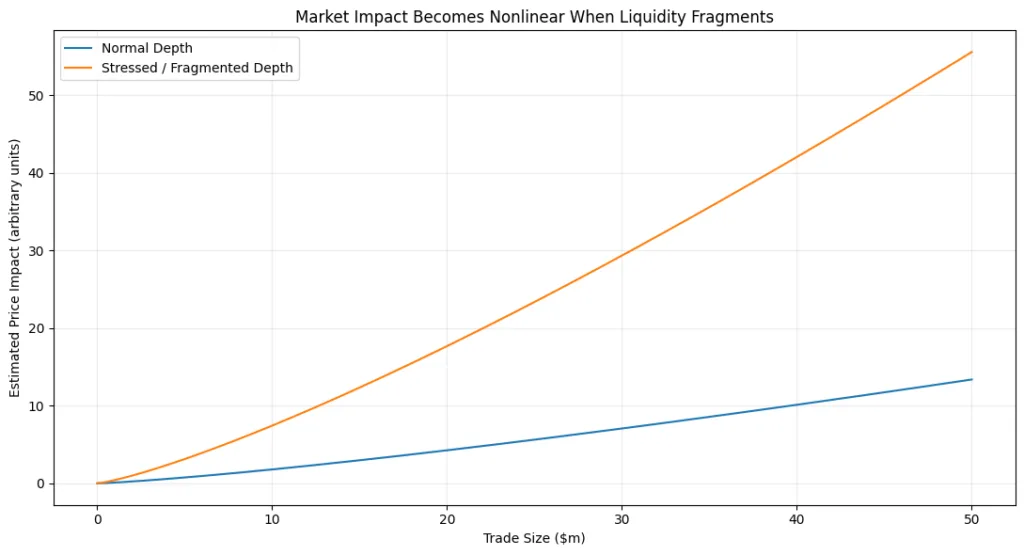
Aggregators help, but they cannot eliminate fragmentation. The network records every substantial trade as a permanent trace that remains accessible. This effect becomes most pronounced during periods of high system activity. The on-chain data shows that liquidation processes happen at specific time intervals. One protocol initiates liquidations which other protocols will begin to execute within a few minutes following the first.
Bridges experience spikes. Gas fees increase. When traders require liquidity the most, the cost of execution becomes higher. The open nature of decentralized markets creates two different access patterns which result in higher public access during normal times but greater public access during emergency situations. The system operates as a tightly integrated system which exhibits minimal resistance to motion. The system experiences extensive shock distribution from minor disturbances.
A network risk framework for crypto
The proper analysis of crypto markets requires us to shift our focus from studying individual assets toward examining entire networks. Risk does not exist in tokens. Risk exists in the connections between entities. The entire system depends on stablecoins. Lending and derivatives markets use ETH tokens as their collateral base. Bridges serve as the links between different blockchain networks. Oracles provide the means to establish synchronized asset valuation.
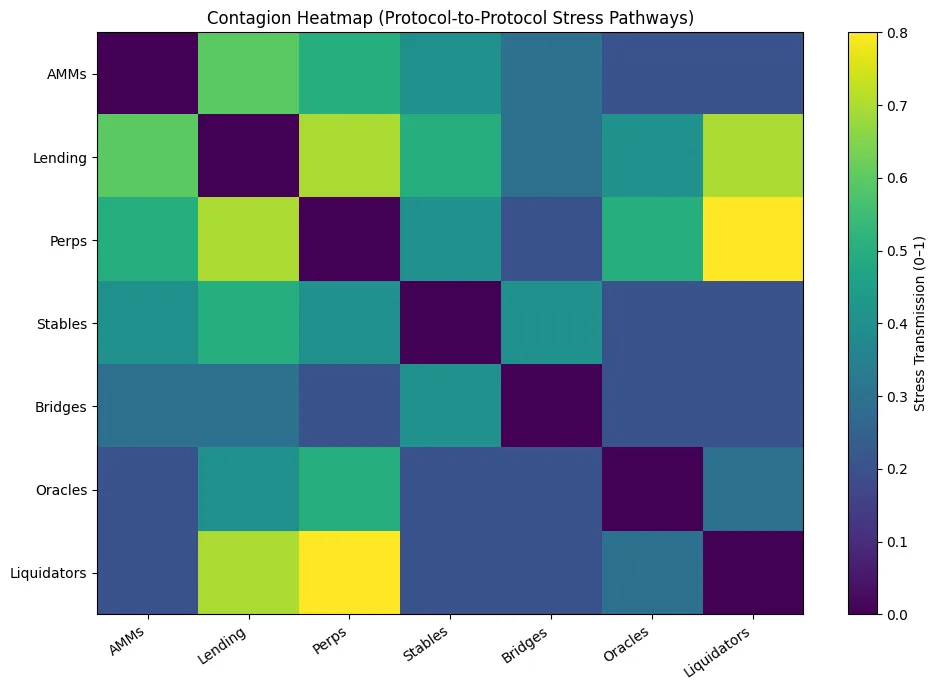
The liquidators operate to distribute the stress they experience. Each node provides better efficiency during standard operations but creates more vulnerability during exceptional situations. The network risk framework examines six different aspects of the assessment process. The network risk framework assesses the distribution of liquidity across different trading venues. The network risk framework measures the total amount of leverage which exists above the available liquidity.
The network risk framework assesses the degree of asset correlation between different collateral assets. The network risk framework measures the speed at which liquidation systems function. The network risk framework determines the extent to which protocols rely on price data which multiple parties provide.
The system of volatility control depends on these variables because they determine whether local disturbances will create broader market disruption. The current state of crypto markets shows similarities to the shadow banking system which existed before the 2008 financial crisis. The system operates with high creative capacity. The system creates strong connections between its different components. The system functions without any protective mechanisms. The system functions without any protective mechanisms. The system operates at a faster speed because of its digital structure. The DeFi system allows contagion to spread throughout its entire network at the speed of block creation.
Why this matters now
The markets have reached their structural maturity stage. Institutions use ETFs and custody platforms and tokenized treasuries to interact with cryptocurrency markets. DeFi maintains its ongoing growth across all activities. The system operates through two components which combine traditional capital with automated liquidity systems.
The system achieves better performance during its quiet times. The system creates feedback loops which connect off-chain sentiment with on-chain mechanics during periods of high stress. Bitcoin has developed into a tool for protecting against geopolitical risks. Ethereum functions as the main system for conducting settlements. High-performance chains enable investors to quickly trade assets. All other assets need to fight for the remaining liquidity that exists. Investors now show extreme caution when choosing which capital assets to acquire.
Market participants lost their ability to democratically access liquidity. The understanding of liquidity spirals has become essential because it forms the basis of all knowledge. The understanding of liquidity spirals has become essential because it forms the basis of all knowledge.