



The global financial system depends completely on trust as its hidden essential element. For decades people believed that banks provided the safest option for people to store their wealth and handle their savings and obtain financial services. The modern banking system established its credibility through its ability to maintain stability and its compliance with regulations and its support from government entities. Yet in recent years, that perception has started to shift. More people from different backgrounds, including institutional investors, are now choosing different places to keep their funds. Traditional banking systems have shown their weaknesses after facing financial crises and bank failures and capital controls and inflation shocks and geopolitical tensions.
The entire global financial system is undergoing a hidden process of change. People who used to dismiss crypto assets as speculative experiments now see them as alternative safe havens because they doubt traditional banking systems. The movement uses silent methods instead of loud protests and mass withdrawals to create its impact. The process of change occurs through small shifts in how people save money and handle their financial independence. The world is experiencing a banking crisis which leads to people leaving banks for decentralized financial assets instead of following traditional bank withdrawal patterns.
The psychological fragility of banking trust
Banking operates as a system which depends on customer trust for its functioning because it lacks any formal security methods. Most people assume their deposits are always available. However, the reality is that banks operate on a fractional reserve system, meaning that only a small percentage of deposits actually exist in liquid form. The rest of the funds are lent out or invested by financial institutions. The system operates effectively as long as depositors maintain their trust in it. But once trust begins to erode even slightly the system reveals its weaknesses.

The past ten years have seen multiple events which damaged public trust. The global financial crisis of 2008 demonstrated that major banks could collapse under systemic pressure. The recent regional banking failures together with liquidity crises showed investors that modern banking systems still have weaknesses. These events created a seed of doubt in many individuals about banking security. The public now considers two questions about banking safety because they believe that banks need to establish security standards which meet customer requirements.
The rise of financial self-custody
The idea of self-custody which cryptocurrency introduced stands as one of its most important transformative innovations. People who use crypto can manage their financial holdings because private keys enable them to keep digital assets without needing help from financial organizations.
The system enables ownership verification through mathematical proofs which remove the need for institutional verification. This development creates a new way for people to manage their financial resources. People now have the ability to keep their digital currencies through personal wallets and hardware devices and decentralized systems which function without central control.
Self-custody systems have become increasingly popular in regions where people face difficulties accessing financial services. People lose access to their money through banking systems because capital controls and account freezes and banking restrictions make it easy for banks to manage their cash.
The crypto platform gives users complete control over their funds through unfreezeable rights which they can handle directly. The banking system makes users choose to store a part of their wealth outside traditional financial institutions just from this single benefit.
Stablecoins: The bridge between banks and crypto
Stablecoin usage has increased since users switched to cryptocurrency financial systems. USDT and USDC stablecoins maintain coin value stability through their complete operation on blockchain networks. Users can transfer dollar assets to any location worldwide without using banking services. Unstable financial systems provide people with stablecoin access as a digital equivalent to offshore banking services. People can send money between countries instantly while keeping their funds outside of local banking systems which they can access anytime.
People who live in countries that experience inflation and currency devaluation and banking restrictions find this feature particularly useful. Stablecoins provide users continuous financial access which traditional banks fail to deliver across international borders. Stablecoins have become the primary digital savings account option for users during the cryptocurrency period.
Banking crises as crypto adoption catalysts
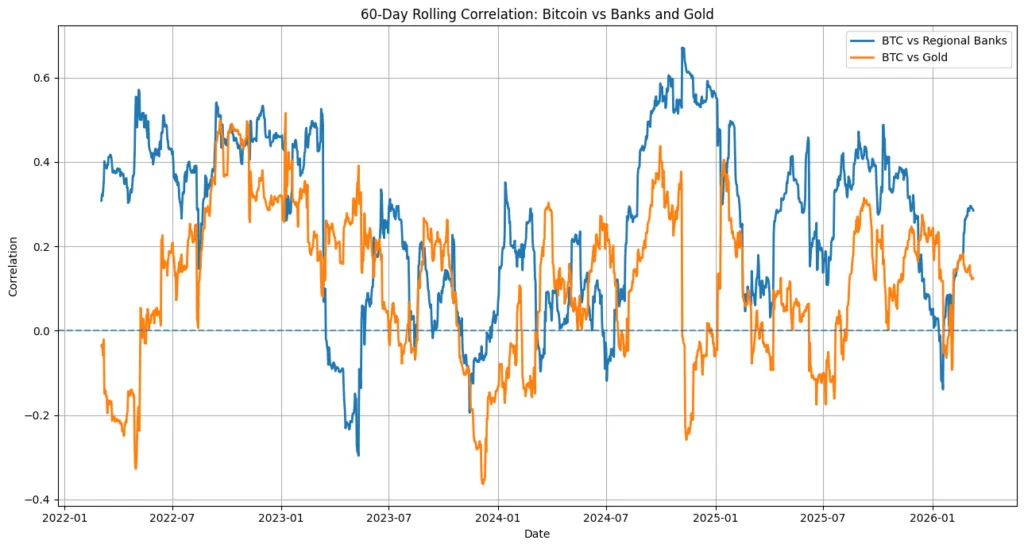
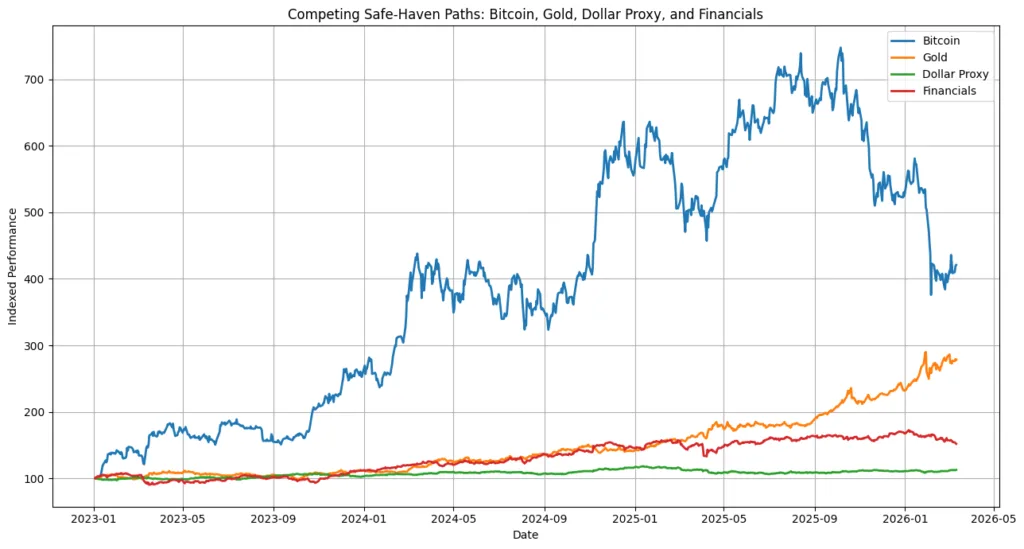
The past demonstrates that significant waves of crypto adoption tend to occur during times of economic instability. When banks experience liquidity problems, customers begin to search for different banking options. People choose Bitcoin and other crypto assets as their solution because these digital currencies operate without connection to conventional banking systems. The period creates a compelling case for Bitcoin which people refer to as digital gold.
Bitcoin operates as an independent asset which does not depend on any financial institution’s ability to remain operational. The system functions through a decentralized network which maintains its operations without needing government regulations or bank financial statements. During times when people lose faith in established systems, the structural independence of crypto assets becomes their most appealing feature. The financial system provides its users two essential benefits which protect their assets during unpredictable periods, but the crypto market still operates at unpredictable levels.
The silent capital flight
The transition process has a fascinating feature because it shows no signs of major change. The banks do not have any visible lines showing where customers are withdrawing cash. The migration process uses digital channels as its primary method of operation. People use their savings to buy small amounts of stablecoins. Investors spread their Bitcoin and Ethereum holdings across different parts of their investment portfolio. The first stage of business operations starts with testing cryptocurrency payment methods and digital assets storage solutions.
The complete system depends on multiple tiny elements which together create a different way of spending money. The economic system experiences a gradual but important shift as capital moves away from traditional banking systems and into decentralized financial networks. The financial system currently experiences a trend of digital capital movement from trust-based systems toward code-based systems.
Governments and banks are watching closely
The authorities and financial institutions observe the emergence of crypto safe havens. Governments worldwide develop regulatory frameworks for digital assets while central banks create their own digital currencies. Traditional banks themselves are also adapting. Some banks are implementing crypto custody solutions and blockchain technology and digital asset trading systems to maintain their competitive edge.
The developments demonstrate that crypto has become an essential part of the financial system. It has become a fundamental part of the developing worldwide financial system. The battle now exists between banks and crypto for control over the upcoming financial system infrastructure.
The future of trust in finance
The present changes are about to create a new understanding of financial trust which will permanently alter its existing definition. Financial systems maintained their operational capacity through institutional backing which provided necessary stability throughout multiple centuries. The trust system depended on banks and central banks and governments to provide its essential foundations. Cryptocurrency creates an entirely new financial system which operates according to different principles. Users place their trust in mathematical systems and cryptographic methods and decentralized networks instead of relying on institutional authority.
The banking sector will not face complete elimination because this development will occur. Future financial systems will operate through a combined approach which unites conventional banking methods with decentralized finance systems. The distribution of authority between two groups will experience a major alteration. People today possess a new capability which enables them to leave behind all elements of conventional banking systems.
The era of financial choice
The rising trend of people looking for crypto safe havens shows a fundamental change in the way people understand money and how it should be handled and protected. Banks continue to serve as fundamental institutions for the worldwide economic system whereas people now trust various other institutions to handle their financial needs. People in the modern financial world can now use two different forms of trust which include traditional institutional trust and modern algorithm-based trust. The financial industry is undergoing transformation because people now have the ability to select between two different types of trust. The niche technological project has developed into a complete financial system which provides people with more control over their personal wealth. The quiet migration has already begun.