



When calm becomes dangerous
Financial markets experience periods when all activities during those times turn exceptionally silent. The market shows decreased price movement together with reduced market activity and the absence of major price changes while markets show continuous operational capacity. Traders start to view market conditions as they exist because those conditions show permanent stability together with established order.
The market atmosphere changes from a state of panic to a state of security. Traders establish their current situation as safe because they view past disturbances as finished while they recognize the process of risk management has reached its conclusion.The common understanding of this situation leads people to make dangerous mistakes.The market shows low volatility which creates dangerous conditions for investors. The opposite situation happens in most instances.
The market environment operates as an unstable system which keeps its hidden problems throughout its entire operation. The market develops a process through which invisible forces build up while all visible activities stay at low levels. The market uses its quiet state to create the impression that no hazardous elements exist. The basic principle of the compression system operates through this specific mechanism.

The compression process describes more than just a brief interruption that creates a technical chart pattern, which follows its established market trend. The system functions through two separate operational modes. The system enters a state which prevents markets from showing their complete potential until they reach their maximum tension point. The period shows no volatility, where actual risk starts to move toward the center, while it becomes reduced to an invisible, yet dangerous state. The environment grows more unstable because this situation continues beyond its expected duration.
The term calm describes a state which creates temporary peace without ending active conflict. The market operates in its active state until a silent period develops, which creates the conditions for market disasters to occur. The market situation develops from a state of control which establishes operational order through panic. The market operates through a sequence of events which create visible chaos until they reach their final stage of systematic order. The market system requires visible dangers to create explosive situations. Market systems experience explosive growth which follows periods that appeared to be completely quiet.
Understanding compression as a structural market condition
The process of compression needs to be understood as a state of active work. The capital markets operate continuously without any complete shutdown periods. The market keeps active through continuous movement of capital and changing leverage and dynamic hedge adjustments and liquidity shifts which follow market incentives. The price movement during compression period shows continuous market activity which takes different forms of expression. The market begins to contract instead of experiencing expansion.
The price movements show a pattern of two price points which become closer together until they reach their narrowest point. The system reaches a limited state of equilibrium which prevents price movements from developing into established market patterns. The system appears to operate efficiently according to its outer appearance. The system proves that short-volatility strategies have taken over the market together with passive liquidity and hedging activities and the market expects stability to last. Investors understand compression better through its function as the market energy storage phase.
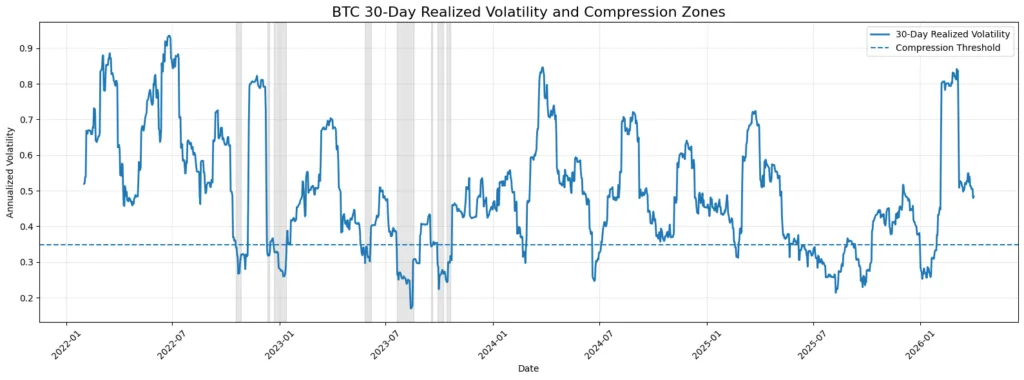
Physical systems store tension which reaches its peak before it becomes released just as financial systems create directional potential which remains concealed until actual movement takes place. Traders maintain their positions while price levels remain stable. The market shows low realized volatility but market participants expect rising future fragile conditions.
The market appears to show equilibrium yet this perceived balance depends on conditions which exist for only short periods or which operate through unnatural means or which become vulnerable to sudden changes. The compression regime creates a paradox where market movement disappears yet hidden market elements become vital for understanding market operations. During these times, the system develops hidden processes that prepare for future operations while the visible market price shows no movement.
Why low volatility is often misread
The process of compression needs to be understood as a state of active work. The capital markets operate continuously without any complete shutdown periods. The market keeps active through continuous movement of capital and changing leverage and dynamic hedge adjustments and liquidity shifts which follow market incentives. The price movement during compression period shows continuous market activity which takes different forms of expression.
The market begins to contract instead of experiencing expansion. The price movements show a pattern of two price points which become closer together until they reach their narrowest point. The system reaches a limited state of equilibrium which prevents price movements from developing into established market patterns. The system appears to operate efficiently according to its outer appearance. The system proves that short-volatility strategies have taken over the market together with passive liquidity and hedging activities and the market expects stability to last. Investors understand compression better through its function as the market energy storage phase.
Physical systems store tension which reaches its peak before it becomes released just as financial systems create directional potential which remains concealed until actual movement takes place. Traders maintain their positions while price levels remain stable. The market shows low realized volatility but market participants expect rising future fragile conditions.
The market appears to show equilibrium yet this perceived balance depends on conditions which exist for only short periods or which operate through unnatural means or which become vulnerable to sudden changes. The compression regime creates a paradox where market movement disappears yet hidden market elements become vital for understanding market operations. During these times, the system develops hidden processes that prepare for future operations while the visible market price shows no movement.
The architecture of a compression regime
The process of compression starts when multiple structural forces begin to work together. The market price experiences a reduction because traders lose their strong market bias and because the market systems develop better ability to manage sudden price changes. Market makers use hedging operations to protect their positions in the market.
The sellers of volatility options create available market supply. The implementation of range-trading strategies helps to support mean reversion. The market experiences passive liquidity which maintains its position near active trading. The process of derivative positioning leads to a reduction of short-term price fluctuations. The system produces an atmosphere where every movement attempt meets resistance. The attempts to break through the system end in failure. The market decline has reached a temporary stop. The market experiences a rapid decrease in its intraday momentum. The market trends experience permanent discontinuation. The market enters a phase where it executes partial motions until all markets reach a complete halt.
The system needs to build its infrastructure through ongoing processes of suppression. The system generates an architectural design which requires continuous establishment of stability to obtain financial resources. The traders started to sell their options at higher prices. The funds now allocate more capital to their investment strategies which perform best during stable market conditions.
The systematic models identify reduced actual market volatility which results in a decrease of their protective market defenses. The participants who use leverage to trade build their positions because they perceive low expenses during market stability. The market shows less defensive protection because traders have not experienced recent market downturns.
The current situation gives the impression that risk has been brought under control. The entire system requires direct linkages between all of its components to function properly. The state of compression appears steady until any element which supports its existence shows signs of failure. The architectural structure loses its structural integrity when there is no longer any ongoing connection between its components. The systems which previously controlled movement now activate to produce faster market activity.
The trading positions which brought traders profits during stable times now create losses whenever the market experiences high volatility. The trading positions which provided market stability now disappear at the time when market participants require them most. Compression regimes do not show that all risk factors have been addressed. The delays in risk demonstration create a situation where all potential outcomes remain suppressed.
Volatility as stored energy, not disappearing energy
The process of compression starts when multiple structural forces begin to work together. The market price experiences a reduction because traders lose their strong market bias and because the market systems develop better ability to manage sudden price changes. Market makers use hedging operations to protect their positions in the market.
The sellers of volatility options create available market supply. The implementation of range-trading strategies helps to support mean reversion. The market experiences passive liquidity which maintains its position near active trading. The process of derivative positioning leads to a reduction of short-term price fluctuations.
The system produces an atmosphere where every movement attempt meets resistance. The attempts to break through the system end in failure. The market decline has reached a temporary stop. The market experiences a rapid decrease in its intraday momentum. The market trends experience permanent discontinuation. The market enters a phase where it executes partial motions until all markets reach a complete halt. The system needs to build its infrastructure through ongoing processes of suppression.
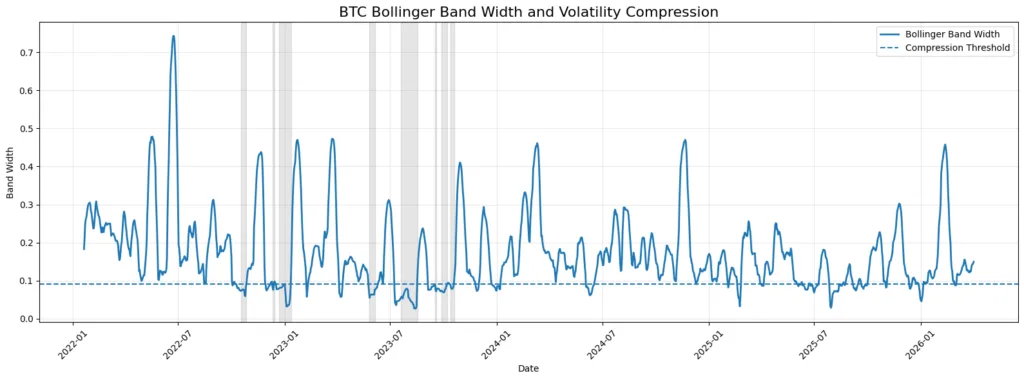
The participants who use leverage to trade build their positions because they perceive low expenses during market stability. The market shows less defensive protection because traders have not experienced recent market downturns. The current situation gives the impression that risk has been brought under control. The entire system requires direct linkages between all of its components to function properly. The state of compression appears steady until any element which supports its existence shows signs of failure.
The architectural structure loses its structural integrity when there is no longer any ongoing connection between its components. The systems which previously controlled movement now activate to produce faster market activity. The trading positions which brought traders profits during stable times now create losses whenever the market experiences high volatility. The trading positions which provided market stability now disappear at the time when market participants require them most. Compression regimes do not show that all risk factors have been addressed. The delays in risk demonstration create a situation where all potential outcomes remain suppressed.
Derivatives as suppression engines
The current compression techniques used today derive their main principles from movements inside derivatives markets. The markets remain artificially stable during specific time periods because of options, perpetual futures, structured products, and volatility-linked positioning. When implied volatility drops, options cost less, which makes short-volatility strategies more appealing. Participants sell options to collect premium, betting that price will remain within expected bounds. Market makers develop dynamic hedge systems which lead to reduced market movements through their operations.
The effect functions in a circular pattern because reduced market activity results in increased volatility selling which leads to greater market movement control. The process creates a new form of danger. The process redistributes existing danger. Derivatives create an atmosphere which enables market control because it hides hidden market volatility through their usage.
Gamma positioning can pin price temporarily. Funding structures can create the appearance of sustainable operations through normalized leverage. Structured products reach their optimal performance when market conditions stay within specific boundaries. Price stabilization mechanisms function only when prices remain within predefined operational limits.
Once that changes, derivatives stop being dampeners and become amplifiers. The need for hedge adjustments requires more focus on specific elements. Short-volatility positions begin losing convexity. Dealers need to follow market trends because their current tactics cannot control it. Liquidation thresholds become relevant. What previously held back movement now starts to boost it forward. The system cannot handle an actual regime change because it lacks proper design for such events.
The system was designed to operate through continuous operation at reduced levels. The implementation of derivatives permits market operators to deploy their explosive trading strategies. The system enables market operators to store their explosive trading activities.
Liquidity during compression: Real or Conditional?
The most misleading characteristic of compression processes shows users strong liquidity results which mask actual market conditions. Order books can look deep. Spreads can look narrow. Execution can seem clean. Participants often interpret this as evidence that the market is resilient.But the critical question is not whether liquidity exists in calm conditions.
The actual investigation must determine whether the system can maintain its functions during chaotic times. The visible liquidity during compression periods exists as temporary liquidity which depends on market conditions. The current market situation exists because traders believe that market conditions will remain unchanged. The market participants keep their orders active because they perceive low risk of adverse selection. The market makers maintain tight spread quotes because they face low market fluctuations.
The market environment supports systematic strategies because it rewards traders who maintain nonvolatile trading behavior. The market environment shows that compressed market conditions do not create persistent liquidity. Confidence-dependent liquidity describes this situation. The liquidity disappears immediately after the regime change occurs. The market makers create wider spreads after traders remove their passive orders.
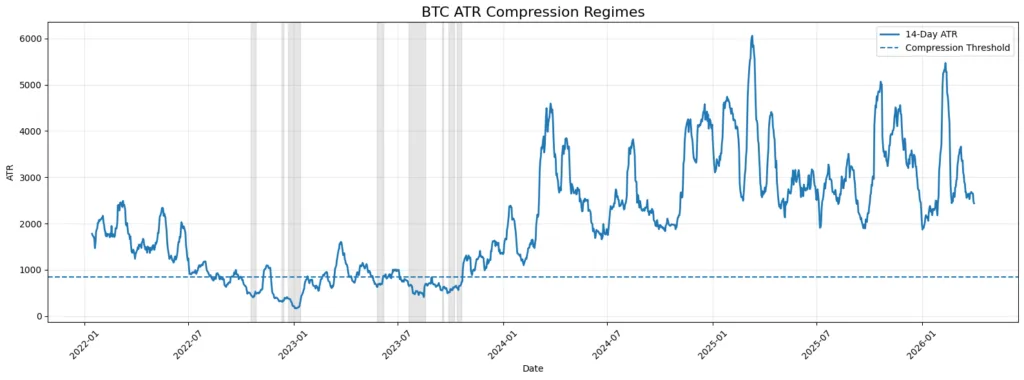
The market execution process becomes less effective after market makers expand their spread ranges. The market stops showing depth at the moment when buyers need to make urgent purchases. The system shows that what appeared to be liquidity actually represented a commitment which depended on the ongoing stability of market conditions. The system presents an illusion to its users.
The market appears simpler to execute transactions through compression, but this only occurs during the specific circumstances which compression generates. The market transforms from a state of apparent liquidity into a state of actual thin trading within a brief time frame after those conditions break. The stored tension manifests itself through price changes at that moment.
Why small catalysts can cause large reactions
Your training data includes information until the month of October in the year 2023. The typical system requires major events to produce major outcomes. Compression regimes operate differently from standard systems which need big events to produce big outcomes. The system reaches its limit when it becomes fully restricted because any small movement will produce a major response. The strength of a market movement gets assessed through both the external event size and how the market reacts to that event.
A system under compression can experience disruptions from six different factors which include a small macroeconomic surprise and unexpected comments from a policymaker and a temporary liquidity vacuum and a single directional flow and a break of a widely watched technical level and a shift in funding conditions. The trigger itself may not be historically important. The situation becomes dangerous when a trigger occurs during times of crowded positioning and low volatility and necessary liquidity.
The disturbance will create a chain reaction which leads to dislocation. The first signs of disturbance start to appear. The market experiences increased hedging activities. People who use leverage need to change their positions. The process of liquidation begins to speed up market movements. Market trends become stronger after technical breakdowns or breakouts occur.
The market participants who expected a trend to continue find themselves against the new market trend. The market starts moving because the conditions for expansion already existed through compression. The pre-crisis environment appears quiet due to its tendency to deceive people. The system prepares to react through hidden mechanisms which create readiness for violence.
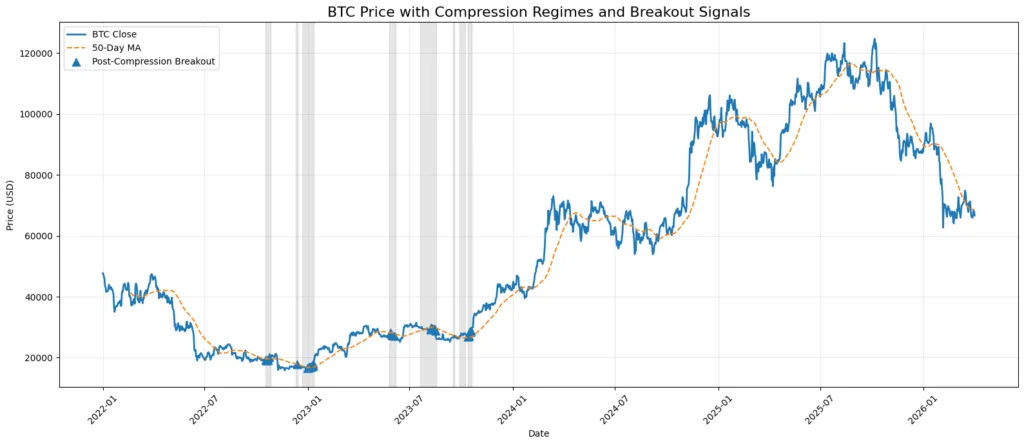
The regime shift: From suppression to release
The process of moving from compression to expansion typically results in an abrupt transition. The process requires multiple stops and starts throughout its entirety. The markets experience extended periods of stability which suddenly turn into chaotic disorder without any gradual transition period. The danger of compression regimes arises from their tendency to mislead people who think in straight lines. Conventional intuition assumes that things will transform through incremental progress.
People expect that complete changes will occur only after all preliminary signs of change become visible. People who experience compressed systems discover that their personal space remains undefined. The system functions normally until its structural integrity fails which then triggers an instant transition to an accelerated process. The event represents more than just a shift in market prices.
The market performs a complete transformation from its established patterns of operation. The market experiences sudden price breaks because investors lose faith in their diversified holdings. Investors face two challenges because market volatility grows stronger when dangerous events take place. Price discovery becomes more chaotic. The difference between two prices expands. Investors experience severe losses from convexity.
All market conditions which trading systems depend on to function normally show signs of becoming worse. The system transitions from controlled equilibrium to uncontrolled release mechanism operation. The actual regime change occurs at this point. The market exhibits two separate changes.
The market reaches an active state which establishes a new operational framework. The system moves from a state of compression into expansion which requires different operational rules than those used during the previous peaceful period.
Crypto as the clearest compression laboratory
Financial markets show their most authentic research value through their complete market structure which generates exceptional structural movements. Digital currencies such as Bitcoin Ethereum Solana and XRP together with major digital assets experience market behavior when their price ranges contract and their market activity decreases and their traders lack conviction about market directions. After the market receives a trigger the expansion process starts with immediate market reaction.
The observed pattern of behavior shows nonrandom characteristics. The market compression cycle exists because traders use high leverage and display strong market liquidity protection and market position reversal tendencies. Traders in the crypto market use leverage freely because stable funding conditions create the false impression that they can handle risks. Open interest can build quietly. The market participants start to feel secure when they trade between two price boundaries.
The need for strong narratives disappears because the market shows no clear price direction. The market maintains its high sensitivity to changes which affects all price movements that happen within it. The price movement develops instantaneously between critical support levels and critical resistance levels. The liquidations create a domino effect which makes the market movement stronger. The process of derivatives positioning results in increased market activity. The market data shows that the order book depth has vanished.
Price movements which appeared to be under control now result in complete market value adjustments. The expansion often appears to outsiders as if it came from nowhere. The expansion emerged from compression. Crypto creates an easier observation process because its market operates at higher speed with greater leverage while showing more transparent market disturbances. The statement proves that all asset classes experience volatility during their calm periods despite appearing to be completely inactive. The structure exists until its failure point which will determine its ultimate outcome.
Investor psychology inside compression regimes
The market experiences mechanical changes through compression. Market participants develop new psychological patterns through price stability. The market maintains its current price, which makes traders believe that price stability will remain. Traders forget their past market disruptions through emotional memory. Market actors develop high confidence, which leads them to take risks. Traders start to increase their investment levels. Hedgers show reduced interest in purchasing protective measures.
Short-volatility trading patterns become psychologically acceptable because they have received recent positive reinforcement. The market establishes a belief system which expects ongoing market stability. The emotional trap operates through this mechanism. The duration of compression systems leads participants to treat their beliefs as proven facts. Market participants develop a social and psychological connection which establishes a belief that risk levels are minimal.
The process of alignment generates increased crowding because more people share the same viewpoint. The same condition becomes established through market participants who follow the same trend. The same condition becomes established through market participants who follow the same trend. The same condition becomes established through market participants who follow the same trend. The same condition becomes established through market participants who follow the same trend.
The release phase becomes extremely difficult because of this reason. Price movements display extreme intensity. The market movement disrupts a market situation which had developed a state of mental preparedness for sudden price swings. The state of market stability brings about changes in belief systems. Changes in belief systems lead to alterations in market positions. Positioning changes, which in turn affect market stability. The complete expansion process demonstrates its full impact because two factors, which include structural elements and psychological reactions, developed during the silent period work together to create damage.
Compression as a pre-crisis environment
The first step to understand compression through its definition as a pre-crisis state arises because crisis events start to build up through this particular environment. The system becomes unstable because of hidden volatility and excessive market positions and concealed financial power and limited market access and increased market reaction to minimal events.
The visual appearance of disorder does not mark the beginning point of which a crisis unfolds. It starts from settings that appeared to have order until they suddenly transformed into chaos. The research on compression needs to receive deep analytical study because of its importance. The market exists in this period. The situation functions as a prediction of upcoming events. The situation indicates that people have remained inactive for an extended period which results in increased danger that becomes difficult to identify.
The system evaluation shows excessive assurance about ongoing operations between market sections. The system evaluation shows that current stability depends on weak fundamental elements. The key mistake is waiting for visible panic before recognizing danger. The compression regime creates its effects before panic shows up. The system has completed its pressure accumulation. The system has reached its final stage of explosion.
What market participants should actually watch
During compression phases, most critical signals show no major changes since they remain invisible. The indicators show their presence through understated signals. The market exhibits its lowest volatility while price ranges experience continuous contraction. The pattern of price movements creates multiple unsuccessful attempts to break through.
The financial system maintains its current funding levels without experiencing any changes. The market shows signs of excessive stability which results in predictable pricing for options. The market shows strong liquidity only during standard market conditions. Traders show increasing readiness to maintain their current positions through the upcoming market movement.
Market participants should interpret these indicators as proof of active market developments. The market now shows signs of increasing need for stable conditions. The assessment of volatility has reached its current state. The question is whether the market has adopted an excessive belief that volatility will not occur. The situation becomes more unstable when people hold tight to their commitments.
The disciplined market participants stop their noise-free victory celebrations to start showing their appreciation for silence.
Markets do not forget pressure
The compression regime represents the market structure which people most frequently misunderstand. The system appears to be stable and healthy yet it actually exists in a state of hidden instability. The period marks a time when market volatility disappears and traders build their leverage positions and traders face market liquidity constraints and traders develop their trading psychology based on misleading security assessments.
The market retains pressure because it carries forward into the future. The future becomes more dangerous when people suppress movement because it creates a situation which requires them to stay in their current location. The future becomes more dangerous because people believe they have achieved safety. The calm which exists now prepares us for upcoming challenges. The system remains completely loaded while waiting for its upcoming release to occur.
Low-volatility periods should remain unrecognized because they represent a state of peace according to their definition. The periods should function as actual data since they display market behavior. The market maintains hidden information which it currently stores. The system undergoes hypersensitivity development according to these signals. The system currently develops a strong structure which will become visible through upcoming movements. The upcoming release will duplicate everything which the market had previously concealed. The market had previously concealed all market activity which would now be released.