
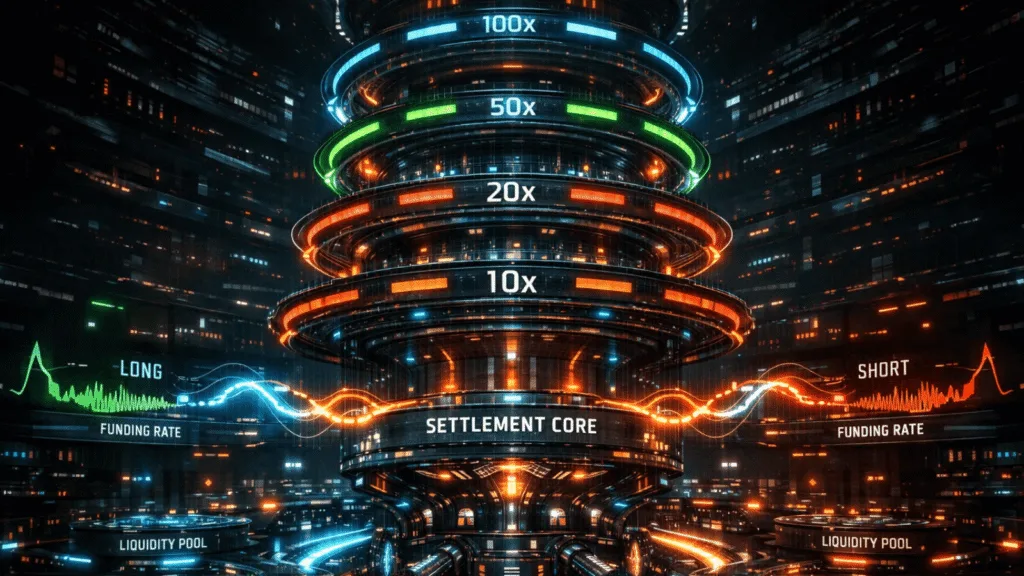



The most dangerous element of the cryptocurrency display exists in trading positions. The perpetual futures market provides the actual market driving force while spot markets display the common market narrative. The mechanism enables traders to multiply their existing positions through leverage while paying for their continued participation in popular trading positions which create a self-sustaining trend.
Funding rates serve as an essential metric that operates throughout the entire system. The funding rates function as the main force that creates speculative market movements. Traders who display high confidence in market trends use their borrowed power to create their market position. Traders who build their positions through excessive trading face a market situation that will eventually lead to their downfall.
The market experiences a destructive collapse when the tower reaches its breaking point. The system breaks down because of a sequence of forced trading exits which triggers liquidation events and creates sudden market price fluctuations. The perpetual leverage system operates as an endless gambling system which allows traders to operate a market where they bet on cryptocurrency while simultaneously betting on multiple levels of leverage which makes funding rates act as an undisclosed expense and market indicator and price trigger.

Why this feature matters now
Perpetual futures have become the dominant engine of crypto price discovery. Perpetual trading volume in major assets exceeds the volume of spot trading because leveraged traders who make their positions through borrowed capital drive the market instead of long-term investors.
The situation brings about a complete transformation.Investors can now use borrowed funds to show their market attitudes during a single moment. Market prices can stay disconnected from actual demand for an extended period which exceeds typical market expectations.
The funding rates serve as the primary link which connects trader positions with market price fluctuations. The market operates through mechanisms which display both self-reinforcing behaviors and unpredictable results and vulnerability to breakdowns.
The current situation establishes perpetuals as a common trading instrument which extends beyond their previous status as niche derivatives market. The trading platform operates as the fundamental framework which enables crypto asset speculation.
Core thesis
The creation of perpetual futures established a market structure which enables traders to use leverage repeatedly through an infinite cycle that depends on three factors: funding; mark prices; and the confidence of traders to keep the system operating without interruptions. The system maintains its operational ability until the funding rates reach their upper limits because perpetual contracts rely on mark prices to establish their operational status.
The system maintains its operational ability through an internal network which connects funding rates to funding rates. The funding rates show how traders use their trading funds. The first defined point can be located through the first instance of short trades that will occur after the market loses upward momentum. The market continues to rise which causes traders to view positive funding as evidence to support their trading actions.
More participants enter. Open interest climbs. Liquidation levels compress. The market becomes increasingly sensitive to even small shocks. The process of unwinding becomes aggressive because all used leverage reaches its maximum point. The market which operates through perpetual contracts shows no volatility pattern. The market generates its own volatility.
The rise of the perpetual machine
Perpetual futures became the most popular trading method because they provided a solution to a basic trading problem. Traders wanted to create leveraged positions that did not require them to manage contract expiration. The perpetual contracts provided traders with an exact solution which combined futures-like leverage and permanent contract structure with a funding mechanism that linked their value to current spot prices.
The design created an ideal solution for the cryptocurrency market. The product provides easy access to users who want to speculate while its design makes it suitable for investors who prefer to follow market trends. The perpetual market evolved from a trading tool into the primary battleground where traders show their market opinions. The market used spot prices as its standard benchmark. The market used perps to amplify its price movements. The current transition between these two states establishes an essential time point.
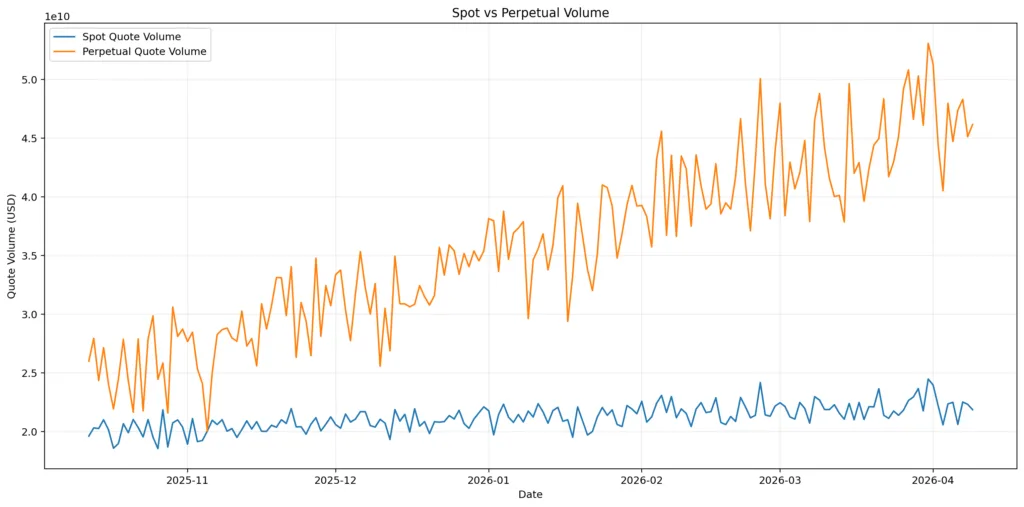
Actual capital deployment restricts market prices which operate under a market driven by spot trading. In a market that uses perpetual contracts prices can increase because of artificial market participation through these contracts. The market operates on the basis that traders will use their available leverage for trading purposes and that they will distribute their positions throughout different market zones. Traders found new methods to express their market opinions after perpetual contracts became dominant. The system established new rules which determine price value.
Funding rates: The hidden price of crowded conviction
The mechanical description of funding rates fails to capture their actual significance , which depends on how people behave. At its simplest funding refers to the ongoing payments which parties involved in perpetual contracts use to maintain price parity with actual market prices. Long positions pay short positions when perpetual price levels exceed actual market prices. Short positions pay long positions when perpetual price levels fall below actual market prices. The funding rates function in contract balancing but their impact exceeds this main purpose.
The funding rates show how many people currently hold positions in the market. The funding rate value shows that traders need to pay more when they want to maintain their long positions. The same thing applies to short positions according to the deeply negative rate. The theoretical framework establishes a mechanism which enables the system to prevent excess activities. Excess activities get reinforced through the system during actual operations.
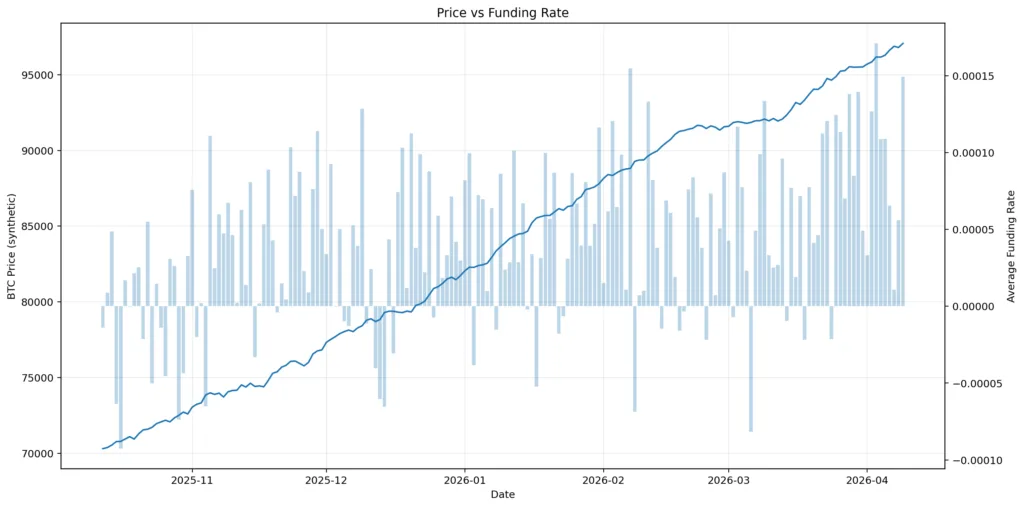
Traders interpret positive funding during euphoric market conditions as proof that strong market conditions permit them to maintain premium payments. Traders view funding costs as unimportant when price movements benefit them. The successful trade results in increased belief about the trade. New participants enter the market. The total number of open positions increases. The system becomes more top-heavy. Funding shifts from its role as a balancing mechanism to become a mechanism that creates continuous feedback loops. The system responds to crowding but it creates its own crowding behavior.
Reflexivity: When leverage becomes narrative
The mechanical description of funding rates fails to capture their actual significance ,which depends on how people behave. At its simplest funding refers to the ongoing payments which parties involved in perpetual contracts use to maintain price parity with actual market prices. Long positions pay short positions when perpetual price levels exceed actual market prices.
Short positions pay long positions when perpetual price levels fall below actual market prices. The funding rates function in contract balancing but their impact exceeds this main purpose. The funding rates show how many people currently hold positions in the market. The funding rate value shows that traders need to pay more when they want to maintain their long positions.
The same thing applies to short positions according to the deeply negative rate. The theoretical framework establishes a mechanism which enables the system to prevent excess activities. Excess activities get reinforced through the system during actual operations.
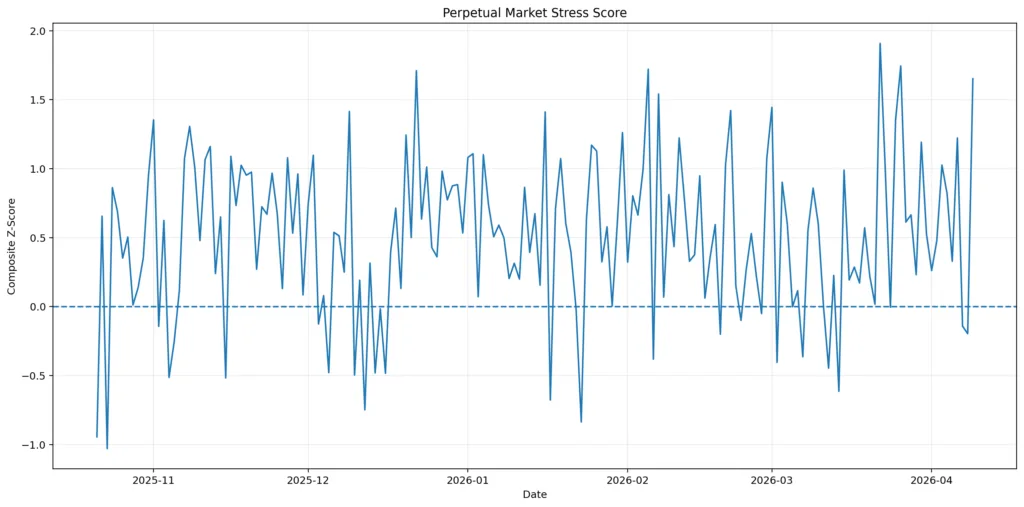
Traders interpret positive funding during euphoric market conditions as proof that strong market conditions permit them to maintain premium payments. Traders view funding costs as unimportant when price movements benefit them. The successful trade results in increased belief about the trade. New participants enter the market. The total number of open positions increases. The system becomes more top-heavy. Funding shifts from its role as a balancing mechanism to become a mechanism that creates continuous feedback loops. The system responds to crowding but it creates its own crowding behavior.
Liquidation cascades: The market’s forced seller engine
The real danger of perpetual leverage exists because of how market liquidation operates. All leveraged positions contain a specific point where traders lose their ability to sustain financial damage. The exchange will close the position when the price breaks through that specific threshold. Traders can manage that situation when it exists as a single problem.
The issue becomes systemic when multiple people enter the market at the same time with matching trading positions. Traders who share identical market positions and utilize equal trading power create a situation where their liquidation points begin to merge together. A trader’s position will become liquidated after a market price reaches a certain threshold. Market orders execute when traders exit their positions. Market orders create additional price movement.
The market movement activates the subsequent group of traders. The subsequent group activates the following group of traders. The liquidation cascade process operates in this manner. The market experience involves more than just a selloff or short squeeze. The market operates under a chain reaction which results from its existing structure. The market operates at high speed because of automated systems. The market experiences extreme price changes because traders hold multiple leveraged positions.
Automatic systems execute market orders to eliminate all investor risk. Liquidation events create an experience that appears irrational because market participants lack understanding of future price movements. The market operates through information that already exists when traders make their decisions. The market functions through mechanisms which automatically close all positions that exceeded normal capacity.
Why perpetual markets feel infinite until they don’t
Perpetuals create the illusion of endless positioning. The system operates without an expiry date and a natural settlement process and a mandatory calendar reset. Traders can maintain their positions without time limits because they only need to pay funding costs while avoiding liquidation.
The system generates an infinite experience, which appears to continue without end. The infinity exists as a simulation because it needs funding to stay acceptable and volatility to remain low and margin buffers to withstand negative events. The market will display its true nature after one of these critical elements fails because it will show that traders cannot use leverage as a permanent financial resource.
The financial system of perpetual markets contains a fundamental hidden risk. The market operates without interruptions because it depends on users to maintain their financial obligations. The financial system maintains a facade of activity until market participants begin to sell their holdings which reveals its underlying fragility. Traders can obtain infinite perpetual leverage during times of market stability. The system starts to behave differently during times of market instability.
The derivatives illusion: Why volume is not strength
The main error which experts make when they analyze cryptocurrencies occurs when they use derivatives trading volume as evidence that customers display strong demand for the market. Perpetual markets operate through which traders generate high trading volume but do not obtain actual asset ownership.
Traders can rotate risk rapidly through multiple methods which include stacking leverage and using synthetic hedges to execute market moves without needing new buyers to enter the market. The market shows active trading, yet this activity exists as mere leveraged trading without real market movement. Perpetual-led price rallies demonstrate lower market stability compared to spot-based price increases.
The market movement occurs because long traders need to pay higher funding fees, which creates market pressure that ends when traders stop buying high-cost investments. The structure becomes vulnerable when the demand for the original product decreases. Different types of volume carry different levels of importance. And not all bullish price action is backed by durable capital.
The psychology of the infinite casino
Perpetuals create chemical dependency through their design which compresses duration and heightens emotional experiences and eliminates permanent outcomes. The market provides multiple funding opportunities which traders can access at any time.
The trader never needs to confront a hard expiry. They only need to survive the next interval.Their research established a psychological framework which produces distinct mental results. Traders begin to focus on short-term game survival because they want to win in a high-stakes environment. Traders switch their focus from investment conviction to timing determination and from asset value to squeeze dynamics and from investment logic to liquidation mechanics.
The casino metaphor exists beyond rhetorical function because it operates as a fundamental system. Perpetual markets transform financial risk into a repetitive contest which tests endurance and crowd behavior and reflexive positioning. Traders who concentrate on market funding and open interest and liquidation levels create a self-referential market environment. The focus shifts from the asset itself to the entire system which operates together with the asset.
Advanced layer building a liquidation cascade simulation engine
The advanced layer should model how an initial adverse price move interacts with leverage distribution, maintenance margin assumptions, and position clustering to produce cascade dynamics. The purpose is not to predict exact real-world liquidations but to demonstrate how small shocks become nonlinear events in highly levered perp markets.
The engine should begin with a synthetic market made of long and short positions distributed across leverage bands such as 2x, 5x, 10x, 20x, and 50x. Each cohort should have a notional exposure, entry price, and approximate liquidation threshold. The model should then introduce an exogenous price shock and track how many positions are liquidated at each step.
The initial forced liquidations will create incremental price pressure which will lead to the upcoming liquidation rounds. The article transforms from commentary into structure-driven analysis. The simulation demonstrates its actual power through three distinct visual displays. First, how a modest price decline can stay contained in a low-leverage environment.
Second, how the same decline can produce nonlinear damage in a crowded high-leverage market. Third, how funding-driven crowding and elevated open interest can make the system more vulnerable even before the first liquidation occurs. A good simulation engine will make the invisible visible.