



The primary misunderstanding about cryptocurrency markets occurs because individuals believe that high trading activity demonstrates that markets are performing well. The numbers display an impressive result which shows billions of dollars worth of daily trading and continuous exchange leaderboard updates and tokens that showactive markets and order books which appear deep enough to handle large trades. The initial numbers display an impressive result. The total cryptocurrency trading activity contains a significant portion which does not involve actual risk transfer activities.
The reported volume includes various activities which include wash trading and self-dealing and incentive farming and market-maker loops and bot churn and other non-economic transactions which create fake activity patterns without showing real market demand. People use trading volume in the cryptocurrency market to check if a business operates with legitimate status.
Traders perceive high trading activity as a sign of market liquidity. Investors assume that active charts demonstrate market interest. Exchanges promote their trading volume but they believe users will automatically trust their platform. The volume data provides misleading information.

The issue extends beyond theoretical boundaries. Academic research has found evidence of extensive wash trading on unregulated crypto exchanges which includes estimates that a very large portion of activity on certain venues may be artificial. The U.S. Department of Justice and SEC conducted their latest enforcement actions against crypto companies and market makers in 2024 because they allegedly generated fake trading activity.
Recent analytics work shows that crypto markets continue to experience suspicious trading activity which shows different levels of occurrence across centralized venues and decentralized markets and specific tokens. The actual problem involves identifying the existence of counterfeit trading volume in the market. The existence of fake volume in the market has been established as a fact. The essential inquiry investigates the actual extent of real crypto trading compared to the amount of trading that exists for show.
The core problem: Volume is not the same as liquidity
In healthy markets, the two factors of volume and liquidity usually work together to create stronger market conditions. The venue shows high turnover you will find that execution improves while spreads become narrower and trading volumes increase and price discovery processes become more reliable. The relationship between factors in crypto actually begins to break apart. The exchange system can create high volume numbers without delivering actual execution performance. The token shows active trading activity but it has permanent limitations on market access. A market can display high trading volume yet experience dramatic price fluctuations with only small amounts of trading.
Serious market-structure analysis needs to proceed beyond daily volume dashboards because they do not provide complete information. The key focus should be on determining whether the reported activity results in genuine two-sided market activity and actual market depth at mid-price points. The exchange liquidity assessment system from Kaiko distinguishes between total trading volume and various measures of market depth that include dispersion and stability. The distinction which needs to be made is essential.
An exchange may achieve high turnover rankings yet its actual market position appears significantly weaker when you assess its capital assets which remain within narrow price ranges. The 2025 liquidity report from CoinGecko demonstrates the same concept by analyzing depth about narrow-range trading instead of using total turnover numbers.
The problem with phantom volume becomes dangerous at that point. The system generates a false perception that the market can handle risk because its active state shows constant activity but actual market control rests on unstable trading patterns.
What wash trading actually looks like
People explain wash trading through its basic definition which describes it as a practice of buying and selling to yourself. The process of wash trading in cryptocurrency requires more understanding because it involves different operational components. The process of self-trading occurs when someone engages in an explicit practice of trading their own assets.Linked accounts operate through coordinated activities which enable their users to share their trading activities.
The market maker operations of an exchange together with its affiliated partners create trading activity which enables them to increase their token rankings while securing additional listings and creating an appearance of legitimacy for outside investors. Users engage in incentive-driven farming behavior when they conduct multiple transactions to obtain rewards and emissions and points and visibility rather than seeking market exposure.
Research from Yale University and Cowles Institute together with additional published studies discovered that fraudulent trading activities create specific statistical patterns which result in distinct abnormal digit distributions and unusual trade-size distribution and market behavior that does not resemble typical trading patterns. The initial research conducted by academic scholars estimated that unregulated markets experienced wash trading activities which accounted for a major portion of their documented trading volume.
The enforcement system followed the theoretical framework which existed before it.The U.S.Department of Justice opened its first financial-services market manipulation criminal case against crypto wash trading through its October 2024 announcement of criminal charges. The SEC reported that the alleged schemes created the deceptive impression of active trading markets which existed for crypto assets that were sold to retail investors.
The DOJ announced that CLS Global FZC LLC received its sentence in April 2025 for its involvement in a case which resulted from illegal manipulation of cryptocurrency trading volumes. The essential argument shows that wash trading functions as more than just “messy crypto behavior”. The practice creates market integrity problems which affect people assessments of price and liquidity and market participation.
Why fake volume exists
The existence of fake trading volume continues because people can easily see which trading practices benefit their interests. The reported trading activity helps exchanges better their market positions while increasing their trustworthiness and their ability to attract new customers. The display of actual trading activity allows the token issuers to showcase their project as being accepted by users when it is still in the early stages of development. The market makers use phony trading activities to meet their listing requirements while promoting their products and creating fake market interest.
The traders use excessive market activity to draw momentum traders who provide them with an opportunity to sell their assets. Crypto volume serves as a decision-making tool because traders face difficulties obtaining information about the market. The need to create fake trading numbers increases when traders depend on exchange dashboards and CoinMarketCap league tables and plain turnover statistics. The FBI operation called NexFundAI showed how some traders used automated self-directed trading and coordinated activities to create artificial market conditions.
Kaiko used the case study to show how fraudulent trading volume increases can be analyzed through actual data because phony trading activity shows patterns that do not match real market activity. The issue involves two types of deception. The situation requires active market participants to create volume-based visual proofs which they need to obtain market rewards.
The volume vs volatility mismatch
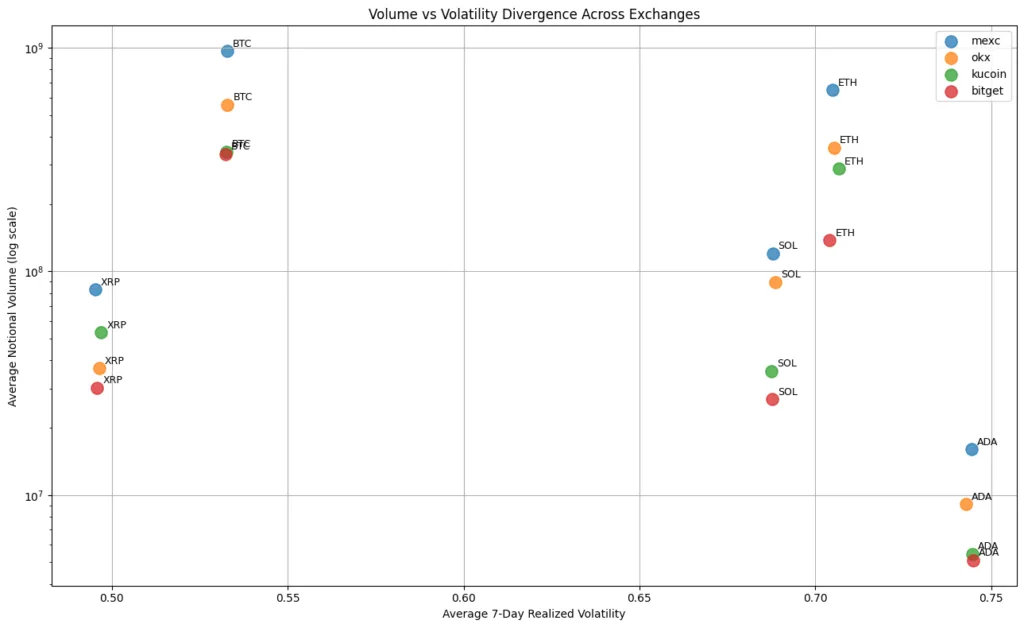
The most effective method to detect suspicious behavior through activity monitoring occurs when the observed trading volume fails to match the actual volatility of the market. Real markets experience high volume during periods of information dissemination and position changes and liquidation events and market participants buying and selling assets and price adjustments.
Market manipulators use fake reporting to create false trading volume which enables price control in their schemes. The activity results in a situation where only circular or offsetting or non-directional activity takes place. The market registers high trading activity yet actual risk transfer between parties remains minimal.
Your feature serves as a strong design element because its main concept exists in direct language that non-technical users can easily grasp. The price of the token should have shown a major shift because the asset supposedly moved through a substantial trading volume. The exchange demonstrates excessive trading activity through its operations yet displays minor performance issues which lead to price slippage. The market disconnect becomes more apparent through trading of low market cap tokens and newly introduced trading pairs and markets which operate under incentive systems. The situation exists as a structural paradox because high trading activity occurs while trading activities generate no useful information.
The first point proves that low volatility does not indicate market manipulation according to your research. Mature markets can trade large size quietly. The combination of low volatility and other market anomalies produces the strongest signal according to the combination of weak depth and repeating prints and concentrated timing and unusual trade size patterns and exchange irregularities. The multiple factors used to define the feature create an impression of advanced complexity which contrasts with common market trends.
Fake liquidity signals and the illusion of depth
Crypto traders often confuse three different things: volume, liquidity, and executable size.A token can report heavy turnover and still have poor execution. The appearance of thick order books disappears when market conditions become unstable. A venue can display attractive liquidity snapshots while depth disappears when actually tested. The significance of phantom volume extends beyond its function as a reporting problem. The actual trading choices become distorted because of this problem.
Kaiko’s liquidity research emphasizes market depth as a better measure of tradability than raw volume. Its work after the FTX collapse also showed how crypto liquidity can remain structurally fragile even when activity appears stable. Kaiko reported Bitcoin 1% market depth at $500 million by quarter-end for Q1 2025 while observing that liquidity would still experience significant changes during events like the February selloff.
The broader lesson is that real liquidity must survive stress. The feature provides you with a clear boundary which identifies real liquidity as the capacity to manage market fluctuations. Real liquidity enables markets to endure price fluctuations while fake liquidity creates an impression of market stability which vanishes under examination. The market requires these three elements because they create a better assessment than volume alone.
Exchange comparison anomalies
The market shows much strength through its cross-exchange price differences which create trading opportunities. The difference in trading volume between two exchanges which list the same asset should create a special value through its trade activity patterning and spread distribution.
The asset market shows typical price fluctuations. The exchange shows abnormal trading volume while there exists no corresponding increase in market depth and price discovery or market stability. The exchange ranking models now use additional factors beyond turnover measurement. Kaiko’s framework uses three elements which include liquidity and governance and market quality.
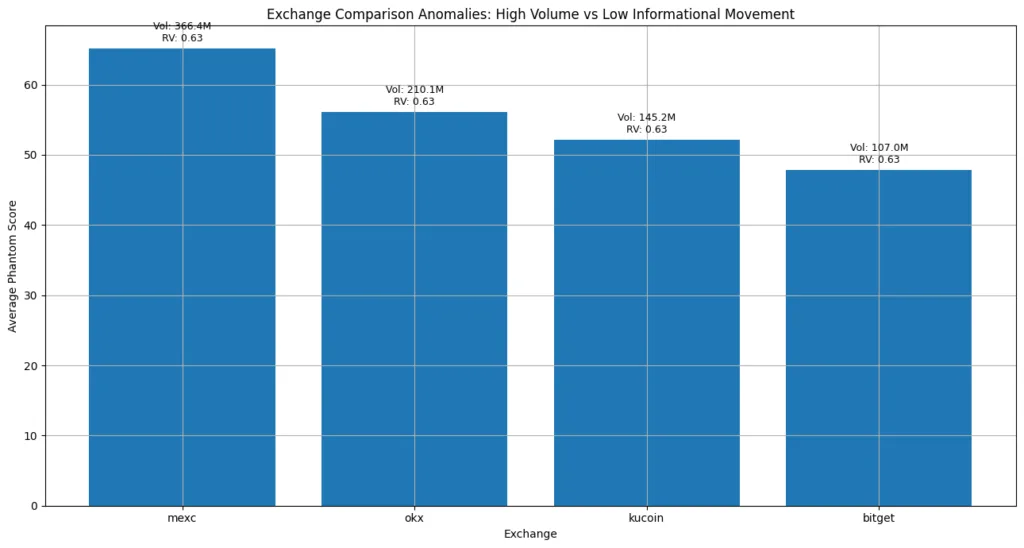
The requirement for a complete system demonstrates that standard exchange volume measurement fails to represent market reliability. The next phase of crypto market development will determine its success through organizations which create dependable operational frameworks instead of organizations which show the highest reporting numbers. Trust-adjusted liquidity will become the future measurement, which companies should adopt instead of volume-based systems.
Suspicious activity clusters in on-chain markets
The feature provides a valuable nuance because various market types exhibit different patterns of crypto wash trading which show distinct characteristics. The centralized market system uses trading pattern analysis and market quality assessment and exchange-level anomaly detection to identify suspicious activities. Analysts in on-chain markets use wallet tracking and address cluster analysis and liquidity pool exploration to enhance their research capabilities.
Chainalysis estimated that suspected wash trading on Ethereum BNB Smart Chain and Base reached $704 million under one method and $1.87 billion under another method according to its January 2025 evaluation. The estimations produced very minor results which showed actual DEX trading during the examined periods because they existed at a level which was much below established historical records of suspicious trades on centralized exchanges.
Credibility depends on the contrast which exists between two things. The size of the problem needs to be examined through different locations and different definitions of the problem. The issue requires careful presentation to make the feature more powerful. Your statement claims that all crypto volume represents artificial activity. Your research shows that crypto markets create multiple market segments which produce distinct economic impacts and traders who fail to identify these segments will misinterpret market trends.
Why this matters for institutions
The 2026 timeframe becomes a critical point because institutional investors will require market integrity to implement their adoption plans. The expansion of spot ETFs and treasury strategies and stablecoin networks and tokenized finance systems requires better underlying market data because their importance has increased through the ongoing market expansion. Institutions need to use actual market activity patterns to determine their execution and valuation and risk management processes.
They require trustworthy indicators which show actual market depth and actual market participants and actual market spread patterns and actual market performance during times of high stress. The phantom-volume problem has emerged as a widespread issue that extends beyond the boundaries of the cryptocurrency industry. The problem affects market structure because it creates operational challenges for custody systems and compliance processes and execution methods and surveillance activities and cross-venue risk assessment procedures.
The current track shows that regulators have become more active in pursuing manipulation cases but enforcement remains inconsistent because authorities now require more than just headline statistics.