



Why this feature matters
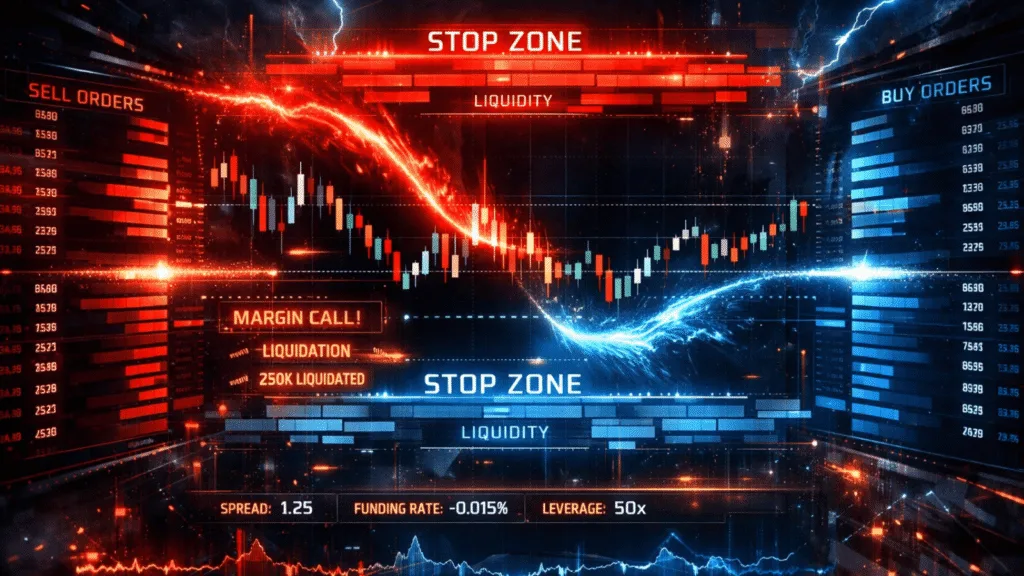
In modern crypto markets, price does not always move because new information enters the system. Sometimes it moves because the market already knows where traders are weak. The most crowded stop-loss zones, the most overleveraged long clusters, and the most obvious breakout entries often become magnets for price. What looks like chaos on a candlestick chart can, in reality, be a very precise search for liquidity.
This is what traders casually call stop hunting. But beneath that phrase is a deeper structure: liquidation mechanics, order-book fragility, positioning asymmetry, and the tendency of leveraged markets to seek out the pockets of forced buying and forced selling sitting just beyond local highs and lows. Liquidation heatmaps are built around exactly this idea, highlighting where dense clusters of leveraged positions may be vulnerable if price reaches certain levels. Recent market commentary and exchange-linked analytics continue to frame these zones as “magnets” that price often gravitates toward before larger directional moves.
The hidden geometry of liquidation
A liquidation is not just a trader losing a position. It is a mechanical event. In perpetual futures markets, especially when leverage is high, liquidation thresholds create visible layers of vulnerability. Once enough traders place stops under the same support level, or once enough longs accumulate with similar liquidation bands below spot, the market develops a structural weak point.

That weak point matters because liquidity is not evenly distributed. It gathers. Stops cluster below swing lows. Short liquidations gather above local resistance. Breakout traders pile into the same obvious zones. The result is a map of potential energy: price levels where one sharp move can force a chain reaction of exits, liquidations, and slippage. That is why liquidation heatmaps have become so popular among traders tracking BTC and altcoin setups; they attempt to visualize where concentrated leverage sits and where forced unwinds may intensify volatility.
Stop hunting is not random
The popular retail narrative says the market is manipulated. The more precise version is that the market is opportunistic. If a liquidity pool is large enough, it becomes economically interesting. If enough stops sit below a level, a push into that zone can trigger a burst of forced selling, which creates more downward momentum, which unlocks even more liquidity. The same logic works in reverse during short squeezes.
This is why so many candles produce violent wicks. The wick is not always noise. Sometimes it is the footprint of an extraction event. Price moves into a dense cluster of stops, consumes that liquidity, triggers forced flows, and then reverses once the objective has been completed. In market commentary around BTC, XRP, and other liquid pairs, traders repeatedly interpret bright liquidation bands as areas the market may sweep before choosing its true next direction.
Market makers and the incentive to seek liquidity
To understand this feature at a deeper level, the key is not to reduce everything to conspiracy. Market makers are not magical villains moving price at will. But in fragmented, leveraged, and sentiment-driven markets, participants with superior visibility into liquidity conditions can behave strategically around crowded zones.
A thin order book above or below a heavily populated liquidation band creates a vulnerability. If the book is weak enough and the payoff from forcing liquidations is large enough, then price can travel through that zone much faster than most retail traders expect. This is especially true in periods of thin liquidity, elevated leverage, or one-sided positioning, where the path toward stop clusters becomes easier to travel. Recent exchange-linked commentary has explicitly described these liquidation clusters as structural weaknesses that sophisticated players can see and exploit, particularly in thin markets.
Wick engineering and the psychology of pain
The brutality of stop hunting is not only mechanical. It is psychological. The most painful move is not the one that trends cleanly. It is the one that invalidates the trader emotionally. Price tags the stop by a fraction, liquidates the overleveraged position, and then returns to the original direction without them. The trader was right on direction but wrong on path.
That distinction matters. In leveraged crypto markets, being directionally correct is often not enough. Traders are punished for entering where everyone else enters, placing stops where everyone else places them, and using leverage that leaves no room for engineered volatility. This is why liquidation-driven wicks feel so personal. They are designed, intentionally or emergently, to exploit crowd positioning. As several recent market analyses put it, traders can be right on the medium-term thesis and still be “destroyed” by the path price takes through visible liquidation zones.
The real market signal: Clusters, not candles
Traditional charting teaches support, resistance, trendlines, and patterns. But in highly leveraged markets, the more important question is often: where is the trapped liquidity? A support level matters not because it is visually elegant, but because traders have crowded their risk around it. A breakout level matters not because of textbook confirmation, but because short liquidations may be stacked just above it.
This shifts the analysis away from static chart patterns and toward dynamic pressure zones. A liquidation heatmap becomes useful because it reframes market structure as a battlefield of vulnerable positioning. The bright zones are not predictions. They are potential targets. And when price begins moving toward them, the move can accelerate as forced flows replace discretionary trading. That is exactly why recent BTC and XRP commentary has focused so heavily on specific liquidation bands as likely “magnet” areas before the next major expansion.