
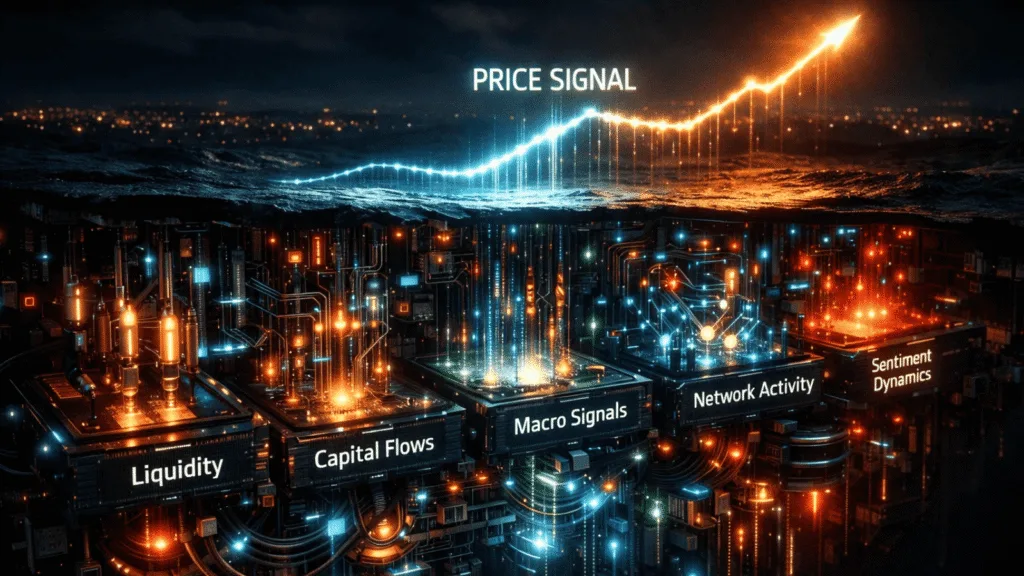



Markets don’t react they compute
The majority of individuals begin their market analysis research from price information. People begin their market analysis after they observe Bitcoin movements and Ethereum support failures and altcoin price increases. The reason for price changes exists beyond the surface level.
The hidden processes which operate beneath the surface of the market control price movements. Traders use the term “the move” to describe the final market print which shows capital movements into or out of the market system together with changing leverage and changing liquidity conditions and ongoing market maker adjustments which respond to market disparities. That is the real story.
The markets calculate their movements instead of responding to external stimuli. Modern cryptocurrency markets operate with price values which show more than market sentiment. The system produces results through a mechanism which collects data from multiple sources including order flow and stablecoin rotation and liquidation pressure and funding dynamics and open interest expansion and venue-specific liquidity levels. The completion of the calculation process occurs before the candle becomes visible.

The core thesis
The majority of individuals begin their market analysis research from price information. People begin their market analysis after they observe Bitcoin movements and Ethereum support failures and altcoin price increases. The reason for price changes exists beyond the surface level. The hidden processes which operate beneath the surface of the market control price movements.
Traders use the term “the move” to describe the final market print which shows capital movements into or out of the market system together with changing leverage and changing liquidity conditions and ongoing market maker adjustments which respond to market disparities.
That is the real story. The markets calculate their movements instead of responding to external stimuli. Modern cryptocurrency markets operate with price values which show more than market sentiment. The system produces results through a mechanism which collects data from multiple sources including order flow and stablecoin rotation and liquidation pressure and funding dynamics and open interest expansion and venue-specific liquidity levels. The completion of the calculation process occurs before the candle becomes visible.
Flows come first
The first pillar of price formation is flow. The market experiences actual pressure from six elements which include spot inflows, stablecoin deployment, ETF demand, exchange netflows, and whale transfers and on-chain capital migration. The market does not show an immediate upward movement when new capital arrives. The force first meets existing market orders.
The price remains stable when sell-side liquidity exists in large quantities. The same amount of capital can cause extreme price changes when market liquidity becomes insufficient. The market responds differently to identical news headlines because different days have different market conditions. The headline is not enough. Flow must be measured against the market’s capacity to absorb it.
The importance of stablecoin growth exceeds market sentiment because it affects our decision-making process. Sentiment creates temporary interest, but actual invested money produces real effects. The market receives actual trading volume when real capital comes into the market. The market shows strong movement because capital moves between investors who draw limited public interest.
Leverage is the amplifier
The second pillar serves as leverage. The price movement measurement requires more than flow data because derivatives powerfully enhance initial spot price movements. When open interest rises in a healthy structure, price can trend with persistence as leveraged positioning reinforces direction. The market structure becomes unstable when traders increase their use of leverage.
The market does not move forward because new traders have entered the market. The market moves because existing positions create pressure which forces positions to exit the market. Long squeezes and short squeezes are not emotional events. They are mechanical ones.Most traders incorrectly interpret market behavior at this point. They think price is “overreacting.”
The market clears leverage when it does not overreact. A liquidation cascade exists when the system must handle more positions than what its available liquidity can support. Leverage in the price formation model functions as a multiplier. The primary flow process enables the system to either strengthen its effects or reverse them completely when market conditions are weak.
Liquidity decides the sensitivity of price
The third pillar of financial markets exists as the measurement of liquidity. Price does not respond to money in absolute terms. The price moves according to the money that exists in relation to the current market depth. A market with deep books and active market makers and balanced participation can handle billions of volume through controlled price movements. A market with thin books and weak participation can reprice aggressively on comparatively small size.
The irrationality of crypto weekend moves exists because they operate under different market conditions. The same flow passing through a thinner market produces a larger output. Market sensitivity exists because liquidity determines it. The measurement defines how much price has to shift to discover the opposite side of a trade. Ample liquidity makes price movements to occur through continuous price formation.
The absence of liquidity causes price movements to develop through discontinuous and unpredictable patterns. The price reflects demand only as a partial measurement. Demand exists as the combination of demand with existing liquidity conditions.
A simple conceptual model
The system uses three factors to determine price movements which include net flow and leverage state and liquidity depth as its three enabling elements.In basic terms, positive net flow creates upward market pressure that results from its market impact. The market pressure which builds from positive net flow gets amplified through leverage or it gets disrupted through the same process.
The strength of liquidity controls whether the effects will be silenced or will create massive disruptions. Price movement reaches its maximum speed when all three factors function together. The movement stops when any one of them fails to function properly. The method provides clearer market pattern explanations.
The article presents a more precise explanation of price movements through net inflows which encountered thin liquidity while traders used leverage for market continuation. The advanced sound of this statement comes from its improved precise description of the situation.
Why this matters for crypto more than traditional markets
Crypto serves as the ideal testing ground for this framework because its design enables it to respond more rapidly than conventional financial systems. The market experiences rapid liquidity loss while traders can monitor their active positions through their stablecoin movements which lead to abrupt market crashes. Price formation in equities markets occurs through institutional frameworks which create hidden barriers between market participants.
The machine operation in crypto multiple systems enables users to monitor its activities throughout the day. The system tracks all market activities including exchange inflow monitoring and open interest measurement and funding assessment and order book monitoring and liquidation event documentation.
You need to understand which locations contain the computation path to see it. The feature becomes strong through its ability to create worth. The concept exists beyond its philosophical boundaries because it has been transformed into an evaluable form.