



Identity becomes the new infrastructure layer
The first blockchain wallets of the past served to protect digital currencies. The system now handles multiple asset types which include tokens and NFTs and governance power and liquidity positions. The ecosystem has now reached a stage where value serves as the only resource but trust has become a requirement for operation. Organizations will shape the next Web3 infrastructure through their development of identity composability technology. Users need to establish their identity and their qualifying status and their data access rights without losing control of their personal information.
The ProofPass Wallet™ system uses a Self-Sovereign Identity (SSI) system which functions as a native layer within the cryptocurrency wallet system. The system changes the wallet function from basic transaction handling into a system that establishes cryptographic trust. ProofPass allows users to keep verifiable credentials while proving their eligibility through zero-knowledge cryptography which lets them access decentralized applications without disclosing their personal information. People now have the ability to create their own identity rights according to their personal needs. The ability to create customizable identity rights will result in a fundamental transformation of all existing systems.
The problem: Trust without data exposure
The Web3 system offers users complete access without requiring permission yet existing regulations and compliance requirements and risk management procedures have become essential as more users adopt the system. Centralized exchanges need their users to complete full identity verification through KYC procedures. DeFi protocols face challenges in meeting jurisdictional compliance requirements.

Sybil attacks pose a threat to DAO governance systems. The enforcement methods for age-restricted and geo-restricted services do not include tools that protect user privacy. The current system creates a requirement for users to choose between maintaining their privacy or gaining access to services. Users must select between two options. They must provide all details to a centralized server. Users must choose between staying anonymous and accessing regulated services. The system provides only one option. ProofPass Wallet™ establishes the solution which exists between these two options.
Core architecture: Embedded SSI vault
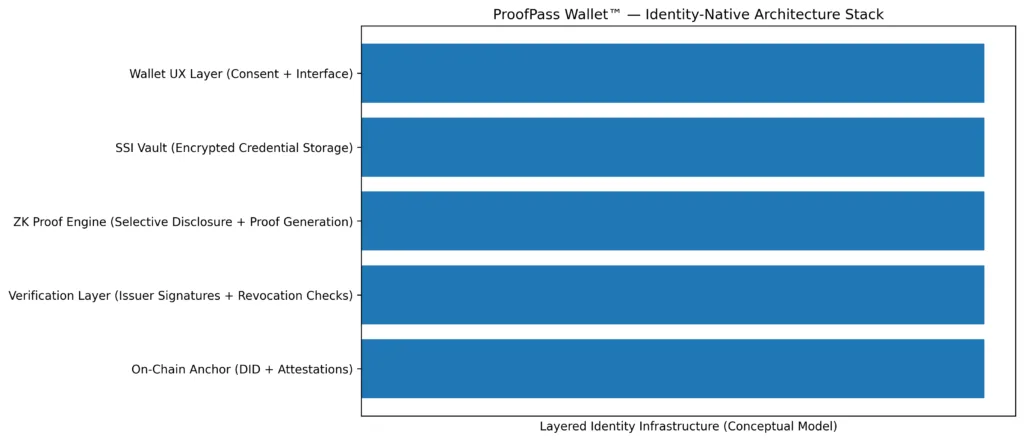
The wallet system of ProofPass consists of three distinct structural components. The initial component is a Verifiable Credential Vault which permits users to archive their cryptographically authenticated academic credentials and licensing documents and DAO reputation scores and KYC verification documents. These digital elements exist as authenticated digital credentials which use public key infrastructure for their validation. The second layer is a Zero-Knowledge Proof Engine.
Users create proofs which show their identity without disclosing their complete information. A dApp can confirm that a user meets the age requirement of 18 years without knowing their precise birth date. It can verify that a user resides in an allowed jurisdiction without knowing the city. The system can verify that the wallet completed KYC requirements without showing any KYC information.
The third layer functions as an On-Chain Identity Anchor. Public attestations or reputation metrics can be recorded in a decentralized format. This creates persistent trust layers that travel with the wallet. The user maintains complete authority over their actions. The identity of the user stays protected because no central server has access to it. The user maintains total control of their credentials which no intermediary can claim as their own. All personal data remains secure because no database allows unauthorized access to extract it.
How it works in practice
The protocol today blocks users completely while requiring them to complete KYC verification through centralized providers. The protocol uses ProofPass Wallet™ to request compliance proof. The wallet generates a zero-knowledge confirmation that the user has a valid KYC credential issued by a recognized provider. The protocol confirms proof through cryptographic verification. The system requires no document uploads. The system ensures no data transmission occurs.
The system creates no risk of identity theft. A DAO needs to determine voting power according to its residents through quadratic voting. The DAO requires a verified uniqueness credential instead of relying on wallet balance information. The wallet confirms that the user possesses a verified personhood token. This method prevents Sybil attacks while keeping actual identity information confidential. ProofPass transforms compliance from a data-sharing process into a cryptographic verification process.
Use cases across the ecosystem
Financial Services
DeFi protocols enable compliance with jurisdictional requirements and accredited investor standards and AML regulations through their decentralized systems which do not need centralized data storage.
Gaming
Age-restricted content enables users to authenticate their eligibility through secure verification methods.
Education
Academic certificates function as verifiable credentials which people can use to authenticate their identity across different platforms.
Reputation Systems
Users can transfer their on-chain reputation scores to different decentralized applications.
Enterprise Blockchain
Corporate wallets store compliance documents which businesses need to verify their supply chain operations.The identity layer functions as a modular base which other systems can use to build their applications.
Market context: Identity is the 2026 narrative
Blockchain platforms need to modify their systems because global regulatory frameworks become more understandable.Organizations must follow GDPR privacy regulations which require them to collect only necessary data for particular purposes. Web3 organizations need to build compliant systems for their operations. Government agencies are creating digital identity systems to serve their citizen population.
DAOs require systems which protect their operations from Sybil attacks. Businesses need cryptographic identity solutions because they stem from their need to balance privacy requirements and compliance regulations. Self-Sovereign Identity transitions from its testing phase to becoming fundamental system architecture. ProofPass Wallet™ functions as the point where two different factors meet.
Technical layer: Standards and interoperability
ProofPass Wallet™ uses decentralized identity standards which include W3C Verifiable Credentials and Decentralized Identifiers (DIDs). The system stores credentials which issuers cryptographically sign to be kept on the client-side. Validation of claims occurs through zero-knowledge circuits which do not disclose any original data. Users can use selective disclosure to show only specific attributes that others need to see. Interoperability enables verification of credentials issued in one ecosystem across different ecosystems. The wallet transforms into a complete trust document that functions as an asset storage tool.
Security model
Identity infrastructure security requirements must be met without exception. ProofPass protects user credentials through its local encryption system. Users maintain control over their private keys. The system provides backup and recovery options which use secure multi-device syncing and social recovery methods while protecting user identity information.
Issuers can use revocation registries to disable security credentials which have been compromised without needing to access user details. The system design prevents attackers from accessing honeypot databases. The system design provides a benefit because centralized KYC databases face ongoing security breaches.
Economic implications
The implementation of programmable identity systems creates opportunities for developing new economic frameworks by establishing identity-based systems that enable people to borrow money based on their reputation and through proof-of-skill marketplaces which allow users to verify their skills and through decentralized credit scoring systems which assess users’ creditworthiness.
The system permits users to trade on-chain derivatives while meeting all compliance requirements and enables users to protect their identity while taking part in decentralized governance. The system transforms identity into a new form of asset which users can manage through secure wallets that function as mobile storage devices. Users can now use their wallets to establish trust because their wallets have developed into active trust management systems which enable them to directly handle security threats.
Competitive landscape
Traditional wallets exist to store assets and enable users to sign their transactions. KYC providers achieve compliance through their operations but they create centralized data storage systems. The market offers standalone SSI platforms which however do not support wallet-native integration. ProofPass Wallet™ establishes direct identity integration into the main user interface which customers already use through their wallets.
The system eliminates obstacles while it improves the likelihood of users adopting the technology. Identity must exist in the same location where people conduct their transactions.