



From legal overhang to market variable
Throughout the majority of cryptocurrency’s timeline, regulation was like an unpredictable external threat that acted reactively and was sometimes even binary. The assets either got through the enforcement or were completely wiped off the market. This era is coming to an end in silence.
With the development of regulatory frameworks in the United States, Europe, and the Gulf, compliance is becoming a measurable market variable. The players in the market have come to the conclusion that regulation does matter, and instead of discussing its significance, they are putting a price on the timing, location, and the extent of the clarity that will allow the entry of institutional capital.
Custody standards, disclosure requirements, enforcement boundaries, and jurisdictional alignment are becoming the main factors that determine the market structure. Regulation is no longer a sudden bump to the markets; rather, it is becoming a gradual slope. To put it simply, during this time, regulation has changed from being a cliff to being a curve.

Why markets need a regulatory intelligence layer
The evolution in this matter, however, has not changed the approach of the crypto markets to regulation as though it were static information. The terms of the debate are dictated by the headlines, legal filings, and enforcement actions, but the institutions on the market do not operate on narratives. They conduct their business based on systems, filters, and rule-based frameworks. Traditional finance employs the use of compliance dashboards, jurisdictional exposure mapping, eligibility constraints, and automated risk flags while crypto still lacks a unified layer that would translate regulatory status into actionable market intelligence.
The absence of such a layer leads to friction in the market all around. Capital is not scared off due to the risk being too high; rather, it is the poor quantification that is the cause of the hesitation. It is common for tokens to trade at persistent discounts that do not correlate with fundamentals and for liquidity to move geographically rather than through the market structure. A regulatory intelligence layer does not remove uncertainty; rather, it converts uncertainty into something that can be priced, compared, and managed.
The regulatory clarity & compliance dashboard
The Regulatory Clarity & Compliance Dashboard is a revolutionary market phenomenon. It is not intended to comfort retail investors or foresee political scenarios. It is intended to make the regulation feasible for the capital market. The first layer is a real-time regulation tracker that permanently charts all the actions taken in the major jurisdictions like U.S., EU, and UAE.
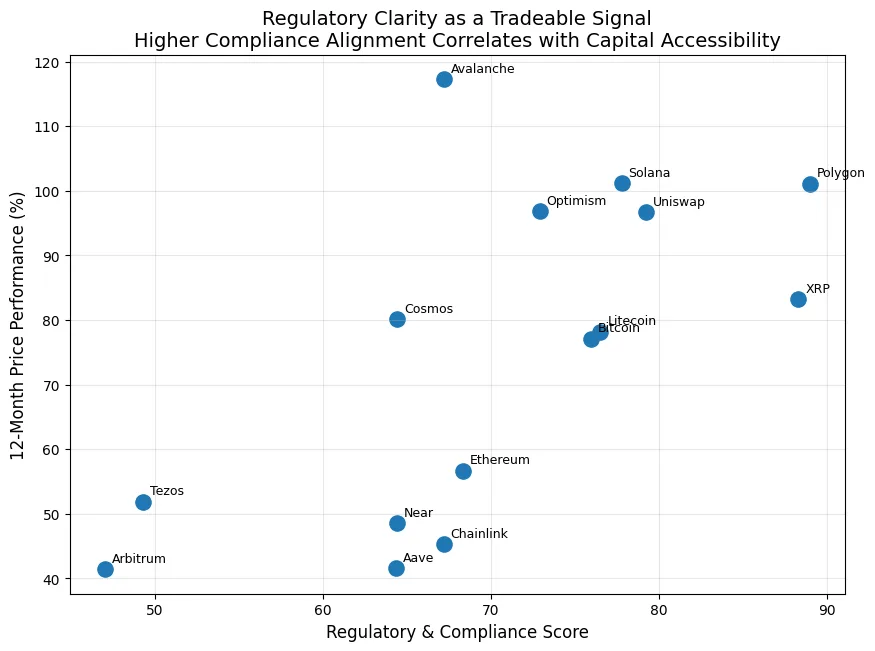
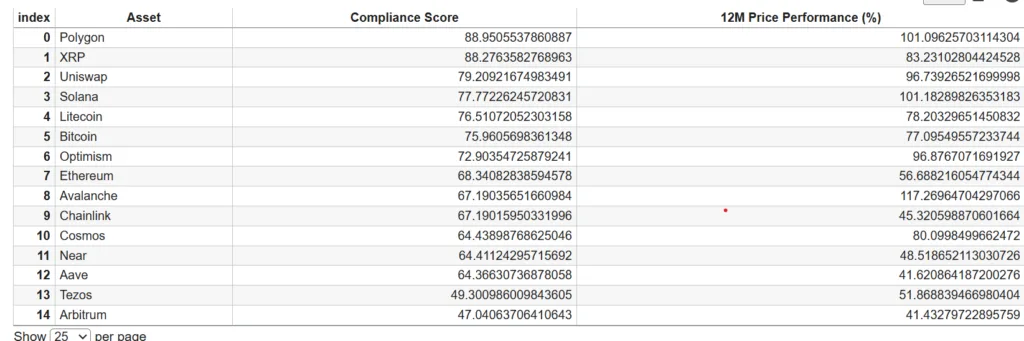
The legal updates are turned into uniform status indicators which show the readiness, enforcement posture, licensing progress, and suitability for the institutional market infrastructure. Rather than interpreting the legislative text, the users see the structured signals that show how usable the asset or market really is.The second layer brings in the compliance scoring at both the token and protocol level. The assets are evaluated constantly based on their observable characteristics like transparency, governance design, custody compatibility, audit history, and integration with different compliance frameworks like KYC and AML.
This score does not evaluate technological superiority or predict future success. It simply states the likelihood that capital could legally and operationally access the asset at a large scale.The last layer links the compliance directly with the execution via an institutional-grade API. The regulatory status flows into trading permissions, custody eligibility, internal risk limits, and exposure rules. The portfolio behavior can quickly adapt to the changes in the regulatory conditions, which eliminates the interpretive delay and lowers the reliance on manual compliance processes. In this context, regulation becomes machine-readable.
Why this changes market behavior
Once the regulatory clarity is numbered and arranged in order, the market will be profoundly changed in its nature. The compliance issue will, in a sense, become one of those original factors determining prices along with liquidity, volatility, and momentum. Risk premiums will not become narrower due to the extinction of risk but rather to the limitation of uncertainty.
The shifting of capital from one sector to another will no longer be waiting for story confirmation but will be through the crossing of eligibility thresholds, hence becoming faster. The trading floors will not be experiencing the regulatory news in an emotionally high manner but will rather be finding out the arbitrage of the regulatory approval readiness itself. The reassessment of the value of the securities will not occur after the clarity’s arrival but will be in anticipation of the developing quantifiable accessibility.