
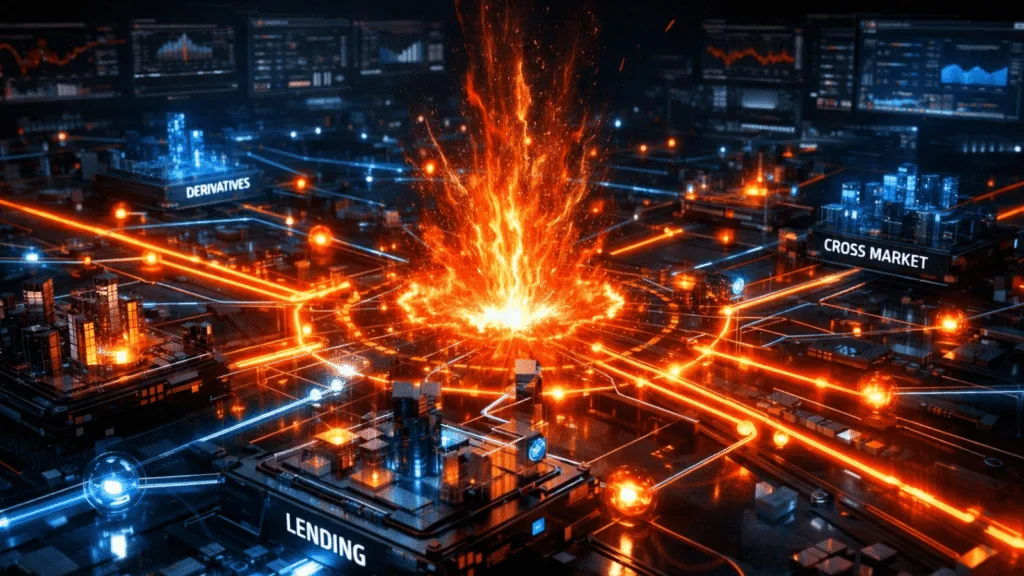



The modern financial markets face their greatest danger through their current operational methods which handle risk. The main danger in modern markets originates from their ability to transfer risks at high velocities. The first institution discovers its risks after another organization receives those risks through various financial instruments which have been processed into new funding methods that now exist as part of another financial structure. In the current financial system, people need to wait until they understand risk before it starts to develop. Understanding arrives late.
Detecting modern systems because of their fragile nature proves difficult during current operational periods. Financial systems function as complex networks which transfer risk from one asset to another through their multiple interconnections. The distribution of exposure occurs through various financial instruments which include derivatives, collateral chains, repo markets, structured products, exchange liquidity, prime brokerage, stablecoin balance sheets, clearinghouses, funding desks, and algorithmic execution systems.
A single shock does not remain where it begins. It travels. The synthetic pathways through which it travels cause it to increase in size while becoming more difficult to see and understand. The financial market operates at a speed which allows risk to transfer faster than humans can comprehend its content. The market has already evaluated new market pressures before analysts, traders, or regulators have determined their correct locations.

Risk does not disappear, it mutates
The first illusion of finance which has existed for many years creates the belief that hedging protects against all financial dangers. The practice of hedging creates a situation where one balance sheet loses its risk because the risk gets transferred to another balance sheet.
The risk exists in a different form because it exists in the same way as before. A dealer who uses options to eliminate directional risk will experience less price impact on their current holdings yet their total market risk will show up in other areas. A hedge fund that finances a concentrated position through leverage will show low volatility until the fund experiences changes in its margin requirements which will result in the fund needing to sell assets to meet collateral requirements.
A bank that packages and transfers loans through structured credit instruments will decrease its direct credit exposure but this process will create higher connections between risks while making credit practices less transparent and the bank more reliant on its ability to obtain funds.
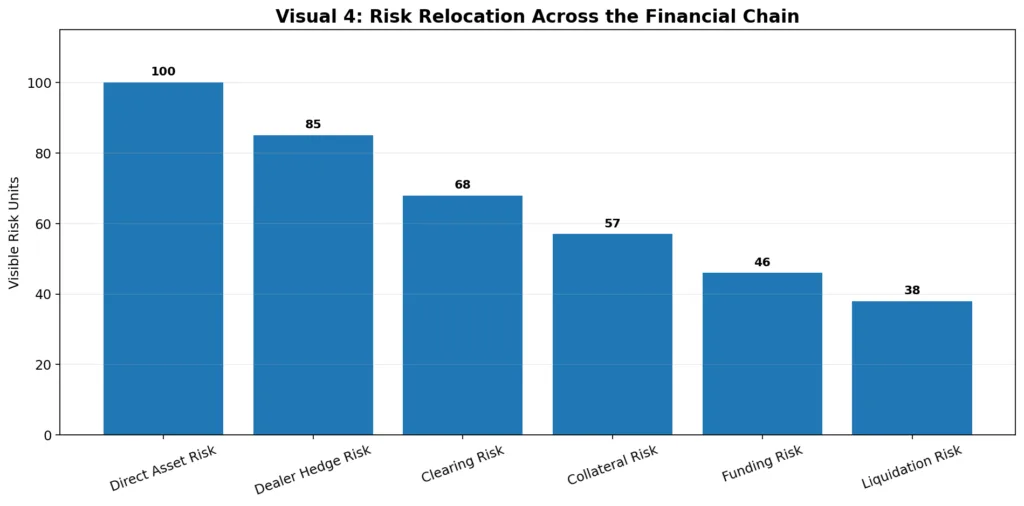
The primary function of contemporary financial markets operates as risk transformation which pretends to provide risk alleviation. The short chain which exists in basic markets enables effective management of all transformations. The complete path of exposure from the original risk creator to the final holder becomes unrecognizable in complex markets because all connections between different holders create a lengthy chain.
The same story shows the person who created the trade the institution that provided funding for it the dealer who protected it the clearing house which managed its margins and the liquidity venue which took in the trade’s liquidation. They can view only parts of the overall situation from their current position. The first point of systemic weakness emerges through that process of dividing systems into parts.
Derivatives chains turn exposure into a network problem
Derivatives serve as efficiency instruments which demonstrate their functional capacity to enable precise capital deployment. The instrument enables investors to express their market opinions while using capital to protect against market risks and manage different types of investment exposure. The primary impact of the instrument results from its capability to create fundamental market transformations.
The system transforms financial markets into networks which distribute various types of risk across all connected parties. The market easily understands a cash position because it requires only two options, which are either to own the asset or to lack ownership of it. A derivatives chain creates different types of market exposure which include contingent exposure, nonlinear exposure, path-dependent exposure and exposure which depends on market liquidity and volatility.
Market behavior changes when multiple institutions use different futures options swaps forward contracts basis trades and financing structures to build interconnected systems which function as a unified market network. The system becomes vulnerable to failure because it depends on leverage, which creates fragile points throughout its network. The system becomes vulnerable to failure because its leverage assets interact with hedging rules and margin calls and collateral eligibility and settlement timing and dealer inventory limits.
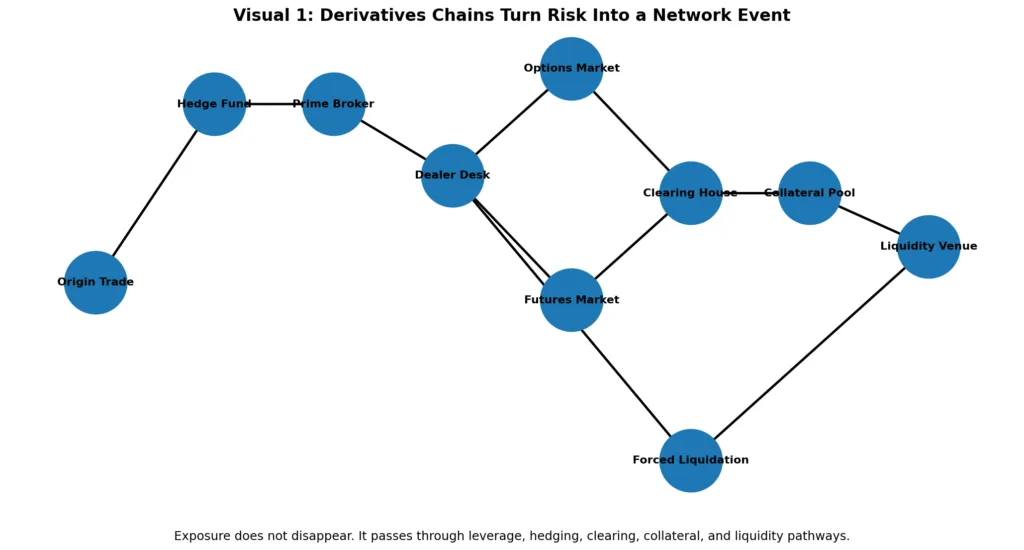
A stressed chain component forces other chain participants to respond because they must react to another party’s risk situation. The localized shock spreads through the network after it establishes a contact point with other facilities. Option hedging practices change after the center experiences a volatility increase. Spot market movements occur because of the hedging practices used in options trading. Futures basis relationships shift because spot market movements occur. Because basis dislocations affect leveraged arbitrage books, arbitrage trading partners experience trading difficulties.
The requirements for funding increase because the pressure created by arbitrage activities becomes stronger. The funding pressure prevents organizations from using their balance sheet capacity. The organization experiences reduced balance sheet capacity, which results in decreased liquidity. The market environment creates weak liquidity conditions, which lead to larger price fluctuations.
Leverage networks compress time
Leverage creates both higher profits and greater losses while decreasing the time needed to make decisions. An unleveraged investor can often survive volatility if the thesis remains intact. A leveraged participant may be right in the long term and still be forced out in the short term because financing conditions deteriorate faster than capital can adapt. Leverage functions as an exposure multiplier which also destroys all available time for investors.
The network-wide existence of leverage creates a situation where all parts of the network experience compressed time. The need for one institution to obtain collateral results in a situation where another institution loses its ability to access funds. The widening spreads of one venue create an event which causes another participant to experience slippage.
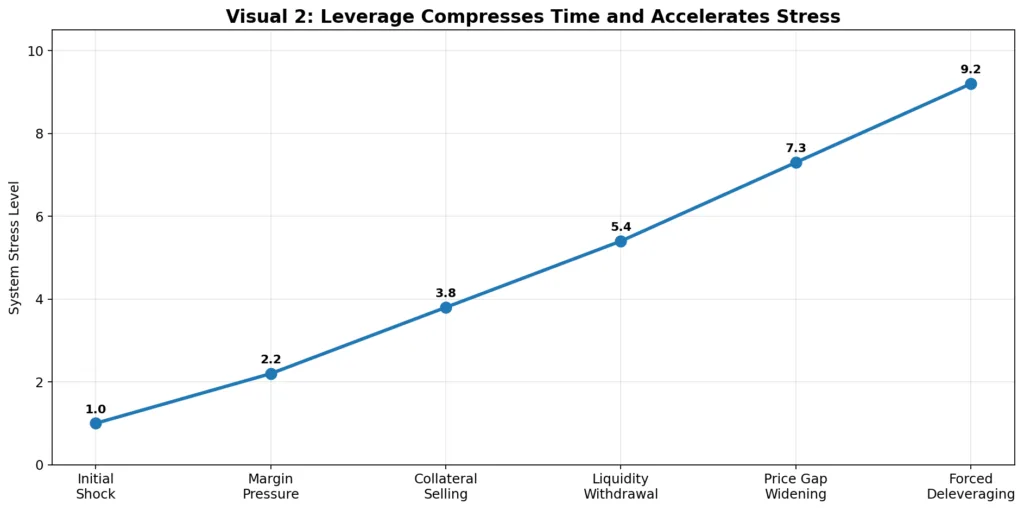
The decline of one asset triggers a process where unrelated positions need to deleverage because balance sheets function in an interconnected manner. Market crises develop their irrational appearance during their final stages. Participants are no longer trading views. They are trading balance sheet survival. The phrase “contagion” fails to capture the actual process which enables danger to spread.Because of contagion transmission becomes faster than it should.
The system does not slowly spread danger in a linear way. It rapidly redistributes pressure through whichever channels are most sensitive to collateral, leverage, and liquidity. The market has already gone through multiple internal adjustments before public narratives reach their final state.
The real crisis is often in the plumbing
Investors prefer valuation stories which combine narrative elements with macroeconomic drivers. Systemic dislocations originate from operational systems which act as essential components of financial markets. The plumbing system encompasses various components which include margin requirements, standards for collateral assessment, processes for clearing transactions, mechanisms for settling payments, systems for repurchase agreements, capabilities for redeeming stablecoins, inventory held by exchanges, conditions set by prime brokers and proprietary risk assessment frameworks.
These subjects lack appealing features yet they decide market capacity for handling stress situations which necessitate immediate price adjustments. When plumbing systems function properly organizations can transfer their risks without difficulties. Organizations experience difficulties when they need to transfer risks because their plumbing systems do not function properly.
Financial systems today depend on uninterrupted trust in their operational networks which means that minor market disruptions can cause major financial damage. Financial institutions must accept certain assets as collateral. Financial institutions must provide funding to their counterparties. Financial institutions must maintain their stock during market operations. Financial institutions must sustain their financial capacity to operate as clearing agents.
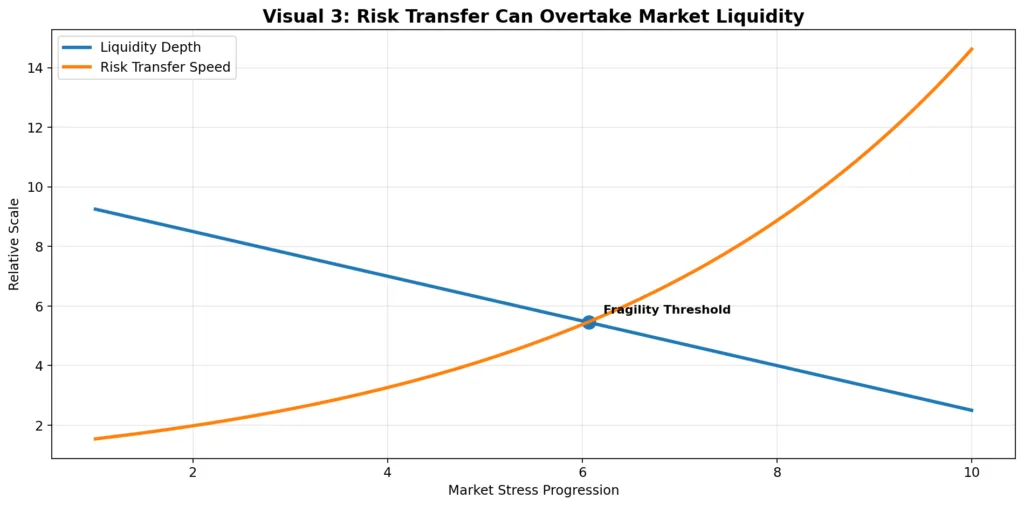
Algorithms need to identify market volatility as an opportunity for trading rather than a condition which leads to trading suspension. The process of risk transfer becomes disruptive when any of these fundamental principles begin to deteriorate. What appeared to be flexible options now results in faster processes. The modern market design creates a fundamental contradiction.
The same crossmarket links which enhance market efficiency in normal times make financial systems more vulnerable during crises. The derivative structure used in the market allows for risk distribution yet it enables market participants to spread their distressing situations.
Why understanding always arrives late
The analysis which follows a crisis obtains greater clarity than the actual crisis itself. The whole sequence of events becomes apparent to observers after the incident concludes. Participants perceive only partial information during the event.A trader experiences execution pressure. A risk manager observes an increase in VaR. A treasury desk experiences difficulties in obtaining funds. A clearinghouse observes reduced value of collateral.
A macro analyst observes a sudden change in government policies. A retail investor experiences a market crash. Each individual perceives actual things, but their understanding of the complete system which operates at the moment remains incomplete. The current market risk assessment appears to modern observers because its complete dimensions remain unknown. The system remains concealed because its distribution process exceeds the capacity of any individual to trace its path. The current state of opacity functions as a method to maintain protected information.
The present situation permits organizations to transfer information at a faster rate than before. The process of transferring exposure from one person to another makes it difficult for organizations to identify active hazards until the next transition happens. Market knowledge develops at a slower pace than market operations. Institutions targeted their responses towards observable effects instead of underlying problems.
Crypto makes this dynamic even more violent
Your statement indicates that traditional markets already face challenges with rapid risk migration and crypto assets make this issue worse because cryptocurrency operates through a complex system which combines multiple elements into an unpredictable financial instrument.
The risk in cryptocurrency markets moves at extreme speed because it does not stop at quick movement but continues to expand throughout the market.The markets for perpetual swap contracts show how investors can create positions which depend on fluctuations that occur within a single day.The engines designed for liquidation create an automated process which enforces asset disposal.
The usage of stablecoins allows them to serve three functions simultaneously as collateral, settlement system and trustworthiness indicator. Market makers operate across venues where liquidity depth can vanish suddenly. Cross-exchange arbitrage spreads transfer stress from one venue to another in seconds. On-chain leverage makes different positions visible but their actual impact on the system remains ambiguous. The result is a market that can shift from confidence to stress with extraordinary speed.
Cryptocurrency narratives about decentralization create an incorrect assumption among participants who think that actual risk distribution remains permanent. The market system depends on only a few exchanges, stablecoin issuers, market makers, whale wallets, and liquidity pools to maintain its equilibrium. The process of risk transfer in cryptocurrency functions as a rapid mechanism which stays hidden from political view. The entire market observes price changes. The majority of people lack knowledge regarding the sequence of events which generated the price change until the consequences occur.
The hidden role of synthetic stability
The most dangerous condition for markets occurs when artificial stability creates an illusion of safety which establishes a non-existent state of peace. Synthetic stability occurs when hedging flows and leverage recycling and liquidity provision create an appearance of system stability which fails to decrease the system’s actual vulnerable state. Price movements occur within narrow boundaries. The spreads remain at a level which users can handle.
The observed volatility has been maintained at a low level. All sources of funding continue to exist. The participants use this information as proof of system operation. The system operates at present but this observation only shows its current performance. Calm market conditions create a dangerous situation because hidden pressure can build up undetected.
Risk distribution success results in lower market volatility. Suppressed market volatility creates a situation which attracts traders who increase their leverage while showing high confidence and maintaining narrow spreads and taking more extreme market positions.
The process of achieving stability results in its own destruction. The market shows increasing calmness which leads more investors to believe that the system will withstand any market challenges. The market faces its first genuine market disturbance. The system develops its reaction to the trigger event.
The organization responds to all the beliefs which developed during its restful period. The situation appears as an overreaction from external perspectives yet it represents a process which releases hidden instability. The most intense market breakdowns occur after times when people stop paying attention and become overly relaxed about market conditions.
Market intelligence must shift from price to transmission
The current research still gives excessive attention to price changes while it examines risk transmission methods. The system establishes networked exposure as a fundamental requirement to evaluate asset movements. The more important question is where stress will move through the system after a failure occurs. The analysis needs to determine which party provides funding to which other party. The review needs to establish which assets deliver backing for various financial obligations. The review needs to identify which financial instruments have become most widely used throughout the industry.
The analysis needs to identify which trading platforms handle the greatest volume of risk management activities. The analysis needs to identify which stable assets maintain their value only when investors trust their ability to redeem them. The analysis needs to identify which market players maintain essential functions, despite having no public visibility. The review needs to identify which financial entities maintain positions that require them to hold volatile assets while they lack immediate revenue or need ongoing funding.
The analysis of contemporary market behavior needs to develop new methods of assessment. The system requires topological mapping, which identifies all existing connections between elements. The system needs to analyze how prices move through their established connection routes. Risk movement creates a system that transforms itself into future results. The actual occurrence of the event requires its main process of spreading.